
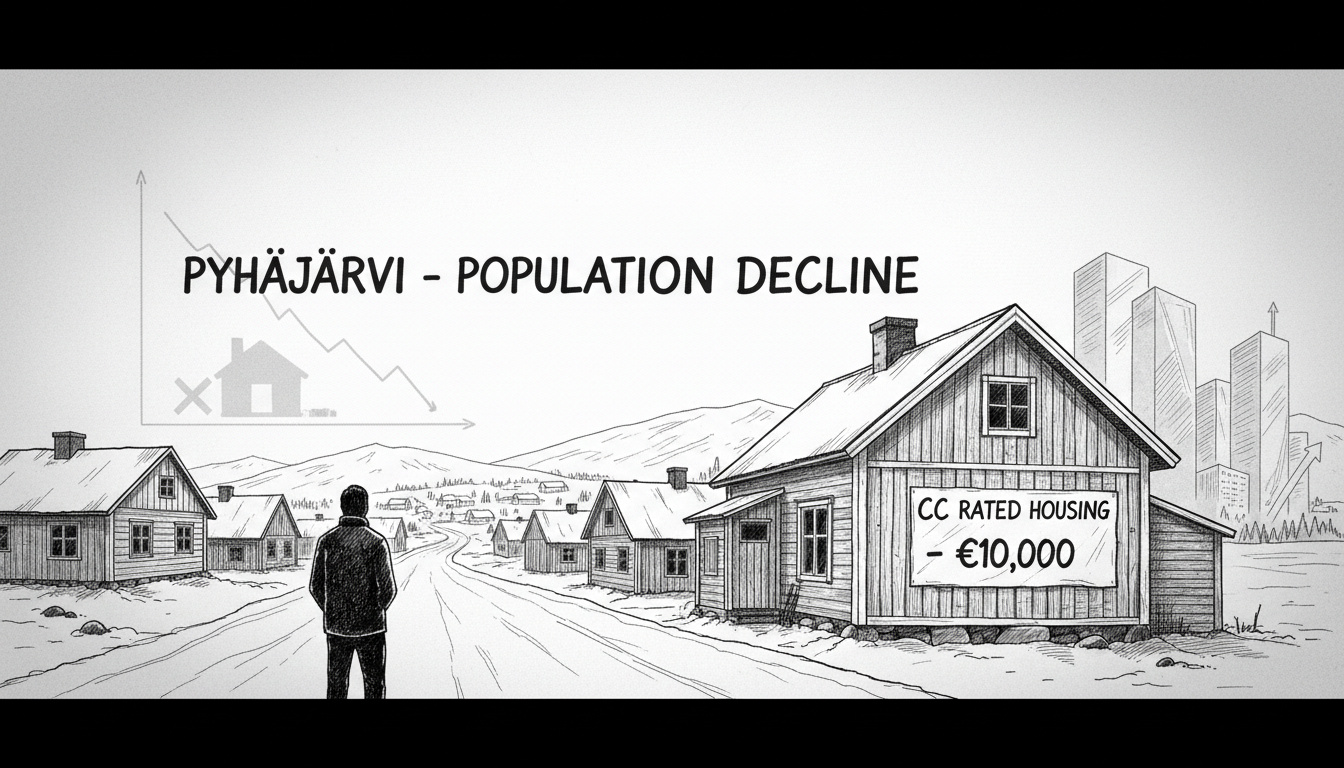
Finland's housing market shows deepening regional divides according to the latest housing credit ratings. The classification system ranks municipalities from AAA (best) to DDD (riskiest). Only Pyhäjärvi municipality now sits in the CC category, down from four municipalities last year.
CC classification signals high risk for homeowners and banks. Population decline and economic challenges cloud Pyhäjärvi's future prospects.
But what kind of properties are available in Finland's lowest-rated housing market? We examined current listings in Pyhäjärvi.
Twenty-nine homes are currently for sale. The inventory includes six detached houses, eight row houses, and twelve apartment units. Five properties are under ten years old.
Prices surprise those accustomed to urban markets. The cheapest listing is a 70-square-meter apartment built in 1972, priced at just €10,000. The building received pipe renovations and surface updates in 2020. The listing describes a quiet location near services and berry forests.
Affordable options include a three-unit row house on a one-hectare plot priced at €19,000. The cheapest detached house costs €48,000 for a 119-square-meter home built in 1975 with outbuildings.
At the luxury end, a lakeside log home built in 2019 lists for €390,000. The property includes a 120-square-meter house, heated garage, carport, shore sauna, horse stable, and guest cabin.
Pyhäjärvi sits in Northern Ostrobothnia with 4,756 residents. The municipality boasts excellent transport connections at the intersection of E75 and Highway 27. Five airports lie within two hours' drive, including Oulu Airport, Finland's second-largest international airport.
The town offers railway access for transporting bioenergy and heavy components. Services include daycare centers, comprehensive schools, and an upper secondary school.
Finland's housing market polarization intensifies. Only 13 municipalities achieve top A-ratings while 247 fall into BB category or lower. Sixty-three municipalities sit in the red C-zone.
Growth centers like Helsinki and Pirkkala (A+) attract population. Espoo, Tampere, Kempele and Lempäälä also score A-ratings. Demand grows for larger homes as foreign-language population needs increase.
Division occurs within cities too. Even top-rated municipalities contain BB-areas with poor transport or segregation issues. New flood risks threaten about five percent of Finland's residential square footage.
While housing market bottom appears reached and prices should rise coming years, regional differences remain substantial. Population growth and migration patterns drive market development, emphasizing location and sustainable municipal economies.
The data reveals a clear split between vibrant growth centers and depopulating regions. Homebuyers must weigh cheap prices against long-term viability in struggling municipalities.