
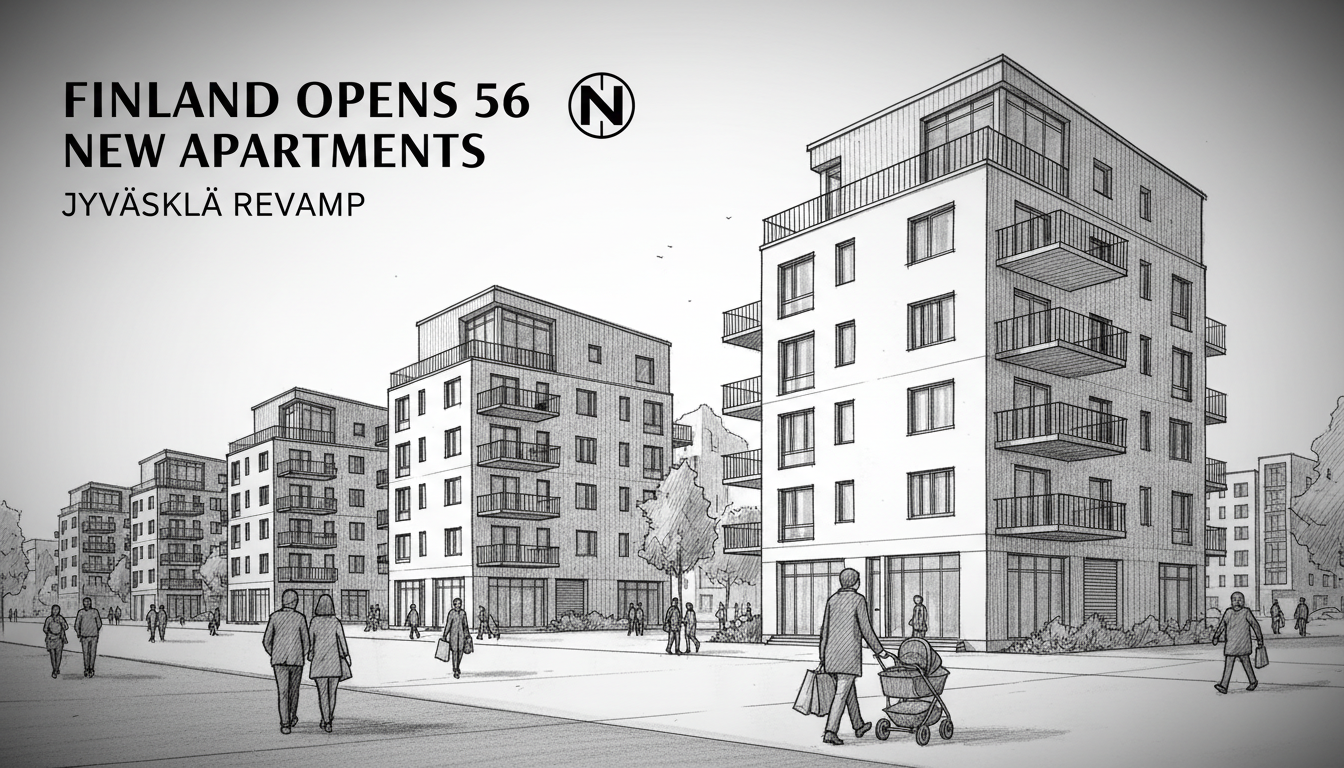
Finland's ongoing push to increase its affordable housing stock has a new address at Rullakatu 3 in Jyväskylä. A new rental apartment building with 56 units welcomed its first tenants at the turn of the year, a project commissioned by non-profit provider A-Kruunu and built by YIT Housing. This development is more than just a new building; it is a key piece in the complex puzzle of Finnish housing policy and urban regeneration, situated on the transforming former industrial lands of the Kankaan district.
From Paper Mill to Modern Homes
The Kankaan district, where the new A-Kruunu building now stands, embodies a nationwide Finnish trend of post-industrial transformation. For decades, this area was dominated by a paper mill, a symbol of an older economic era. Like similar sites in Tampere, Turku, and Helsinki, the closure of such industrial plants left behind large, centrally located brownfield sites. City planners saw potential where others saw decay. The strategy, common across Finnish municipalities, is to redevelop these areas into dense, mixed-use urban neighborhoods with housing, services, and green spaces. This approach tackles two problems at once: it cleans up contaminated land and creates new space for urban growth without encroaching on valuable forests or agricultural areas. The Jyväskylä city master plan for Kankaan envisions a vibrant new city district, and each completed building brings that vision closer to reality.
The new apartment building at Rullakatu 3 is a direct product of this planning philosophy. By placing affordable rental housing in a newly developing area, the city and housing providers aim to create socially mixed communities from the outset. This prevents the segregation that can occur when affordable housing is concentrated in older, sometimes isolated suburbs. The 56 apartments add critical mass to the fledgling neighborhood, supporting local businesses and public transport viability. Experts point to this integrated planning as a strength of the Finnish system, where municipal land ownership and strong zoning laws give cities significant leverage in guiding development.
The Crucial Role of Non-Profit Housing Providers
The project developer, A-Kruunu, is not a private speculative builder. It is part of Finland's extensive network of non-profit housing providers, organizations that operate on a cost-rent principle. Their fundamental mission is to provide affordable, high-quality rental housing without a profit motive. This model is a cornerstone of Finland's housing policy, acting as a stabilising force in the rental market. While private investors may focus on luxury apartments or fluctuate with market cycles, providers like A-Kruunu maintain a long-term commitment to offering reasonably priced homes. They finance construction through low-interest loans from the state-owned mortgage bank, Suomen Hypoteekkiyhdistys (Hypo), and municipal land is often leased to them at reduced rates. This reduces overall project costs, savings that are passed on to tenants through lower rents.
Finland's Ministry of the Environment has consistently supported the expansion of this sector. In recent government negotiations, maintaining and increasing the production targets for cost-rental apartments has been a recurring topic, often finding cross-party support. The rationale is clear: a healthy supply of affordable non-profit housing eases pressure on the social housing system and provides a secure option for students, young families, and low-to-middle-income earners. The Jyväskylä project, though modest in scale, represents incremental progress toward national housing production goals. Each such building helps mitigate the housing shortages that persistently affect growing urban centers like Jyväskylä, Tampere, and the Helsinki region.
Policy Framework and the National Housing Drive
This specific building in Jyväskylä exists within a dense framework of national policy. The Finnish government, under various coalitions, has set ambitious targets for new housing construction, aiming for tens of thousands of new units annually. The focus is not just on quantity but on affordability and sustainability. The current government programme includes commitments to streamline planning processes and encourage construction in growth centers. Furthermore, Finland's unique "Housing First" policy, which has virtually eliminated chronic homelessness, relies on a steady supply of permanent, affordable apartments. While the "Housing First" model primarily uses existing dispersed stock, new non-profit buildings like this one replenish that broader pool, creating a virtuous cycle.
The role of the European Union is also pertinent. While housing policy remains primarily a national competence, EU state aid rules and funding programmes influence the landscape. Finland must carefully design its support for non-profit providers to comply with EU regulations. Additionally, EU cohesion funds have previously been directed toward urban regeneration projects similar to Kankaan's transformation, particularly in areas dealing with industrial decline. The sustainable development principles emphasized in EU directives are also reflected in modern Finnish building codes, meaning new constructions like Rullakatu 3 must meet high energy efficiency and environmental standards.
Analysis: A Model Under Pressure
Finland's approach to housing, blending market-rate ownership, a strong non-profit rental sector, and targeted social housing, is often admired internationally. The Jyväskylä project is a textbook example of its mechanics: municipal land planning, non-profit development, and integration into a larger urban vision. However, analysts caution that the model faces significant headwinds. Rising construction costs, high interest rates, and complex supply chain issues have slowed down building starts across the board. For non-profit providers, the economic calculus has become tougher, potentially requiring increased state subsidies to maintain production levels.
There is also a persistent geographical mismatch. Housing pressures are most acute in the largest cities, particularly the capital region. While Jyväskylä is a growing university city, the challenge in Helsinki and Espoo is of a different magnitude. Encouraging construction in growth centers outside Helsinki is part of the national strategy, but it requires parallel investments in jobs, transport, and services. The Kankaan district development fits this logic perfectly, aiming to make Jyväskylä itself a more attractive and self-sufficient place to live and work.
The success of individual projects like Rullakatu 3 will be measured not just by timely completion and full occupancy, which are highly likely, but by their long-term integration into the community. Does the building foster a sense of belonging? Does it contribute to a lively street scene? In five years, will the Kankaan district feel like a cohesive part of Jyväskylä? The answers depend on the continued commitment of the city, housing providers, and residents. For now, the 56 new households have a modern home in a district being built from the ground up. Their presence is the first step in turning architectural plans and policy objectives into a living, functioning neighborhood. As Finland continues to grapple with the universal challenge of providing affordable homes, the lessons learned in districts like Kankaan will inform future policy in the Eduskunta and city halls across the country.