
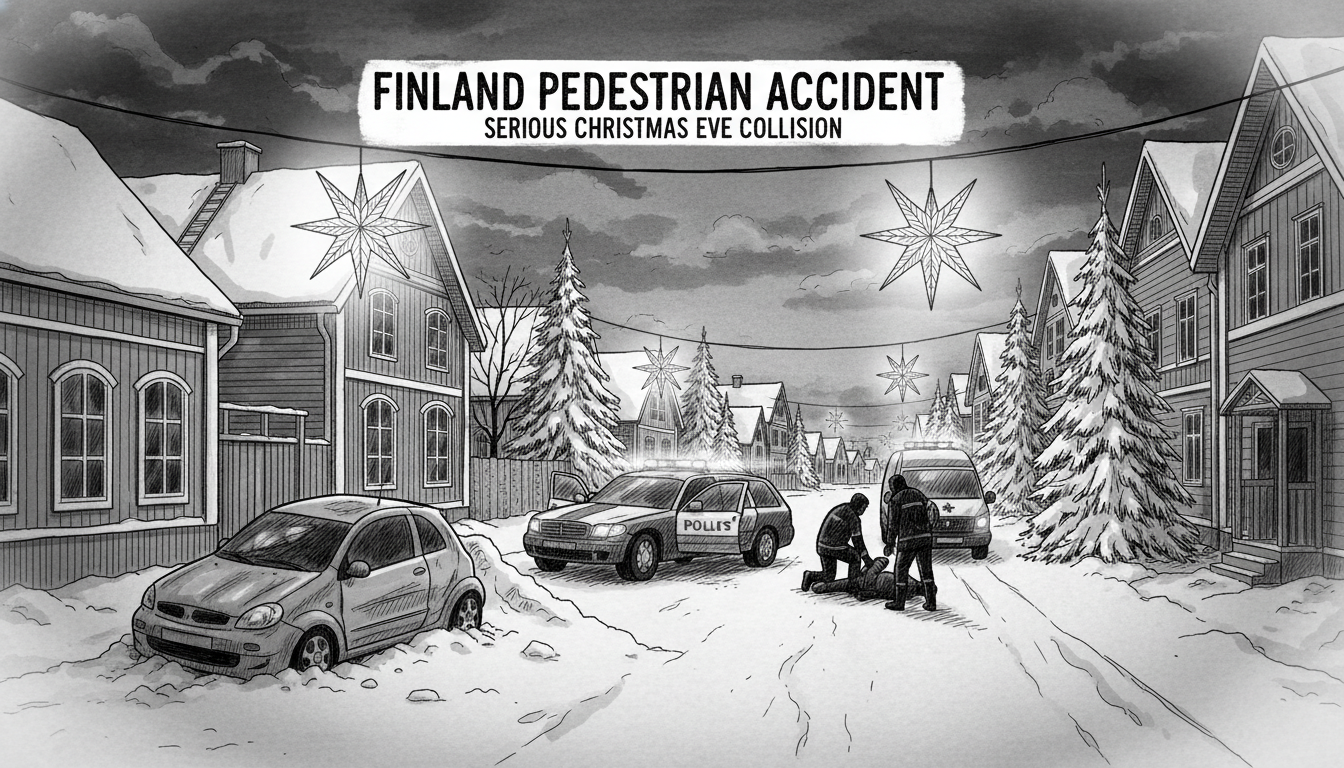
Finland road safety faces a grim reminder after a serious pedestrian collision on Christmas Eve morning in Siilinjärvi. A person walking was hit by a car on Varpaisjärventie at approximately 7:45 AM, suffering severe injuries that required transport to Kuopio University Hospital. The driver reported the incident to emergency services. Police confirmed the circumstances were challenging due to snowfall, with the cause of the accident still under active investigation. This incident casts a shadow over a period of family gatherings and highlights the persistent dangers of Finnish winter roads, despite the nation's generally strong safety record.
A Morning Commute Turns Tragic
The accident occurred on Varpaisjärventie, a regional road connecting communities in the Siilinjärvi municipality. At 7:45 AM on December 24th, daylight was just beginning to emerge in eastern Finland, offering only limited visibility during a period of active snowfall. Preliminary police reports indicate a car, coming from the opposite direction, struck a pedestrian. The exact location of the pedestrian—whether on a designated crossing, shoulder, or roadway—remains part of the inquiry. The immediate response from the driver to call emergency services was a critical factor in securing rapid medical attention for the victim. Emergency personnel at the scene provided initial care before transporting the individual to the advanced trauma center at Kuopio University Hospital, known locally as KYS.
Winter's Relentless Grip on Road Safety
This collision underscores a recurring, predictable, and deadly annual pattern in Nordic countries. While Finland maintains one of Europe's safest road networks overall, the winter months consistently bring a spike in vulnerable road user accidents. Statistics from the Finnish Transport and Communications Agency, Trafi, show that in 2022, 221 people died on Finnish roads. Of those, 36 were pedestrians. A significant proportion of pedestrian fatalities occur during the darker, icy months from October through March. Factors converge dangerously: shortened daylight, slippery road and sidewalk surfaces, reduced visibility during precipitation, and the potential for both drivers and pedestrians to underestimate these conditions. Vehicles require greater stopping distances, while pedestrians bundled against the cold may have restricted hearing and peripheral vision.
The Complex Investigation Ahead
Local police have launched a standard investigation to determine the precise cause. Their focus will be multi-faceted, examining technical, environmental, and human factors. Officers will assess the vehicle's condition, including the type and tread depth of its winter tires, which are legally mandated in Finland from November to March. They will analyze potential speed at the moment of impact and check for any technical failures. Crucially, investigators will work to reconstruct the visibility conditions at that exact time and place, considering the snowfall, twilight, and any street lighting. The pedestrian's actions and visibility will also be evaluated. This process is methodical and can take weeks or months to complete before any potential charges are considered. The priority remains the victim's recovery.
A National Challenge Beyond Siilinjärvi
This single accident in a Finnish municipality connects to a broader national policy discussion. The Finnish government's current Strategic Programme includes commitments to enhance traffic safety and active mobility. Road safety experts, like those from the Finnish Crash Data Institute, continually stress the shared responsibility required during winter. For drivers, this means adjusting speed significantly below summer limits, ensuring windshield washer fluid is rated for extreme cold, and maintaining a vigilant watch for pedestrians who can blend into gloomy backgrounds. For pedestrians, it means making themselves visible with reflective materials—a standard practice taught from childhood in Finland—and avoiding assumptions about being seen, even at crossings. Municipalities also bear responsibility for timely road maintenance and adequate lighting.
The Human Cost in the Christmas Season
Beyond the statistics and safety advisories lies the profound human tragedy. A serious injury, especially on Christmas Eve, devastates not only the victim but their entire network of family and friends. The timing, during a holiday centered on peace and family unity, amplifies the emotional impact. The driver involved also faces a traumatic experience, regardless of the investigation's outcome. Such incidents ripple through small communities like Siilinjärvi, prompting collective reflection on local road safety. They serve as a somber public reminder of individual vulnerability during the harsh Nordic winter, a season that demands constant respect and adaptation from everyone using public spaces.
Looking Forward: Technology and Vigilance
The path to preventing future tragedies involves both technological adoption and sustained behavioral change. Finland is exploring intelligent transportation solutions, such as connected vehicle systems and improved pedestrian detection technology in new cars. However, experts agree that technology alone is not a silver bullet. The cornerstone of safety remains individual alertness and adherence to winter driving and walking principles. Public awareness campaigns by organizations like the Finnish Road Safety Council reiterate these messages annually. As the investigation in Siilinjärvi continues, the hope is that its findings will contribute to this broader educational mission. The ultimate goal, shared across the political spectrum from the government to local authorities, is Vision Zero—the elimination of all traffic fatalities and serious injuries. Each accident is a stark measure of the distance left to travel toward that goal, particularly when winter tightens its grip on the Finnish landscape.