
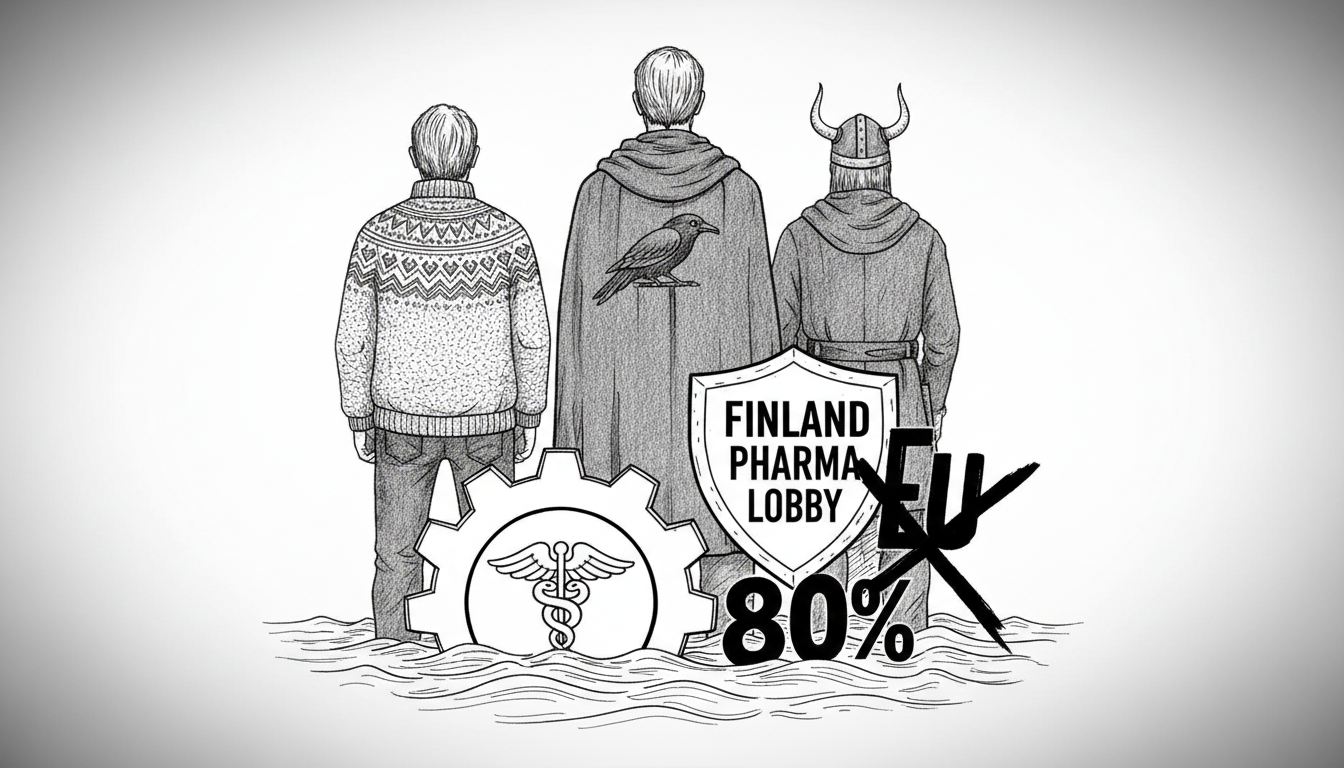
Finland's pharmaceutical industry is mounting a fierce lobbying campaign against a proposed EU directive that would force drugmakers to pay at least 80% of the costs to remove their products' residues from the nation's wastewater. The battle in Helsinki centers on the EU's revised Urban Waste Water Treatment Directive and its strict application of the 'polluter pays' principle, setting up a major clash between environmental goals and industrial interests.
At the heart of the dispute is a fundamental shift in environmental responsibility. For decades, the cost of cleaning pharmaceutical micropollutants—everything from painkillers and antibiotics to hormones—from municipal wastewater has fallen largely on taxpayers and water utilities. The new EU framework seeks to transfer the primary financial burden to the source: the pharmaceutical and cosmetics industries. Finnish pharmaceutical companies, represented by industry group Lääketeollisuus, argue this will stifle innovation and place an unfair economic weight on them, despite their products' societal benefits.
The Stakes of the 'Polluter Pays' Principle
The 'polluter pays' principle is not new to EU environmental law, but its proposed application to pharmaceutical residues marks a significant escalation. A 2023 study for the European Commission estimated the EU-wide cost of upgrading wastewater treatment plants to remove micropollutants, including pharmaceuticals, would reach billions of euros annually. The directive mandates that member states ensure the pharmaceutical industry covers a minimum of 80% of these 'extended producer responsibility' costs. The remaining 20% could be covered by national governments, potentially using funds from general taxation or other sources.
In Finland, this directive would translate to substantial new expenses for drug manufacturers. The Finnish government, currently navigating coalition dynamics in the Eduskunta, must decide how aggressively to implement the EU rules. Lobbying records show a sharp increase in pharmaceutical industry meetings with ministries and MPs, focusing on the Ministry of Social Affairs and Health and the Ministry of the Environment. The industry's core argument is that wastewater treatment is a public service, and the directive unfairly singles out one sector for costs that are societal in nature.
Environmental Imperatives vs. Economic Realities
Environmental scientists and policy experts counter that the pharmaceutical industry has long externalized the environmental cost of its products. Studies consistently show that active pharmaceutical ingredients (APIs) passing through human bodies and into sewage systems can harm aquatic ecosystems. Effects documented in Finnish and Baltic waters include endocrine disruption in fish, leading to fertility problems, and the acceleration of antibiotic resistance—a critical global health threat. While modern wastewater plants remove many contaminants, they are not designed to filter out all complex synthetic drug compounds.
"The 'polluter pays' principle is essential for a sustainable circular economy," said Dr. Elina Saari, an environmental policy researcher at the University of Helsinki. "It creates a financial incentive for producers to consider the entire lifecycle of their product, from design to disposal. Shifting the cleanup cost to taxpayers removes the incentive for the industry to develop greener pharmaceuticals or invest in production processes that generate less persistent waste." She notes that several other European countries are already moving ahead with similar producer responsibility schemes for micropollutants.
The Lobbying Battle in Helsinki's Government District
The corridors of power in Helsinki's government district, from the Parliament House to the ministries on Merikasarmi and Snellmaninkatu, are the current arena for this dispute. The Finnish pharmaceutical industry warns that the directive could impact drug availability and investment in research and development within Finland. They advocate for a broader cost-sharing model, suggesting that the financial responsibility should be spread across multiple parties, including the healthcare sector and consumers, rather than concentrated on manufacturers.
However, officials at the Ministry of the Environment, tasked with transposing the EU directive into Finnish law, emphasize the legal obligation. "The directive's aims are clear: to significantly reduce micropollutant pollution and apply the polluter-pays principle rigorously," a ministry official stated on background. "Our task is to implement it effectively and fairly, ensuring it delivers tangible improvements to our water quality while considering the impacts on Finnish industry." The ministry is analyzing different models for collecting the industry contribution, which could involve a fee based on the volume or environmental risk of pharmaceuticals placed on the Finnish market.
A Test for Finland's Green Leadership
This conflict presents a key test for Finland's self-professed leadership in environmental policy. The country has ambitious carbon neutrality and circular economy goals. Allowing intense industry lobbying to dilute the implementation of a major EU environmental directive could undermine that reputation. Conversely, the government must weigh concerns about the competitiveness of a high-value sector that employs thousands in Finland.
The political calculation within the ruling coalition is delicate. The Green League, part of the government, strongly supports strict application of the directive. Other parties, like the National Coalition Party, are more attuned to business competitiveness arguments. The Social Democratic Party of Prime Minister Petteri Orpo must balance these pressures. The outcome will signal whether Finland prioritizes the precautionary principle in environmental health or opts for a more industry-friendly interpretation of EU rules.
The Path Forward and Wider Implications
The timeline for a decision is pressing. The EU is finalizing the directive, and Finland will have a limited period to enact national legislation. The debate also has implications beyond pharmaceuticals. The directive's framework for extended producer responsibility is a template that could be applied to other sectors producing persistent micropollutants, such as cosmetics and certain chemicals.
Ultimately, the question for Finnish policymakers is who should bear the cost of cleaning up modern pollution. Is it the public, through water bills and taxes, or the companies that design, profit from, and hold the greatest technical knowledge about these complex substances? The pharmaceutical industry's vigorous campaign shows it is determined to avoid opening its wallet. Yet, the growing scientific consensus on the ecological damage caused by pharmaceutical residues, combined with the EU's steadfast environmental agenda, creates a powerful counterforce. The decision made in Helsinki will resonate far beyond Finland's borders, serving as a case study in whether Europe can make its 'polluter pays' principle a tangible reality for one of its most powerful industries.
As the lobbying intensifies, the core issue remains: in an era of escalating environmental challenges, can any industry expect to profit from products without being held fully accountable for their enduring footprint in our shared water? Finland's answer will soon be clear.