
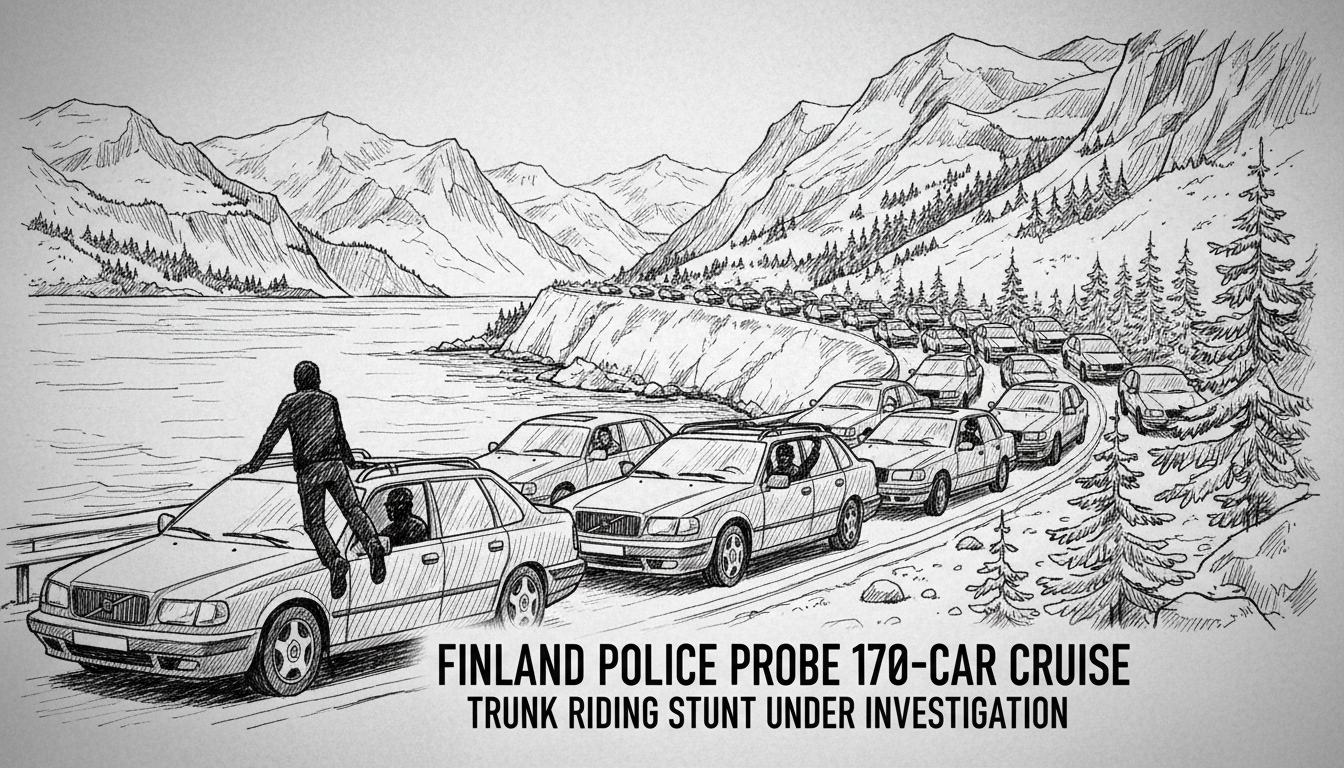
Finland's strict road safety culture faced a jarring challenge last Saturday night when participants in a large-scale 'Ghost Night Cruising' event engaged in what police call 'extremely dangerous and foolish' behavior. A video submitted to authorities shows a car driving for approximately 20 kilometers with its trunk open and two people sitting inside, throwing bottles and cigarette butts onto the road.
According to a reader's report, the incident occurred as a convoy of an estimated 170 cars traveled through the Uusimaa and Häme regions. The witness, who participated in the event with his girlfriend, stated the car with the open trunk drove from Nurmijärvi to Nummela, a stretch where the speed limit is predominantly 80 km/h. The East Uusimaa Police District, which monitored the event, stated they received no direct reports during the cruise but have now launched an investigation based on the new evidence.
"This was new information and must certainly be forwarded there. That is now extremely dangerous and foolish activity, and it must be intervened in," a representative from the East Uusimaa Police commented upon reviewing the report. The West Uusimaa Police command center separately stated they had received no reports of dangerous situations from the event.
A Dangerous Trend in Car Culture
The incident highlights a tension between Finland's generally disciplined driving culture and the risky behaviors that can emerge within niche automotive subcultures. Ghost Night Cruising events, where enthusiasts drive in convoys, are not illegal in themselves. However, the actions of individual participants can quickly cross into clear violations of the Finnish Road Traffic Act, which mandates that all passengers must be properly seated and secured within a vehicle.
Driving with passengers in an open trunk presents multiple catastrophic risks. A sudden stop could eject the occupants onto the road at high speed. In a collision, they would have zero protection. Furthermore, their actions of littering and potentially distracting the driver create additional hazards for every other vehicle in the convoy and on public roads. The witness who reported the incident emphasized the danger, noting he maintained a significant safety distance. "You have to have a proper safety margin so that if something happens, like if someone falls from the ride, you have time to react and stop," he said.
Finland's Road Safety Framework Under Scrutiny
Finland consistently ranks among the safest countries in the world for road traffic, a status achieved through rigorous legislation, evidence-based enforcement, and a strong societal consensus on safety. The Finnish Transport and Communications Agency (Traficom) and the Police work in tandem on campaigns targeting speeding, impaired driving, and seatbelt use. This latest incident presents a challenge outside typical enforcement patterns—a coordinated, moving event where dangerous acts occur fleetingly within a large group.
Traffic safety experts contacted for comment universally condemned the behavior depicted in the video. "This is not a prank; it is a deliberate disregard for life," said one expert familiar with traffic psychology. "The individuals in the trunk are at immediate risk of death or severe disability, and their actions force other drivers into an emergency response role they did not consent to. It transforms a public road into a scene of potential manslaughter."
From a legal standpoint, the driver of the vehicle faces serious consequences. Violations could include endangering traffic safety, a charge that can lead to hefty fines and even imprisonment if an accident occurs. Additional fines would apply for having unsecured passengers and for littering from a vehicle.
Policing Large-Scale Automotive Gatherings
The police response reveals the logistical difficulty of monitoring such events. With 170 cars spread across a moving route spanning multiple police districts, real-time intervention is challenging. The East Uusimaa Police confirmed their traffic unit followed the convoy but observed no situation requiring immediate intervention during their patrol. This suggests the most egregious behavior either happened outside their direct observation or was concealed within the pack.
This gap between occurrence and reporting pushes enforcement into a reactive, investigative phase. Police now depend on participant-submitted video evidence and witness statements to identify vehicles and perpetrators after the fact. The practice of media outlets offering payment for dramatic citizen video, as mentioned in the source material, further complicates the landscape, potentially incentivizing risky behavior for footage or ensuring dangerous acts are documented for authorities.
The Broader Implications for Finnish Society
Beyond the immediate legal case, the incident sparks a discussion about responsibility within community-organized events. Who bears the duty of care when a large, informal gathering moves through public space? While Finnish law is clear on individual driver liability, event organizers and the broader participant community often face moral, if not legal, pressure to self-police.
The reader's decision to report the incident reflects the strong internalized safety ethos many Finns possess. However, the fact that the car reportedly drove 20 kilometers in this state before pulling into a rest stop also indicates a failure of peer intervention within the convoy itself. The witness stated the individuals were not known to him, a common feature in large meets that can reduce social accountability.
Finnish road safety campaigns have successfully targeted mainstream behaviors like speeding and drunk driving. This event suggests a need for targeted messaging towards younger driver subcultures, emphasizing that the pursuit of automotive passion cannot override fundamental safety laws designed to prevent tragedies. The police statement that this was "foolish activity" underscores a societal view of such acts not as rebellious but as immature and recklessly irresponsible.
Looking Ahead: Prevention and Enforcement
The investigation by East Uusimaa Police will focus on identifying the specific vehicle and its driver. Success in prosecution could serve as a potent deterrent for future events. Police may also increase pre-emptive measures for known large cruises, such as visible patrols at gathering points and clear communication of legal boundaries to participants.
Long-term prevention requires a multi-faceted approach. Automotive clubs and online communities that plan these events could adopt explicit codes of conduct. Social media platforms where such events are organized could be partners in disseminating safety warnings. Ultimately, the core principle remains: Finland's public roads are shared spaces governed by rules that exist solely to protect lives. No video, no thrill, and no subcultural tradition is worth the irreversible cost of a single life lost to preventable, senseless risk.
The final question for Finnish authorities and society is whether the strong norms that have made roads safe can withstand the pressures of social media-driven stunts and niche group behaviors. The answer will determine if Saturday night's dangerous sight remains a shocking anomaly or becomes a troubling new pattern to confront.