
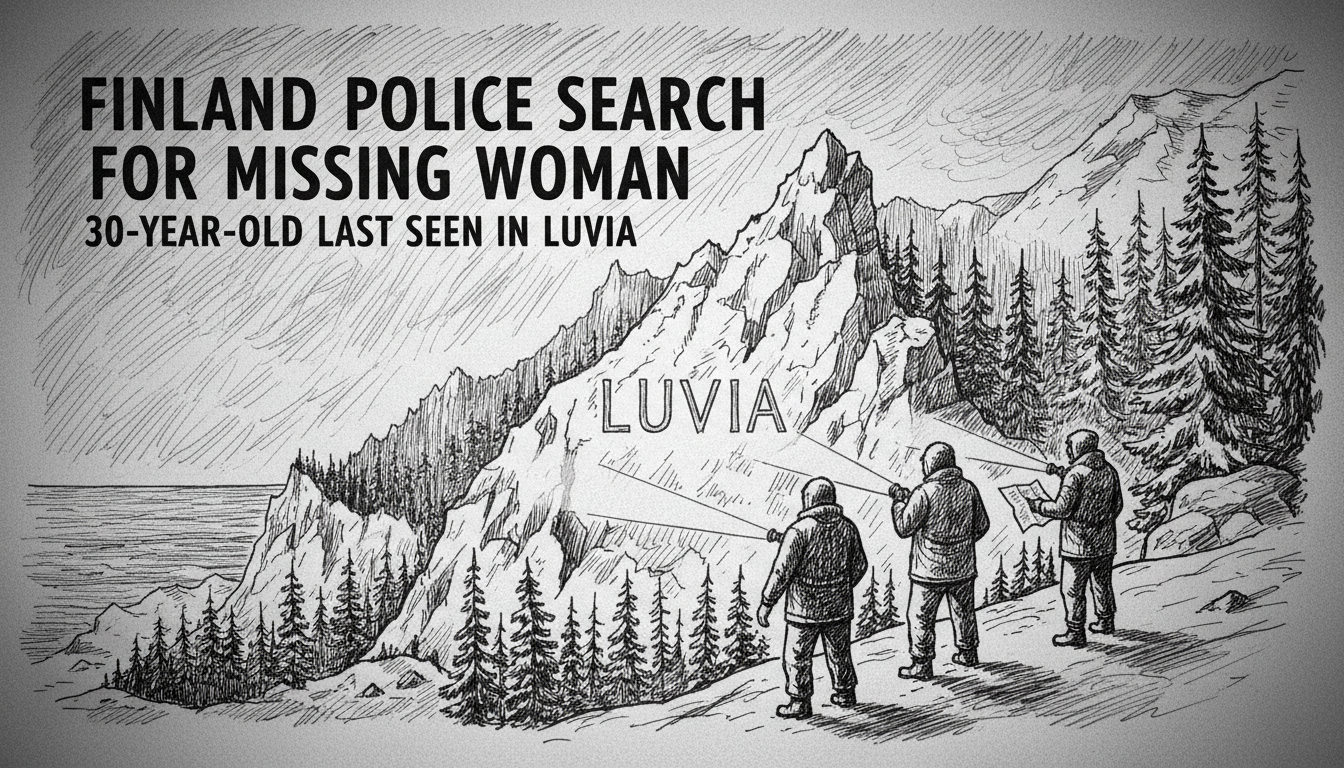
Finland's South-West Finland Police Department is urgently seeking public assistance to locate a 30-year-old woman who disappeared from Luvia over the weekend. The woman was last seen leaving a private residence in the town center between Saturday night and Sunday morning. Authorities have released a detailed description of her clothing but state they do not currently suspect a crime.
An Urgent Appeal in a Quiet Municipality
The disappearance has mobilized police resources in the coastal municipality of Luvia, now part of Eurajoki in the Satakunta region. This area, known more for its nuclear power plant at Olkiluoto than for high-profile missing person cases, is now the focus of an intensive search. The police appeal is direct and broad, asking anyone with information to contact them via email, phone, or text message. The specific clothing description—a long black winter coat, gray Hollister hoodie, Nike cargo sweatpants, and light shoes—is designed to trigger public memory and visual recognition.
Investigators are treating the case with seriousness despite the initial absence of criminal suspicion. "We are using all appropriate methods to locate her as quickly as possible," a police spokesperson said in a statement. The decision to publicize the case widely indicates concern for the woman's welfare given the unclear circumstances. In Finland, such disappearances, especially when deemed out of character, prompt swift and coordinated action from local police districts.
The Mechanics of a Finnish Missing Person Search
When a person vanishes under unexplained conditions, Finnish police protocols activate a multi-faceted response. The initial phase involves gathering all available information from family, friends, and last known locations. Officers then assess the level of risk, which dictates the scale of the response. For a high-risk case, resources can include ground search teams with volunteers from organizations like the Finnish Red Cross, dog units trained in tracking, and aerial support if the terrain warrants it.
Digital forensics also play an increasing role, analyzing phone data, financial transactions, and social media activity. In this Luvia case, the police have not disclosed if such digital tracks are being followed, focusing instead on physical sightings. The public appeal is a critical component, turning the community into a vast network of eyes. This community-centric approach is common in Finland, where public cooperation with police is generally high and often proves decisive.
Expert analysis suggests that the first 48 hours are most critical. "The immediate dissemination of accurate, detailed information to the public is one of the most effective tools in these situations," said a former detective with experience in missing person investigations. "A specific clothing description, like the one released, can generate crucial leads that technology might not immediately provide."
Luvia's Context and Community Impact
The disappearance resonates deeply in a small community like Luvia. With a population of just over 3,000 before its merger with Eurajoki, it is the type of place where residents often know each other. A sudden, unexplained vanishing disrupts the sense of security and quiet routine that defines many Finnish rural municipalities. The incident shifts the local conversation from everyday matters to shared concern and vigilance.
Eurajoki, the larger administrative body, is nationally significant as the host of the Olkiluoto Nuclear Power Plant. This brings a constant flow of workers and some transient population to the region, though Luvia itself remains a distinct, quieter area. The police must now navigate both the tight-knit local community and the broader regional dynamics. Searches may extend to surrounding forests, coastal areas, and road networks, landscapes familiar to many in the Satakunta region.
Local social media groups and community boards are likely flooded with the police bulletin, with residents sharing the information and reporting any possible sightings, however minor they may seem. This collective effort is a hallmark of the Finnish response to crisis, blending official police work with civic responsibility.
The Path Forward for Investigators
The investigation's next steps depend entirely on the leads generated from the public appeal and ongoing police work. If a credible sighting emerges, resources will concentrate on that area. If not, the search may expand geographically, and investigators will deepen their background review of the woman's recent activities and contacts. The police statement that they do not suspect a crime is not static; it is an initial assessment that can change with new evidence.
Family and friends are typically interviewed in depth to build a timeline and understand the missing person's state of mind. In many cases, a resolution is found quickly, often involving a personal crisis or miscommunication. However, the police prepare for all scenarios. The provided contact channels—email at vihjeet.lounais-suomi@poliisi.fi, phone at 0295 417 259, and SMS at 050 411 7655—will be monitored constantly for any fragment of information that could break the case open.
As hours turn into days, the strategy may evolve. News outlets across Finland will likely pick up the story, broadening the appeal beyond the Satakunta region. The hope is that someone, somewhere, will recognize the description of the woman in the long black coat and Nike sweatpants and provide the key detail that brings her home. For now, a community waits and watches, and a police team works methodically to answer the single, urgent question: where is she?