
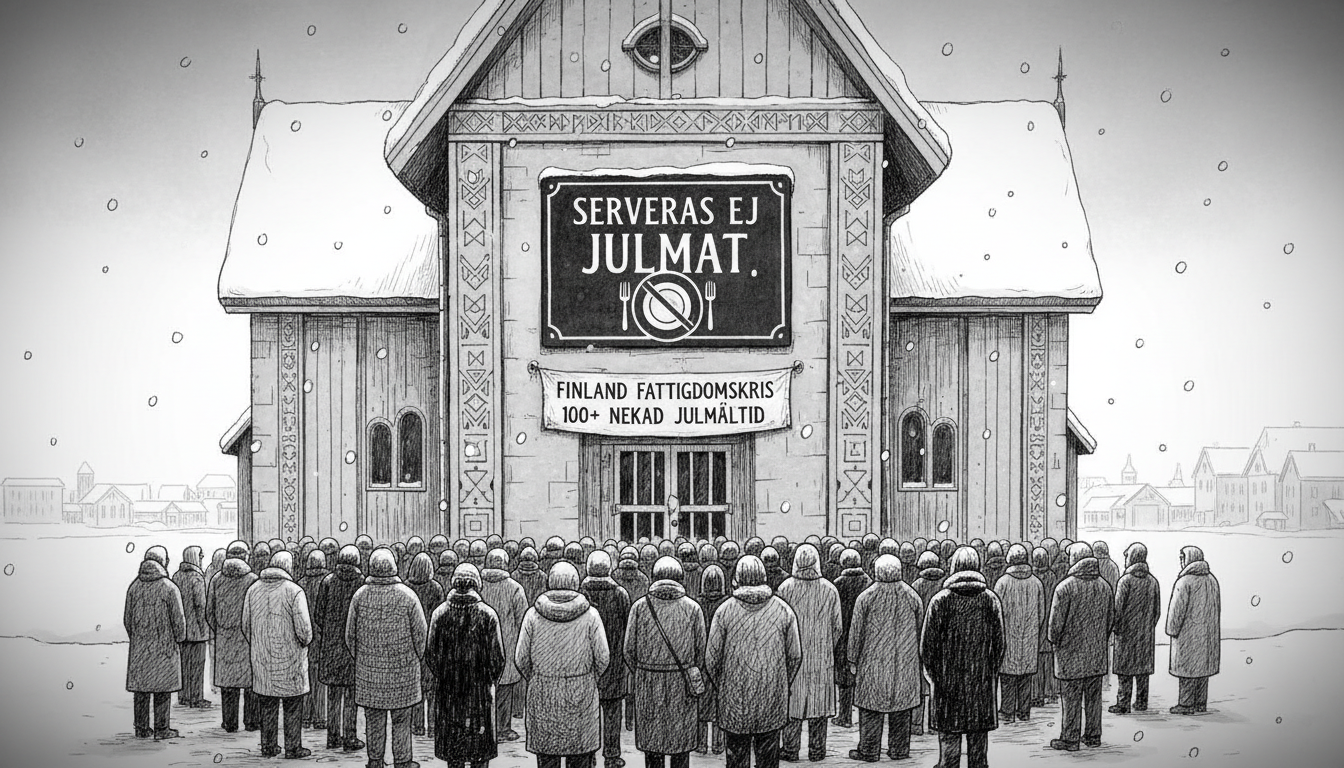
Finland's stark poverty crisis was laid bare at a Helsinki charity event where over 100 vulnerable people were turned away from a traditional Christmas dinner. The annual Heikki Hursti Christmas celebration, organized by the charity Laupeuden Työ ry, could not accommodate everyone despite expanding its capacity at the Helsinki Exhibition and Convention Centre. Organizers planned for 2,000 guests and squeezed in an additional 200-300 people, but still faced the heartbreaking task of closing the doors on those left in the cold.
Heikki Hursti, the association's board chairman and a prominent Finnish philanthropist, broke down in tears describing the scene. "The event's popularity has surprised us all. Unfortunately, we had to turn people away from the door," Hursti said. His emotional reaction underscores the growing pressure on Finland's charitable sector and the deepening need among the population. The event, a decades-long tradition for the lonely and low-income, has become a grim barometer for social distress in the Nordic nation.
A Tradition Stretched Beyond Capacity
The Hursti family's charitable work is a fixture in Finnish society, continuing the legacy of Heikki's parents. Laupeuden Työ ry operates throughout the year, but its Christmas celebration is its most visible public gesture. Holding it at the massive Messukeskus convention center signals its scale, yet even that venue proved insufficient. This year's overwhelming demand points to a systemic issue penetrating Finland's famed social safety net.
"We intend to increase the event's capacity next year," Hursti stated, addressing the immediate logistical failure. However, he quickly pivoted to the larger meaning. "This year's situation tells us that many people are in really poor conditions." His words move the conversation from one charity's planning challenge to a national discussion about deprivation. The image of empty plates where there should have been festive meals is a powerful symbol of shortfall.
Statistics Behind the Heartbreaking Scenes
The line outside Messukeskus is a human manifestation of recent statistics from Statistics Finland. In 2022, approximately 692,000 people in Finland were at risk of poverty, representing 12.6% of the population. The 'at-risk-of-poverty' rate measures those living in households with disposable income below 60% of the national median. While Finland's rate is below the EU average, the trend has been a cause for concern among social policy researchers and non-governmental organizations.
The number of people receiving last-resort social assistance is another key indicator. These figures fluctuate with economic conditions and unemployment rates, but a sustained increase suggests structural problems. Experts directly link the demand for charitable meals to these official metrics. "Charity events like Hursti's are not just about Christmas spirit; they are emergency food distribution points," said one Helsinki-based social policy analyst who requested anonymity. "When public services are stretched, the third sector becomes a critical lifeline."
The Nordic Model Under Pressure
Finland's situation presents a particular paradox. The country is consistently ranked high in global quality-of-life and happiness indexes, built upon a robust Nordic welfare model. This model emphasizes universal benefits, high-quality public services, and income redistribution to ensure a strong social safety net. The scene at Messukeskus, however, suggests cracks are becoming visible.
Analysts point to several converging pressures: rising costs of living, especially for energy and food; housing affordability issues in urban centers like Helsinki; and an aging demographic that strains pension and care systems. While unemployment figures may show improvement, the quality of jobs and the prevalence of insecure, low-wage work contribute to in-work poverty. This means a growing number of people who are employed still cannot make ends meet, making them reliant on occasional charitable support.
"The welfare state is designed to prevent exactly this kind of scene," the social policy analyst noted. "When hundreds rely on a charity dinner for a festive meal, it indicates that the normal mechanisms of social security—housing benefits, income support, subsidized services—are either insufficient or inaccessible to some. It's a warning sign."
Government Response and Charitable Reliance
The incident places indirect pressure on the Finnish government, currently led by Prime Minister Petteri Orpo's coalition. Government ministries responsible for social and health affairs have been implementing reforms aimed at controlling public spending and incentivizing employment. Critics argue that some measures, such as tightening eligibility for certain benefits, may inadvertently push more people toward charitable aid.
There is an ongoing debate in the Eduskunta, Finland's parliament, about the balance between fiscal responsibility and social protection. The center-right coalition emphasizes economic sustainability, while opposition parties from the Left Alliance and the Social Democrats frequently highlight rising inequality and poverty risks. The Hursti event provides tangible evidence for their arguments, showing abstract statistics in human form.
Charities like Laupeuden Työ ry operate in this space between state provision and human need. They are increasingly vital, yet their leaders, like Hursti, are acutely aware they cannot replace systemic solutions. "We will feed more people next year," Hursti promised, but the subtext is clear: charity alone cannot solve a national poverty trend. The event's expansion is a stopgap, not a strategy.
A Look Ahead: More Than Just a Bigger Hall
The promise to book a larger space next Christmas is a practical response, but it sidesteps the deeper question. Should Finland, one of the world's wealthiest and most equitable societies, need to rely on scaling up charity dinners to ensure its citizens have a holiday meal? The answer from social experts is a resounding no.
Long-term solutions require policy interventions. These could include reviewing the adequacy of basic social security levels against real living costs, addressing regional disparities in service provision, and tackling the root causes of loneliness and social exclusion. It also requires a honest conversation about taxation and redistribution, perennial topics in Finnish politics.
The tears of a seasoned philanthropist like Heikki Hursti are more impactful than any political speech. They reveal the personal toll on those who bridge the gap when the state falls short. As Finland looks toward 2025, the challenge is not just to find a bigger venue for a Christmas dinner, but to ensure that fewer people need an invitation in the first place. The true test of the Nordic model will be whether the queue outside Messukeskus grows shorter, not whether the hall inside grows larger.