
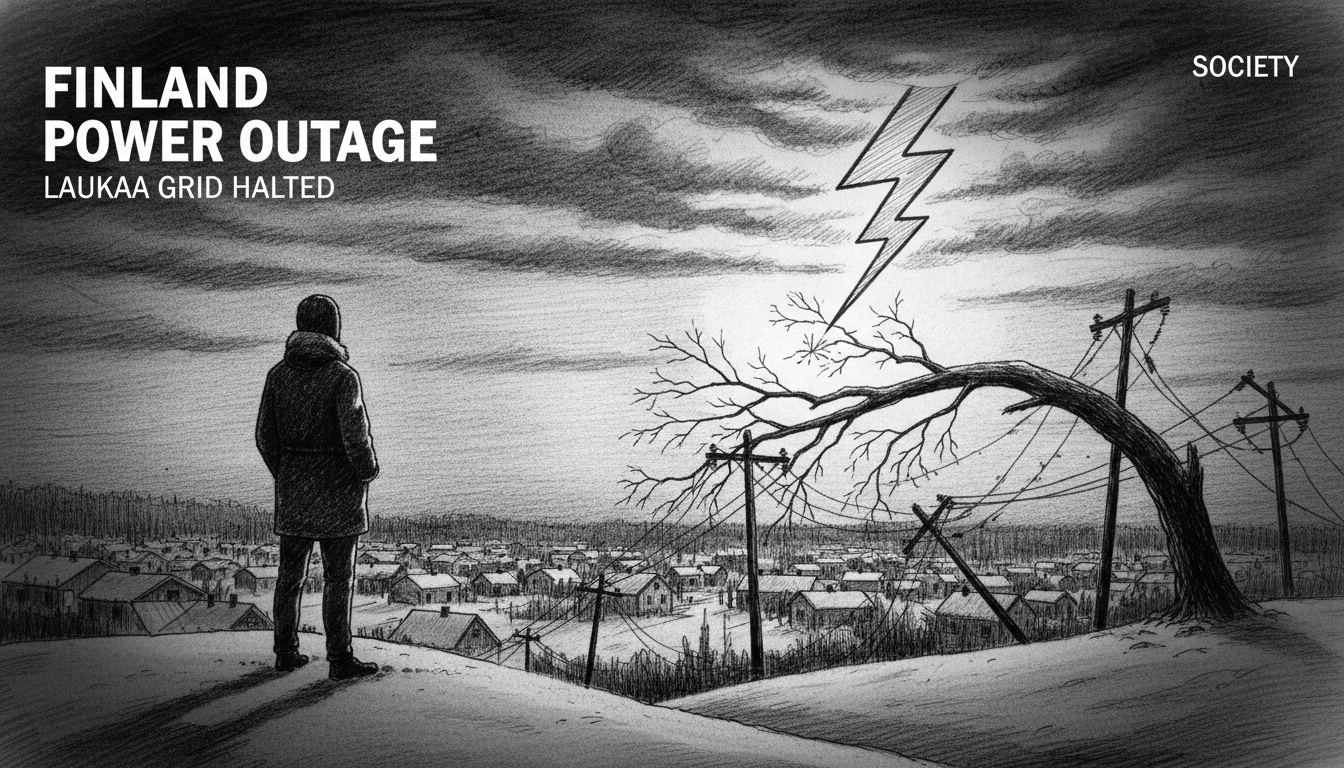
Finland's famously reliable electricity grid met a common foe in the early hours of Sunday: a single tree branch. In the municipality of Laukaa, resident Petri Ruotsalainen was expecting disruptions as warned storm winds battered Central Finland. The surprise came not with the flickering lights, but with the explosive sound and shower of sparks he witnessed in the darkness after midnight, when a branch fell onto a local power line in the Kuhankoski area.
This brief, localized outage underscores a persistent vulnerability for a nation blanketed by forest. While Finland boasts one of the world's most stable power supplies, its extensive woodland, covering over 75% of the land, poses a continuous challenge to infrastructure maintenance. The incident in Laukaa is a microcosm of the balancing act between a natural environment and modern energy security.
The Midnight Spark in Kuhankoski
Petri Ruotsalainen's experience was both mundane and dramatic. Prepared for potential outages due to the forecasted storm, the initial power fluctuation was no shock. The subsequent events were. "But then a popping sound started, and outside in the dark you could see sparks flying," Ruotsalainen recounted. The cause was straightforward—vegetation contact with a live power line—a classic trigger for faults in forested regions.
The local energy distributor, likely part of the Helen or Caruna networks that operate in the area, would have mobilized repair crews. In Finland, response times to such faults are typically swift, a point of pride for the sector. The outage was isolated, preventing a cascade through the network, but for the affected residents, it was a stark reminder of their dependence on overhead lines weaving through endless stands of pine and spruce.
A Nation Built in the Woods
Finland's relationship with its forests is foundational, providing economic wealth, cultural identity, and recreational space. This same abundance, however, complicates the task of keeping the lights on. The statistical reality is impressive: Finland's average annual outage time per customer is remarkably low by global standards, often cited at well under two hours. This reliability is a key selling point for data centers and heavy industry.
Yet, this average masks a seasonal and geographical reality. During the autumn storm season and heavy winter snows, the risk of tree-related damage spikes. Regional differences are also pronounced; rural, heavily forested municipalities like Laukaa face inherently higher exposure than urban centers like Helsinki. The grid is not a monolith, but a vast network whose weakest links are often where the tree canopy meets the conductor.
The Silent Battle: Grid Maintenance vs. Nature
Preventing incidents like the one in Laukaa is a continuous, costly, and largely unseen operation. Energy companies invest millions annually in vegetation management. This involves regular clearance of rights-of-way, creating protective corridors through the forest where trees are trimmed or removed to prevent contact with lines. The practice is guided by strict regulations, but its execution is a logistical challenge across thousands of kilometers of remote power lines.
Expert perspective highlights this as a core priority. "Proactive vegetation management is the first and most crucial line of defense," explains a grid reliability specialist familiar with Nordic infrastructure, who spoke on the condition of anonymity as they were not authorized to comment on the specific event. "It's a constant cycle of growth and clearance. The goal is to stay ahead of the next storm."
The specialist further notes the role of technology. While not preventing the initial contact, smart grid technologies and automated switching can drastically reduce the scale and duration of outages. "When a fault occurs, modern systems can isolate it to a smallest possible segment in milliseconds, sometimes before most customers even notice. What was once a village-wide blackout can now be limited to a few streets."
Climate Change and the Future Grid
The Laukaa incident, while minor, feeds into a broader discussion about climate resilience. Finnish authorities and research institutes, including the Finnish Meteorological Institute, project an increase in the frequency and intensity of extreme weather events. This means more powerful storms, heavier wet snowfalls, and potentially more lightning.
This evolving threat profile is pushing the energy sector to adapt. Investment is flowing not only into maintenance but into hardening the grid. This includes using more resilient materials, burying critical lines where feasible—though this is prohibitively expensive across vast rural distances—and deploying more sophisticated weather monitoring and predictive fault detection systems. The conversation is shifting from mere reliability to ensuring resilience against a changing climate.
The Human Factor in a Digital Age
For residents like Petri Ruotsalainen, the outcome is what matters. A short outage is an inconvenience. A prolonged one, especially in the depths of the Finnish winter, becomes a serious safety and comfort issue. Public tolerance for disruptions is low, given the high expectations set by the grid's overall performance. This public expectation creates political pressure on regulators and municipal authorities to hold distribution companies accountable for maintenance standards.
Furthermore, Finland's increasing digitalization and the growth of remote work mean that even brief power losses can disrupt economic activity far beyond the immediate locality. A home office in Laukaa losing power is a connection severed to a company server in Espoo or a client meeting in Stockholm. The economic cost of outages, therefore, extends beyond the repair bill.
A Branch, a Spark, and a Systemic Reality
The falling branch in Kuhankoski was a random event, but it was not an accident. It was a statistically inevitable occurrence in a country where the grid must coexist with one of Europe's most dense forest covers. The true test of the system is not preventing every single contact—an impossible task—but in minimizing their frequency and, crucially, their consequences.
Finland's success in this arena is evidenced by its world-class reliability metrics. Yet, as climate patterns shift and society's dependence on flawless electricity delivery grows, the work continues. The sparks in the Laukaa night are a brief signal, a reminder that behind the seamless delivery of power lies a relentless, quiet battle against the encroaching forest. The question for planners and policymakers is whether current levels of investment and innovation in grid management will be sufficient to win that battle in the stormier decades to come.