
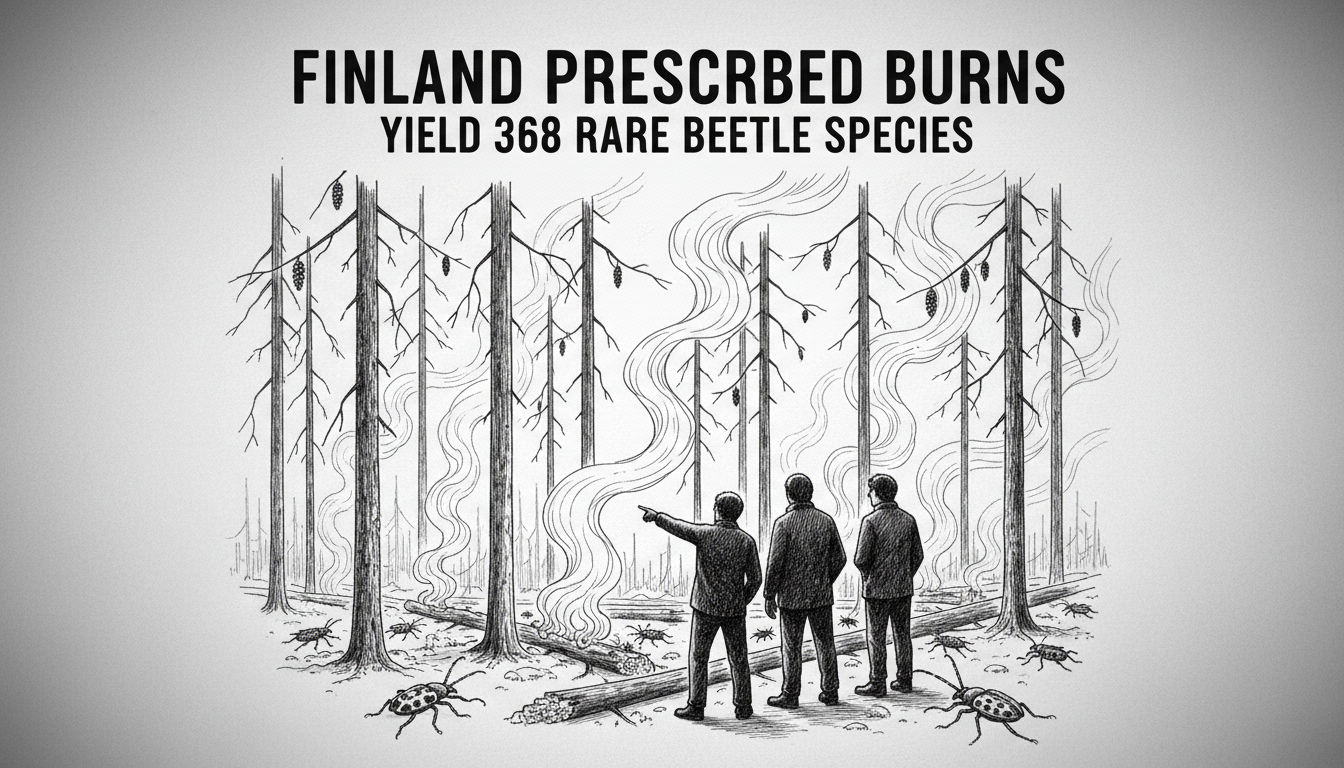
Finland's habitat restoration efforts have uncovered a remarkable biodiversity hotspot on the country's southeastern border. A detailed beetle survey in the Huuhanranta area of Ruokolahti has identified 368 distinct beetle species, including several classified as very rare and endangered. The discovery highlights the success of a targeted conservation method: prescribed burning. 'Huuhanranta has proven to be an extremely interesting site in terms of species,' said beetle researcher Petri Martikainen, who conducted the survey. 'The restoration burns have created a significant number of new habitats for rare beetle species that require heat and aridity.'
This finding is not accidental but the result of a deliberate, multi-year ecological strategy. The Huuhanranta area has been subject to controlled burning over several summers. Researchers placed traps in the terrain for two months following an ecological restoration burn to sample the post-fire environment. They specifically examined life in charred wood and soil, niches where fire-dependent species thrive. The results exceeded expectations, documenting a wealth of specialized insects that had colonized the newly created habitat.
The Science of Fire-Dependent Species
Many of Finland's most threatened insect species are not just survivors of fire but ecological beneficiaries of it. These beetles, along with six species of barklice and several other arthropods found in the survey, rely on the specific conditions a fire creates. Flashes remove competing vegetation, increase sunlight to the forest floor, and leave behind charred timber and bare, warm soil. This creates a temporary but crucial environment for species that cannot compete in dense, shaded forests. Without periodic disturbances like fire, these specialist insects face local extinction as their habitats disappear through natural forest succession.
Controlled burning replicates the natural wildfires that once regularly shaped Finland's forests. Forestry practices and effective fire suppression over the past century have drastically reduced these natural events, leading to a decline in species adapted to them. 'For these insects, fire is not a catastrophe but a reset button that opens up new opportunities,' explained Dr. Lena Sjöberg, a forest ecologist familiar with the project. 'Prescribed burning is a tool to mimic this natural process and prevent the permanent loss of an entire ecological community.'
Finland's Strategic Conservation Framework
The work at Huuhanranta is a microcosm of Finland's broader national and international conservation commitments. It aligns directly with Finland's National Strategy and Action Plan for the Conservation and Sustainable Use of Biodiversity. Nationally, the Finnish government allocates funding for habitat restoration projects through agencies like Metsähallitus (Parks & Wildlife Finland) and the Ministry of the Environment. These projects often focus on restoring habitats for species listed as threatened in Finland's Red List, a comprehensive assessment of species' conservation status.
On the European stage, this work feeds into the ambitious goals of the EU Biodiversity Strategy for 2030. A core pillar of this strategy is the legally binding Nature Restoration Law, which requires member states to implement measures to restore degraded ecosystems. Finland's use of prescribed burning to aid fire-dependent species serves as a practical example of meeting these EU-wide obligations. The success in Ruokolahti provides valuable data that can inform restoration guidelines across the boreal region.
The Logistical and Social Challenges of Burning
Implementing prescribed burns is a complex operation far beyond simply lighting a match. Each burn requires meticulous planning, favorable weather conditions, and a team of trained firefighters to control the blaze. Authorities must coordinate with local municipalities, landowners, and the public to manage smoke impacts and ensure safety. 'It's a balancing act between ecological need and public safety,' notes Jukka Pekkonen, a regional fire management officer. 'We conduct burns in early spring or late autumn when conditions are moist enough to control the fire but dry enough for it to be effective.'
Public perception can also pose a challenge. For decades, the message has been that forest fires are universally destructive. Shifting this mindset to understand the ecological necessity of fire for certain habitats requires continuous communication and education. Conservationists point to concrete results, like the Huuhanranta survey, as powerful tools to demonstrate the benefits. Showing that a managed fire can directly lead to the resurgence of nearly 400 beetle species makes the abstract concept of biodiversity very tangible.
Beyond Beetles: A Ripple Effect in the Ecosystem
The significance of the Huuhanranta discovery extends beyond entomology. A diverse beetle population serves critical functions in a healthy forest ecosystem. Many of these beetles are decomposers, breaking down dead wood and recycling nutrients back into the soil. They also form a crucial part of the food web, serving as prey for birds, bats, and other small mammals. The increase in insect life following a prescribed burn can thus boost populations of these larger animals, creating a cascade of biodiversity benefits.
Furthermore, the burned areas often see a resurgence of fire-adapted flora. Pioneer plant species, along with fungi and lichens that specialize in burned wood, colonize the area. This creates a mosaic of different habitat types within the forest landscape, increasing overall structural and species diversity. The two-month survey window in Huuhanranta captured an early snapshot of this succession; longer-term monitoring would reveal how the plant and animal communities continue to evolve in the years after the fire.
A Model for Future Restoration
The clear success at Huuhanranta strengthens the case for expanding prescribed burning programs in Finland. Conservation biologists argue for identifying other potential sites where fire-dependent species are known or suspected to exist but are struggling due to habitat loss. The data collected provides a benchmark for measuring the effectiveness of future burns elsewhere in the country. It also offers a model that could be adapted by other Nordic and Baltic nations facing similar conservation challenges in their boreal forests.
However, researchers caution that prescribed burning is not a one-size-fits-all solution. It is a targeted intervention for specific ecosystem types and species groups. The decision to burn must be based on solid ecological research and clear conservation objectives. The ongoing challenge is to scale up these successful pilot projects into a coordinated, landscape-level strategy that can make a measurable difference for Finland's threatened species. The 368 species found in Huuhanranta are a compelling argument for doing just that.
As Finland continues to navigate its dual roles of intensive forestry and ambitious nature conservation, stories like Huuhanranta demonstrate that these goals are not always mutually exclusive. Strategic, science-led interventions can create pockets of high biodiversity within managed landscapes. The charred logs and sun-baked clearings of southeastern Finland have become an unexpected ark for endangered life, proving that sometimes, to preserve nature, we must carefully reintroduce the very force of destruction it depends on.