
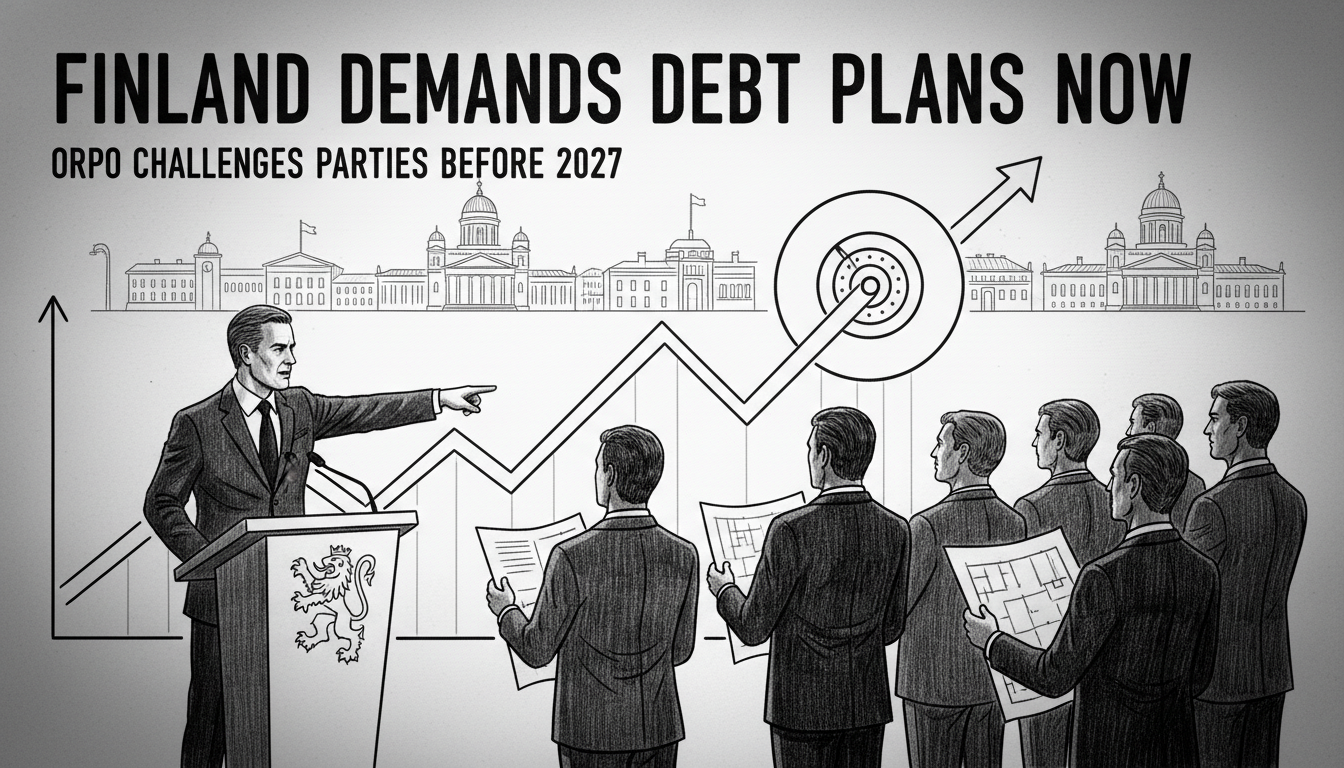
Prime Minister Petteri Orpo has declared that every political party must present concrete plans for controlling Finland's national debt before the next parliamentary elections. The conservative leader made the statement during a party council meeting, calling the recent debt brake agreement a victory for his party's policies.
Orpo specifically challenged the main opposition Social Democratic Party to present what he called a genuine alternative to the current government's economic policies. He argued that without offering their own solutions, opposition parties lose the right to criticize government decisions.
The debt brake mechanism, which all parliamentary parties except the Left Alliance recently supported, requires future governments to reverse Finland's growing debt trajectory. Orpo described this as a fundamental achievement that will force fiscal responsibility.
Next parliamentary elections are scheduled for spring 2027. The Social Democrats have consistently led in recent opinion polls while loudly criticizing the government's spending cuts and employment policies.
Orpo dismissed criticism of Finland's unemployment figures as intellectually dishonest without acknowledging broader challenges. He cited the closed eastern border with Russia, increased defense spending, population aging, and existing national debt as complicating factors.
Despite these challenges, the prime minister vowed his government won't abandon its goal of curbing debt growth. He pointed to recent economic indicators showing signs of improvement, including OP Financial Group's forecast predicting 2% economic growth next year.
A recent small business survey also showed more companies reporting good financial conditions. Orpo emphasized the importance of maintaining hope and confidence in Finland's economic future.
The government has been actively pursuing international technology investments, particularly data centers, to boost employment and economic growth. Officials are preparing a new support model to replace electricity tax benefits that were cut as part of budget savings.
The new model is expected to cost about the same as the previous tax support. Reports suggest government parties disagreed about removing the tax benefit, with concerns that Google might cancel planned billion-euro investments in Kajaani and Muhos without incentives.
Orpo denied any external pressure forced the government to develop alternative support measures. He stated his sole focus is securing investments and jobs for Finland, regardless of political style points.
On fuel distribution concerns following Neste's decision to stop supplying Teboil, Orpo said current reports indicate no major crisis in distribution networks. The state-owned energy company's move had raised questions about fuel availability across Finland.
The prime minister acknowledged the government's responsibility to ensure nationwide fuel distribution but expressed primary reliance on market solutions. He noted companies likely have commercial incentives to maintain distribution networks for essential products.
No government support packages are currently planned for companies potentially affected by distribution issues. Orpo maintains faith in market mechanisms while reserving the right to intervene if major distribution gaps emerge.
Political observers note Orpo's comments represent an early positioning for the next election cycle, attempting to frame fiscal responsibility as his party's signature issue while putting opposition parties on the defensive about their economic plans.