
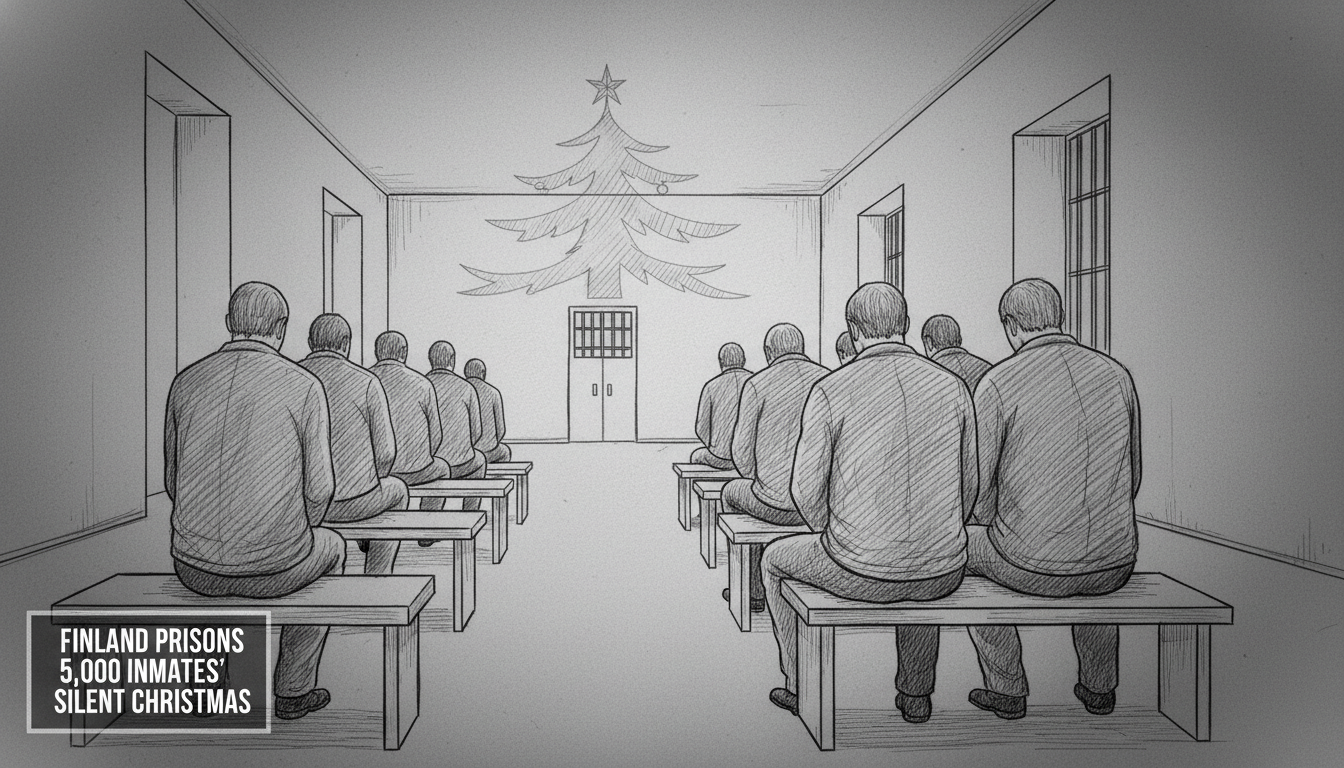
Finland's prison system, housing nearly 5,000 inmates, confronts its most emotionally complex week as the nation prepares for Christmas. In a country where the holiday is synonymous with family, light, and quiet reflection, the separation from loved ones feels most acute behind bars. For inmates like Tino Brunfeldt, 32, the familiar carols sung in Kuopio prison's chapel underscore a painful reality. "It must be five Christmases I haven't been in prison since I became an adult," Brunfeldt reflects, highlighting a seasonal cycle familiar to many in Finland's correctional facilities.
His coping mechanism is starkly practical. He focuses on the temporariness of the day. "The situation is easier if you think it's just one day, after which Christmas is already over," he explains. This sentiment echoes through the corridors of Finnish prisons every December, where a holiday centered on peace and home becomes a test of resilience. The system, globally noted for its humane and rehabilitative focus, faces the delicate task of balancing security with humanity during this culturally profound period.
The Nordic Model Meets Yuletide Reality
Finland's penal philosophy is built on normalization and reintegration. With a prison population rate of approximately 50 per 100,000 inhabitants—one of the lowest in Europe—the system emphasizes maintaining human dignity. Prisoners typically have access to visits, letters, and phone calls. They are offered education and vocational training designed to prepare them for life after release. During Christmas, institutions organize special meals and religious services, like the one where Brunfeldt heard the hymn "Näin sydämeeni joulun teen."
Yet, these provisions cannot fully bridge the emotional chasm. "Many guys would like to be in civilian life now," Brunfeldt states, capturing the universal yearning. Experts confirm this period is critically challenging. "The holiday season acts as a magnifying glass on the pains of imprisonment," says Dr. Eeva-Kaisa Forsman, a criminologist specializing in prisoner well-being. "The contrast between societal celebrations and institutional routine can deepen feelings of isolation, regret, and anxiety. Supporting mental health during this time is not a luxury; it's a core component of a rehabilitative environment."
A System Designed for Connection, Tested by Separation
Finnish law and prison regulations explicitly aim to preserve inmates' connections to the outside world. This is seen as vital for reducing recidivism. In open prisons, which house those nearing the end of their sentences, the holiday disparity can feel even sharper, as inmates experience greater autonomy while still being confined. The Finnish government's focus on rehabilitation extends to family ties, recognizing that successful reintegration often relies on a stable support network waiting beyond the gate.
The Christmas period tests this framework. While facilities may extend phone call allowances or host family visit days in the lead-up to December 24th, the day itself remains a poignant reminder of separation. The system's success is partially measured by its recidivism rates, which are closely monitored. Maintaining prisoner morale and mental health during high-stress periods like Christmas is increasingly viewed as directly linked to these long-term outcomes.
Between Chapel Services and Concrete Walls
The cultural weight of joulurauha—Christmas peace—is a uniquely Finnish concept, a time when society slows down and families gather. In prison chapels, the traditional services offer spiritual solace for some. For others, the rituals underscore what they are missing. The prison administration walks a tightrope, aiming to provide a sense of holiday normalcy within an inherently abnormal environment.
This involves practical logistics: preparing special meals that comply with budgets and security, coordinating volunteer-led events, and ensuring staff, who are also away from their families, can manage the emotional undercurrents of the shift. The approach is not uniform; each prison adapts its activities based on resources and the needs of its specific population. The common goal is to prevent the holiday from becoming a trigger for crises or conflicts within the units.
The Long Shadow of the Season
The impact of a prison Christmas does not end on December 26th. Researchers note that the emotional low of the holidays can extend into the new year, affecting participation in programs and overall behavior. Addressing this requires proactive mental health resources and purposeful activity scheduling in the post-holiday period.
Finland's system, with its relatively small population, has the potential to manage these challenges with a degree of personal attention less feasible in larger systems. The focus on individual progression plans means that for some inmates, Christmas might coincide with preparations for furlough or transfer to an open institution, offering a tangible connection to a future beyond the walls.
However, for those serving long sentences or with strained family ties, the season can solidify a sense of stagnation. "It becomes a marker of time passed, of life moving on without you," explains Dr. Forsman. "This is why continuous psychological support and meaningful activity are crucial year-round, but especially when the outside world's celebrations highlight the inmate's exclusion."
Looking Beyond the Holiday
The silent struggle of the Christmas period in Finnish prisons underscores a broader truth about the justice system. Even in a progressive, humane model, punishment inherently involves deprivation. Finland's model seeks to minimize unnecessary suffering and focus on constructive change. The way it navigates this emotionally charged holiday is a subtle indicator of its philosophical commitments.
As Brunfeldt and nearly 5,000 others mark the day within institutions this year, the system's task is to ensure that the season does not damage, but rather supports, the fragile process of rehabilitation. The ultimate test lies not in the Christmas meal served, but in whether an inmate feels they are on a path where future Christmases might be spent differently. Does a society's commitment to humane justice hold firm when its citizens are out of sight, celebrating the season of peace? Finland's prisons, during the long winter night, provide a quiet, ongoing answer.