
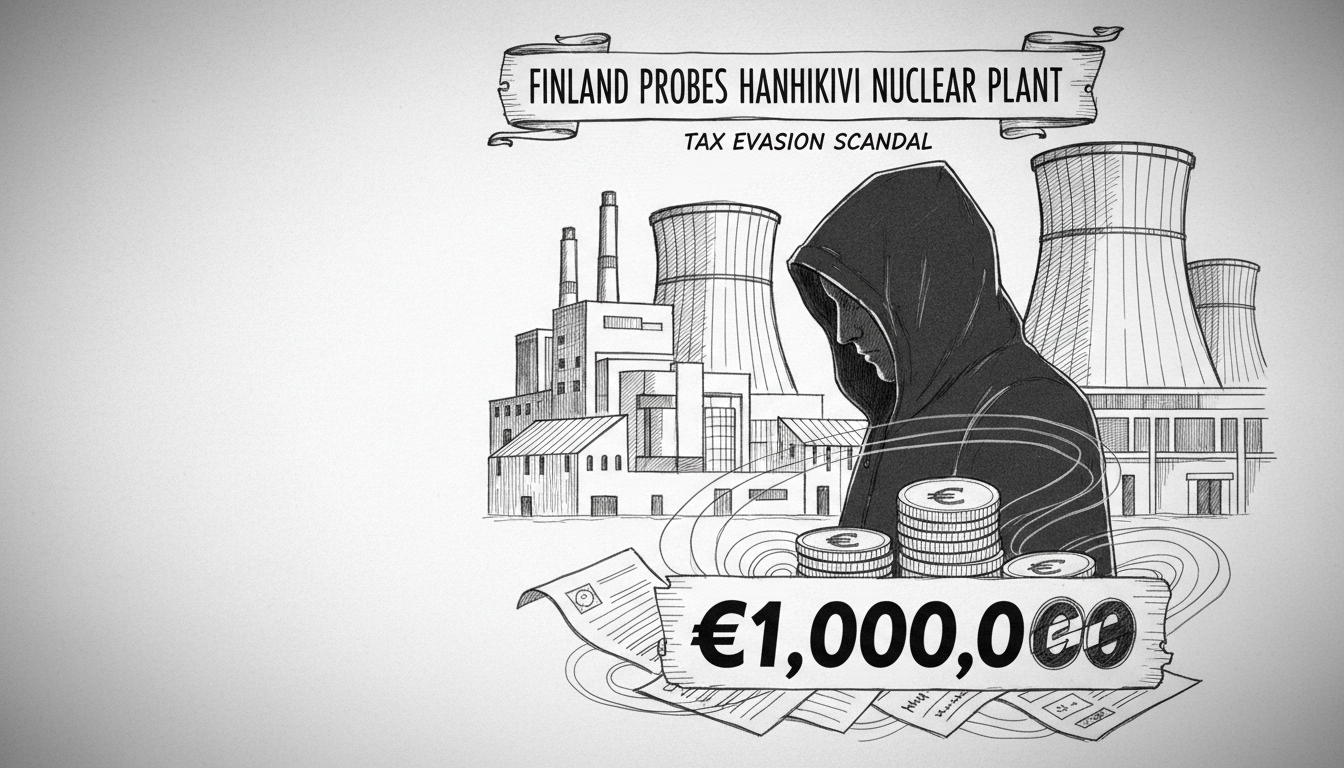
Finland's largest-ever infrastructure project, the cancelled Hanhikivi nuclear plant, is now at the center of a suspected €1 million tax evasion and bribery scandal. The Oulu Police Department reports investigating a construction firm for serious economic crimes, alleging it funneled payments through a secret Polish bank account and paid bribes to secure lucrative contracts.
Authorities seized approximately €400,000 from a company-controlled bank account in Poland and €50,000 in assets within Finland. The primary suspect, a company executive and Estonian national, faces allegations of aggravated tax fraud, aggravated accounting fraud, and aggravated bribery in business operations. Two other individuals, one Lithuanian and one Estonian citizen, are suspected of aiding and abetting the crimes. All suspects deny the allegations.
A Scheme Built on Hidden Accounts
The police investigation focuses on activities between 2020 and 2025. A key allegation states that in spring 2022, after work concluded at the Hanhikivi site in Pyhäjoki, the company wrote off roughly €3.5 million in sales receivables in its official accounting books. However, investigators believe the main contractor had already paid those receivables. The money was allegedly directed to a separate bank account in Poland, established by the company but kept off its official ledger.
This practice of maintaining parallel, undisclosed financial records and accounts in other EU jurisdictions represents a sophisticated attempt to conceal income. "Sales receivables are essentially invoices sent to clients that haven't been paid yet," explained a financial crime detective familiar with the case, speaking on background. "Writing them off as uncollectable while secretly receiving the payment into a hidden account is a classic method of tax evasion."
Bribery Allegations and Cross-Border Complexity
Beyond tax fraud, the company is suspected of unjustly deducting Value-Added Tax (VAT) on expenses for which it had no legitimate claim between 2020 and 2023. More seriously, the firm is accused of aggravated bribery in the course of business. Investigators allege bribes were paid to foreign companies, with these payments acting as a prerequisite for the company to win subcontracts at the Hanhikivi construction site.
The cross-border nature of the suspected crimes complicates the investigation. With suspects holding Estonian and Lithuanian citizenship, a hidden bank account in Poland, and alleged bribe payments to foreign entities, Finnish authorities must navigate international legal cooperation. This case highlights the challenges EU member states face in tracking financial flows and enforcing tax law across internal borders, where capital movement is free but judicial systems remain national.
"This investigation tests the practical depth of European cooperation in combating financial crime," said Dr. Elina Saarinen, a professor of European Law at the University of Helsinki. "While we have frameworks like the European Investigation Order, gathering evidence and securing seizures abroad adds layers of procedural delay and complexity. It creates opportunities for obfuscation that purely domestic schemes do not."
The Shadow Over Hanhikivi's Legacy
The scandal casts a further pall over the ill-fated Hanhikivi 1 project. Planned for Pyhäjoki on Finland's west coast, the Russian-designed reactor was to be built by Fennovoima, a consortium with significant Russian state nuclear giant Rosatom involvement. The project dragged on for over a decade, consuming hundreds of millions of euros in development costs for site preparation, offices, warehouses, and worker housing.
Its abrupt cancellation in May 2022 was a direct consequence of Russia's invasion of Ukraine. Fennovoima terminated its contract with Rosatom before construction on the reactor itself had begun. The site now stands as a monument to a failed energy partnership, and this financial crime probe exposes potential governance failures in its supply chain.
"Major infrastructure projects, especially those with international partners and high cost pressures, are inherently vulnerable to corruption and fraud," commented Markus Mäki, a forensic accountant and partner at a Helsinki-based risk advisory firm. "The scale can attract firms willing to cut corners. Effective oversight requires robust, real-time auditing and transparent subcontracting processes, which may have been lacking here. The project's eventual cancellation and the ensuing financial turmoil for contractors could have also created a desperate environment where such schemes flourish."
Legal Proceedings and Broader Implications
The case has now progressed to the pre-trial investigation phase. Six people were questioned as suspects, and the matters concerning three have been forwarded for consideration of charges. If prosecuted and convicted, the charges of aggravated tax fraud and aggravated accounting fraud carry potential sentences of up to four years' imprisonment. Aggravated bribery in business can result in up to two years behind bars.
This investigation arrives at a time when Finland is investing heavily in new energy and defense infrastructure. The government and construction sector stakeholders will closely watch the outcome, as it underscores the need for enhanced due diligence and anti-corruption protocols in public-private partnerships.
Professor Saarinen points to a potential EU-level lesson. "Finland is generally considered a low-corruption country, but no nation is immune when projects involve complex international finance. This case could serve as a argument for stronger, centralized EU tools for tracking corporate ownership and cross-border transactions related to public contracts, moving beyond mere information sharing to active, collaborative auditing."
The Hanhikivi project promised energy security but ended in geopolitical rupture. Now, its final chapter includes a police probe into alleged financial crimes, serving as a stark reminder that the true cost of a failed megaproject extends far beyond its balance sheet. It exposes systemic vulnerabilities in how Europe manages large-scale, cross-border construction efforts. Will this case lead to tougher safeguards, or will the complexity of EU justice systems allow such schemes to persist in the shadows of the next big project?