
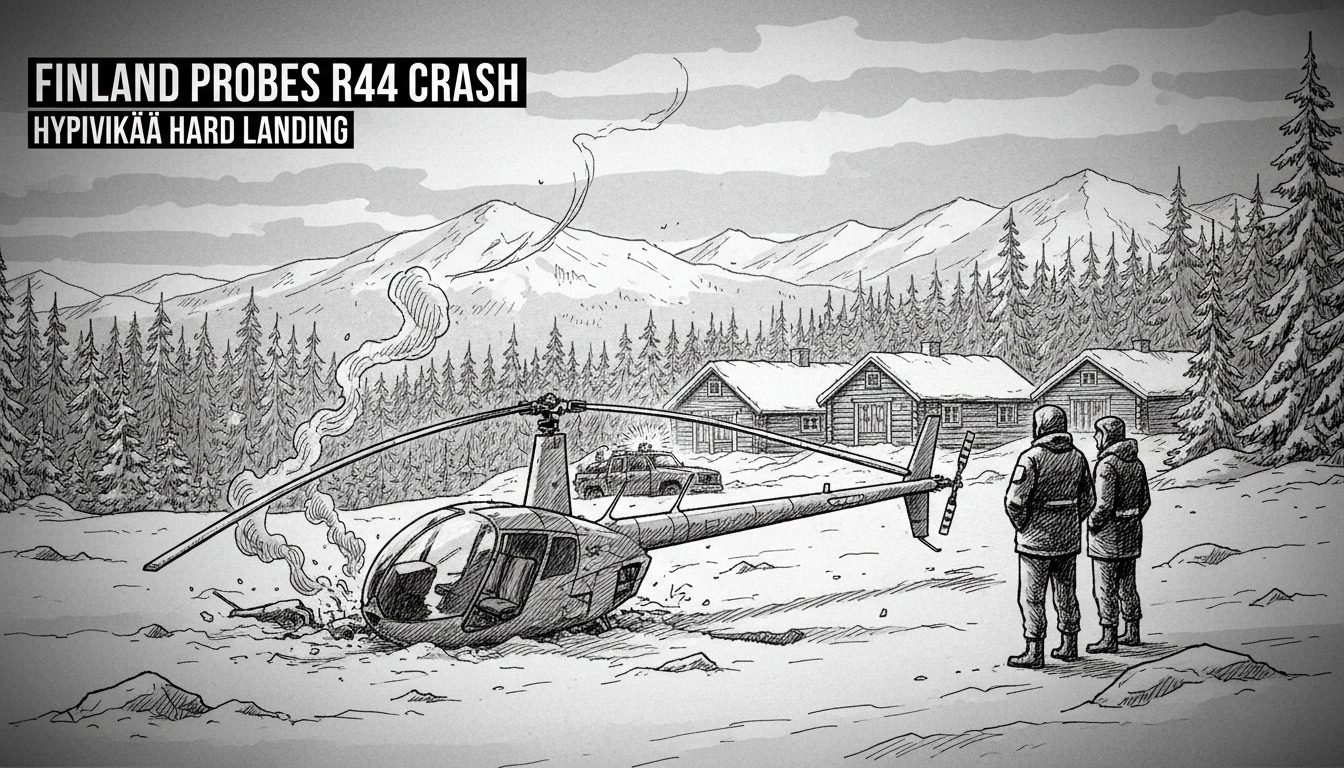
Finland's Safety Investigation Authority (OTKES) has launched a probe into a serious hard landing involving a Robinson R44 helicopter at Hyvinkää Airport. The training flight incident, which occurred Saturday morning, left the aircraft severely damaged but resulted in no injuries to the instructor and student on board. This investigation will scrutinize whether mechanical failure, human error, or environmental factors caused the helicopter to impact the ground from a height of one to two meters.
Hyvinkää Airport Manager Jukka Helminen described the event as a "slightly too hard landing." He confirmed the helicopter, a Robinson R44 Raven I, is no longer airworthy following the accident during its training descent. The Itä-Uudenmaan police department, also investigating the case as an accident, stated preliminary information ruled out intoxication as a factor. "It is not yet known whether this was some kind of device failure or human error," said Commissioner Ben Henriksson of the Itä-Uudenmaan Police.
The Anatomy of a Hard Landing
Aviation accidents are often categorized by their phase of flight, and the landing phase is statistically one of the most critical. A hard landing, distinct from a crash, involves an impact with the ground that exceeds the aircraft's design limits for vertical descent rate. For a light helicopter like the Robinson R44, even a descent from a low altitude of 1-2 meters can cause significant structural damage if the angle or rate of descent is incorrect. The airframe, landing skids, and rotor system are particularly vulnerable to asymmetric or high-force impacts.
Jukka Helminen emphasized this fragility, noting helicopters are "very vulnerable to damage if they land in the wrong attitude." The investigation will meticulously examine the helicopter's wreckage, flight data if available, and interview the two occupants to reconstruct the final seconds before impact. OTKES will determine early this week whether the initial on-site examination warrants a full, formal safety investigation, a process that can take months but yields crucial safety recommendations for the entire aviation community.
The Robinson R44: A Popular Workhorse Under Scrutiny
The aircraft at the center of the investigation, the Robinson R44, is a ubiquitous presence in global general aviation. Manufactured in the United States, it is a popular choice for flight training, aerial photography, and private travel due to its relative affordability and performance. The four-seat, piston-engine helicopter has a long production history, with the Raven I model being an earlier variant. Its prevalence in training schools, like the one operating this flight, makes any incident involving the model a point of focused analysis for safety agencies worldwide.
Aviation safety experts often note that the R44's accident history is a subject of study, with causes spanning the spectrum from mechanical issues to pilot error. Some past investigations internationally have highlighted concerns related to specific components or aerodynamic phenomena, such as mast bumping in certain flight conditions. However, experts universally caution against drawing conclusions before an investigation is complete. Each incident is unique, and the Finnish probe will seek to identify the specific causal chain for the Hyvinkää event, not general trends.
"The goal is never to assign blame but to understand the sequence of failures, both technical and human, that led to the event," explained a veteran Finnish flight instructor familiar with the R44, who spoke on condition of anonymity as the investigation is active. "Training flights are where we stress systems and procedures. An incident here provides data that can improve checklists, training curricula, and even aircraft design."
The Investigative Machinery of OTKES
The Onnettomuustutkintakeskus (OTKES) operates independently from police, judicial authorities, and aviation regulators. This independence is fundamental to its mission of improving transportation safety. While police investigate potential criminal negligence, OTKES focuses solely on the systemic safety lessons that can prevent future accidents. Their final reports do not determine liability or guilt; instead, they publish safety recommendations directed at operators, manufacturers, regulators, and training organizations.
For an aviation accident, an OTKES team typically includes specialists in aircraft operations, engineering, and human factors. They will secure the wreckage, document the scene, collect maintenance records, and interview witnesses and crew. The damaged Robinson R44 will likely be transported to a secure facility for a detailed tear-down analysis. Engineers will examine the engine, flight controls, rotor assembly, and landing gear for signs of pre-impact failure or post-impact damage patterns that reveal the forces involved.
This process is methodical and transparent. Preliminary reports are often issued, with a comprehensive final report published once the analysis is complete. These reports are public documents, contributing to a global database of aviation safety knowledge. Finland's rigorous approach aligns with European Union aviation safety protocols under the European Union Aviation Safety Agency (EASA), ensuring its findings have relevance across the continent.
The Human Factor in the Cockpit
With police preliminarily ruling out substance influence, the investigation will deeply explore the human element. The presence of both a certified flight instructor and a student pilot creates a dynamic environment. Investigators will examine the division of responsibilities, the training exercise being conducted, communication in the cockpit, and any potential physiological factors like fatigue or spatial disorientation.
Training flights are designed to challenge a student's skills under controlled, supervised conditions. Sometimes, this involves practicing emergency procedures or landings in various configurations. Determining whether the hard landing resulted from a student's error that the instructor could not correct in time, a miscommunication, or a joint failure to recognize a developing situation will be a complex but crucial part of the puzzle. OTKES human factors specialists are trained to analyze these interactions without prejudice.
Safety Outcomes from Tragedy Avoided
The most significant fact from Hyvinkää is that no one was injured. This fortunate outcome does not diminish the seriousness of the event but does change its character from a tragedy to a powerful warning. A severely damaged aircraft with unharmed occupants provides investigators with a nearly perfect laboratory: clear evidence of what went wrong without the complicating factor of trauma or fatality.
The findings from this OTKES investigation could lead to tangible safety enhancements. Potential outcomes include a safety bulletin for Finnish R44 operators highlighting a specific risk, a recommendation to the Finnish Transport and Communications Agency (Traficom) to amend training requirements, or communication with Robinson Helicopter Company regarding a potential technical finding. These recommendations are not punitive; they are proactive measures to close safety gaps identified by the evidence.
Finland's aviation safety record is strong, a result of a cold climate culture that prioritizes meticulousness and adherence to procedure. Every incident, even a non-fatal hard landing, is treated with utmost seriousness as an opportunity to reinforce that record. The sight of a damaged training helicopter on the tarmac at Hyvinkää is a stark reminder that safety is maintained through constant vigilance, rigorous training, and learning from every event, no matter how minor it may initially seem.
As the OTKES team begins its detailed work, the aviation community will be watching. The lessons learned from a quiet Saturday morning at a regional Finnish airport may one day contribute to preventing a more serious accident elsewhere. That is the enduring value of a thorough, independent safety investigation.