
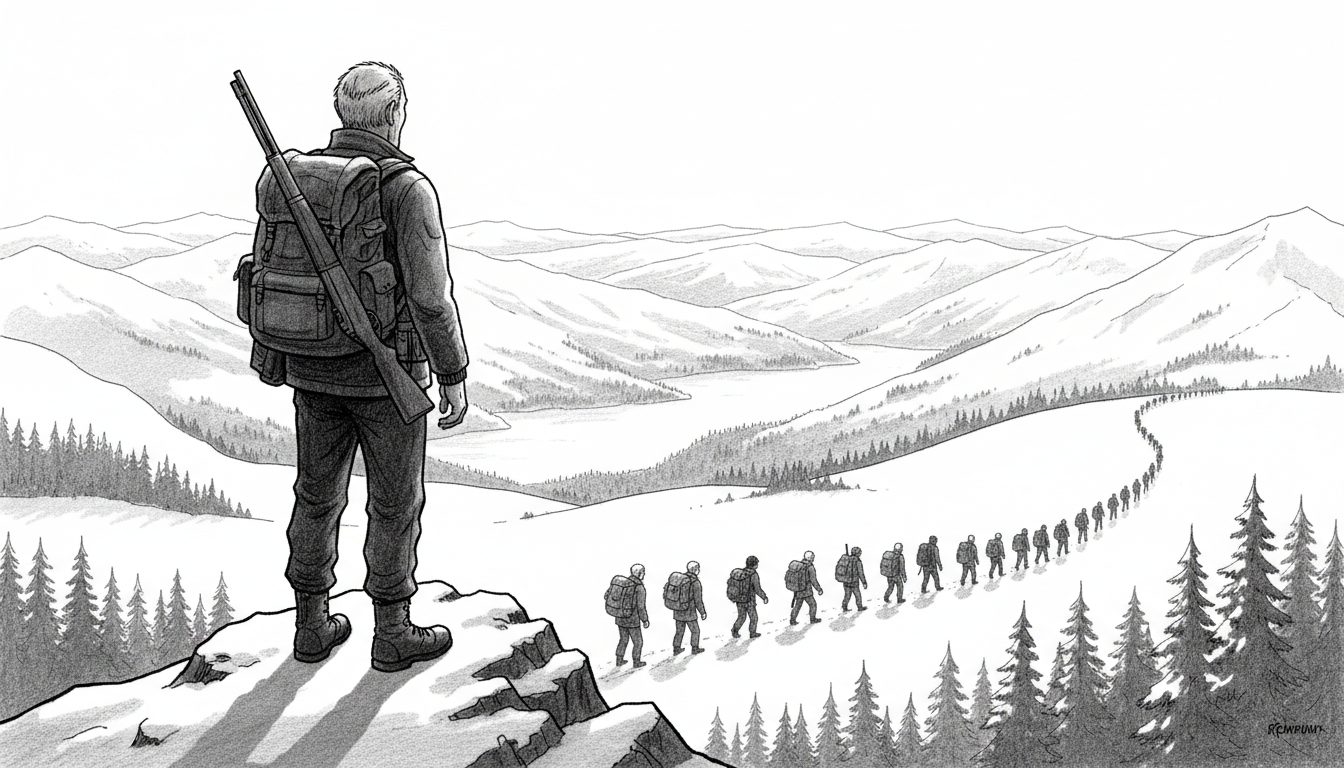
Finland's military reserve age will rise to 65 years for all personnel starting next year, a significant expansion of the nation's defense manpower. The change, announced by the Ministry of Defence, eliminates the previous distinction where enlisted personnel left the reserve at age 50 and officers at 60. This policy shift allows the Finnish Defence Forces and the Border Guard to assign experienced individuals to critical emergency roles regardless of their formal rank. Defence Minister Antti Häkkänen stated the reform is a strategic move to build a reserve of approximately one million people by 2031, leveraging the skills of an aging but capable population for national security.
This decision reflects a profound evolution in Finland's conscription-based defense doctrine, historically rooted in the experiences of World War II and the Cold War. The country maintains a broad political consensus on a strong national defense, especially following its accession to NATO in 2023. The new age limit directly addresses the challenge of a shrinking younger demographic while aiming to retain decades of accumulated expertise. Analysts see it as a pragmatic response to contemporary security realities, where hybrid threats and prolonged crisis scenarios require a deep bench of specialized knowledge.
A Strategic Response to Demographic and Security Shifts
The policy change is not merely a bureaucratic adjustment but a calculated response to two converging trends: Finland's aging society and a more volatile security environment in Northern Europe. With one of Europe's oldest populations, the traditional model of relying primarily on younger reservists is becoming unsustainable. Simultaneously, the war in Ukraine has underscored the immense value of experienced personnel in logistics, communications, engineering, and cyber defense—fields where older professionals often excel. The Finnish government is effectively redefining what constitutes a deployable asset in modern defense planning.
Minister Häkkänen framed the move as essential for comprehensive security. "The change gives the Defence Forces and the Border Guard more opportunities to place skilled individuals in key positions during states of emergency, irrespective of military rank," he said in the official statement. This language indicates a focus on function over formality, where a civilian expert in network security or transport logistics, who holds a low military rank from their conscription decades ago, can now be formally mobilized for their specific professional skills. The reform legally bridges the gap between civilian expertise and military need.
How Finland's Conscription System Adapts
Finland's defense rests on a foundation of universal male conscription, which trains about 20,000 conscripts annually. After completing service, these individuals enter the reserve, where they remain liable for refresher training and mobilization until reaching the age limit. The system is designed for rapid escalation, capable of fielding a wartime strength of 280,000 troops from a core professional force of just 12,000. The raised age limit expands this pool significantly, adding potentially hundreds of thousands of older Finns to the mobilization roster.
The practical implementation will require updates to training and medical classifications. Not all 65-year-olds will be expected to serve in frontline infantry roles. Instead, the Defence Forces will likely use detailed registers to categorize reservists by their civilian professions, skills, and health status. This allows for precise mobilization, where a 60-year-old doctor, electrician, or IT manager could be called to support crisis management in a role matching their lifelong expertise. The policy acknowledges that modern defense is a whole-of-society effort where technical and strategic knowledge can be as valuable as physical endurance.
| Previous Reserve Age Limits vs. New 2024 Policy | |
|---|---|
| Personnel Category | Upper Age Limit (Old Policy) |
| Enlisted Personnel (Miehistö) | 50 years |
| Officers & NCOs (Upseerit & Aliupseerit) | 60 years |
| Total Reserve Target | Variable |
Expert Analysis: Quality Over Quantity
Defense experts view the move as a logical step that emphasizes the quality and specialization of the reserve. "This is about recognizing that defense capability in the 21st century is built on more than just rifle strength," said a senior fellow at the Finnish Institute of International Affairs, who spoke on background. "It's about securing the specialized functions that keep a society running under pressure—managing energy grids, maintaining communications, coordinating complex logistics. These skills often reside in older, experienced professionals."
The reform also sends a clear signal of national resolve to both the domestic population and international allies. In the context of NATO, Finland continues to shoulder a substantial burden for its own territorial defense, a principle known as total defense. By formally extending the liability for service, the state reinforces the civic duty of defense across generations. It is a tangible manifestation of the societal contract that has underpinned Finnish security policy for decades, now adapted for longer lifespans and new threat patterns.
EU and Nordic Context: A Broader Trend
While unique in its scale, Finland's move aligns with broader European discussions on reserve forces and societal resilience. Several Nordic and Baltic states are re-evaluating their reserve models and total defense concepts in light of the war in Ukraine. Sweden, for instance, has reinstated conscription and is bolstering its civil defense structures. Finland's policy stands out for its explicit and sweeping extension of service liability, setting a new benchmark for reserve depth.
Within the European Union's framework for crisis management and hybrid threat response, a deeper, more experienced national reserve enhances Finland's contribution to common security. It provides a larger pool of personnel who could support not only national emergencies but also EU civil protection mechanisms or allied support missions. The policy strengthens Finland's position as a security provider within the Nordic-Baltic region and the wider Atlantic alliance, demonstrating a commitment to investing in long-term resilience.
Public Reception and Civic Duty
The initial public reaction has been muted, reflecting the widespread consensus on defense matters in Finland. There has been little political controversy, with major parties supporting the measure. For many Finns, the change is seen as a natural evolution of the duty they have always known. Social media discussion has focused on practicalities, with some questioning the physical demands on older reservists, while others highlight the value of experience and the fairness of applying the same rule to all ranks.
The government has emphasized that call-ups will be based on necessity and skill. The image is not of grandfathers in trenches, but of specialists contributing in headquarters, field hospitals, repair depots, and coordination centers. This nuanced communication has been key to gaining public acceptance. The underlying message is one of shared responsibility: in a serious crisis, every capable citizen has a role to play, and the state now has a longer legal framework to organize that contribution effectively.
The Road to a Million-Person Reserve
Reaching the target of a one-million-strong reserve by 2031 will require consistent implementation. The Defence Forces must develop updated registration, assessment, and training protocols for older reservist cohorts. This may include tailored refresher courses focused on leadership, specialist skills, and staff functions rather than basic combat training. Collaboration with employers and unions will also be crucial to ensure smooth mobilization of civilian experts without crippling critical sectors of the economy during a crisis.
The demographic math is challenging but achievable. With a population of 5.6 million, the one-million target represents a massive mobilization potential of nearly one in five adults. It underscores the principle of total defense, where national security is inseparable from societal resilience. As Finland integrates further into NATO's military structures, this deep and experienced reserve becomes a significant national asset, contributing to deterrence and stability in Northern Europe.
Finland's decision to raise the reserve age to 65 is more than a policy update; it is a statement of strategic endurance. In an era of persistent hybrid threats and geopolitical uncertainty, the nation is betting on the enduring value of experience and the unwavering commitment of its citizens. The success of this policy will ultimately be measured not by the number of names on a list, but by the depth of expertise and resilience it helps to marshal when needed most. As other nations watch, Finland once again provides a case study in adapting a revered defense model to meet the demands of a new age.