
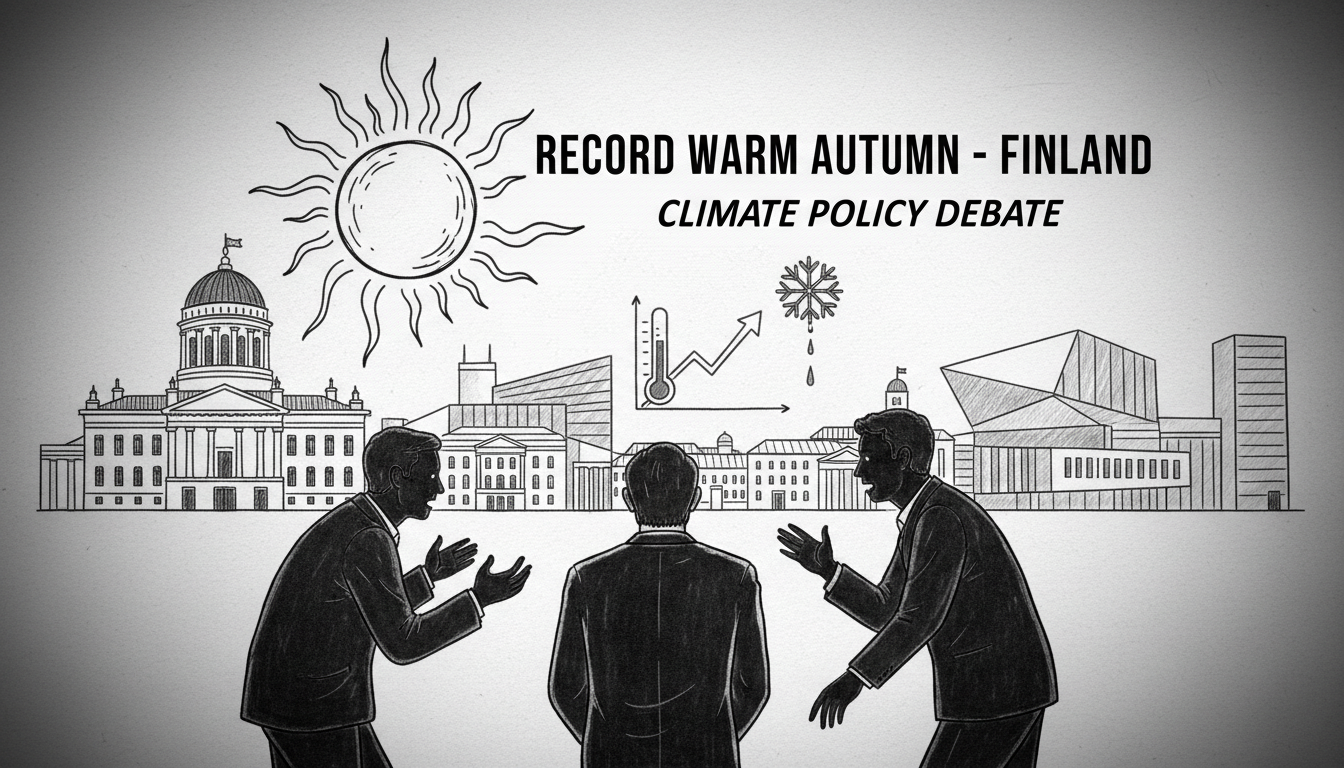
Finland experienced its second warmest autumn on record across most of the country, according to meteorological data. The Finnish Meteorological Institute reported that the period from September to November was exceptionally warm everywhere except Lapland. This data arrives as the Finnish government faces increasing pressure to align its climate policies with European Union directives and national emission targets.
Long-term observation stations with nearly a century of data, such as those in Jokioinen and Kuopio Maaninka, recorded historic highs. The average autumn temperature ranged from around zero degrees Celsius in northwestern Lapland to approximately ten degrees along the southern coast. The deviation from the 1991-2020 reference period average was about 1.5 degrees in Lapland and over two degrees elsewhere, a substantial increase that climate scientists link to broader warming trends.
The highest autumn temperature of 25.8 degrees Celsius was measured at the Kärkkä observation station in Salo on September 8. In stark contrast, the lowest temperature of -31.6 degrees was recorded at Enontekiö Airport on November 24, illustrating Finland's significant climatic range. Precipitation levels during the autumn months were mostly normal or slightly above average, with exceptionally heavy rainfall in a region stretching from Kainuu to Southern Lapland. Meanwhile, North and South Karelia along the eastern border saw less rain than usual.
November presented a complex picture. While Lapland was colder than average, with temperatures two to three degrees below the reference period, the rest of the country remained one to three degrees warmer. The warmest November day was the 5th, when temperatures rose to 12.8 degrees Celsius at the Hammarland Märket station in the Åland Sea. The national average temperature for November varied from about six degrees in the southwestern archipelago to around -11 degrees in northwestern Lapland.
Rainfall in November was generally below average in the south, but with a notable exception. A new national daily precipitation record for November was set at the Koivuniemi observation station in the Gulf of Finland, where 79.0 millimeters fell on November 16. The station's monthly total reached 161.6 millimeters, an exceptionally high figure for the late autumn period.
This meteorological report carries immediate political weight in Helsinki's government district. The Center-Right coalition, led by Prime Minister Petteri Orpo, must reconcile its economic agenda with Finland's legally binding carbon neutrality target. The Green League opposition is likely to cite the warm autumn as evidence that current policy measures are insufficient. An upcoming Eduskunta vote on the national energy and climate strategy will test parliamentary support for more aggressive adaptation funding.
The data also has direct implications for EU relations. Finland must report its progress under the European Climate Law and the Fit for 55 package. Exceptionally warm seasons increase pressure on the Ministry of the Environment to accelerate the green transition, potentially affecting sectors like energy, agriculture, and transportation. The government's ability to manage both winter preparedness in a warming climate and industrial decarbonization will be closely watched in Brussels.
Historical context shows this is not an isolated event but part of a documented trend toward warmer, wetter autumns in the Nordic region. This shift impacts everything from forestry and agriculture to infrastructure planning and public health. For international observers and expats in Finland, it underscores the tangible local effects of global climate change, influencing lifestyle, energy costs, and long-term investment in the region.
The government's response to this data will be a key indicator of its commitment to its climate pledges. Will it lead to revised adaptation plans or increased funding for renewable energy projects? The political debate in the Eduskunta this quarter will provide answers, as ministers from the Finns Party, the National Coalition, and the Swedish People's Party navigate between economic concerns and environmental imperatives in a rapidly changing physical landscape.