
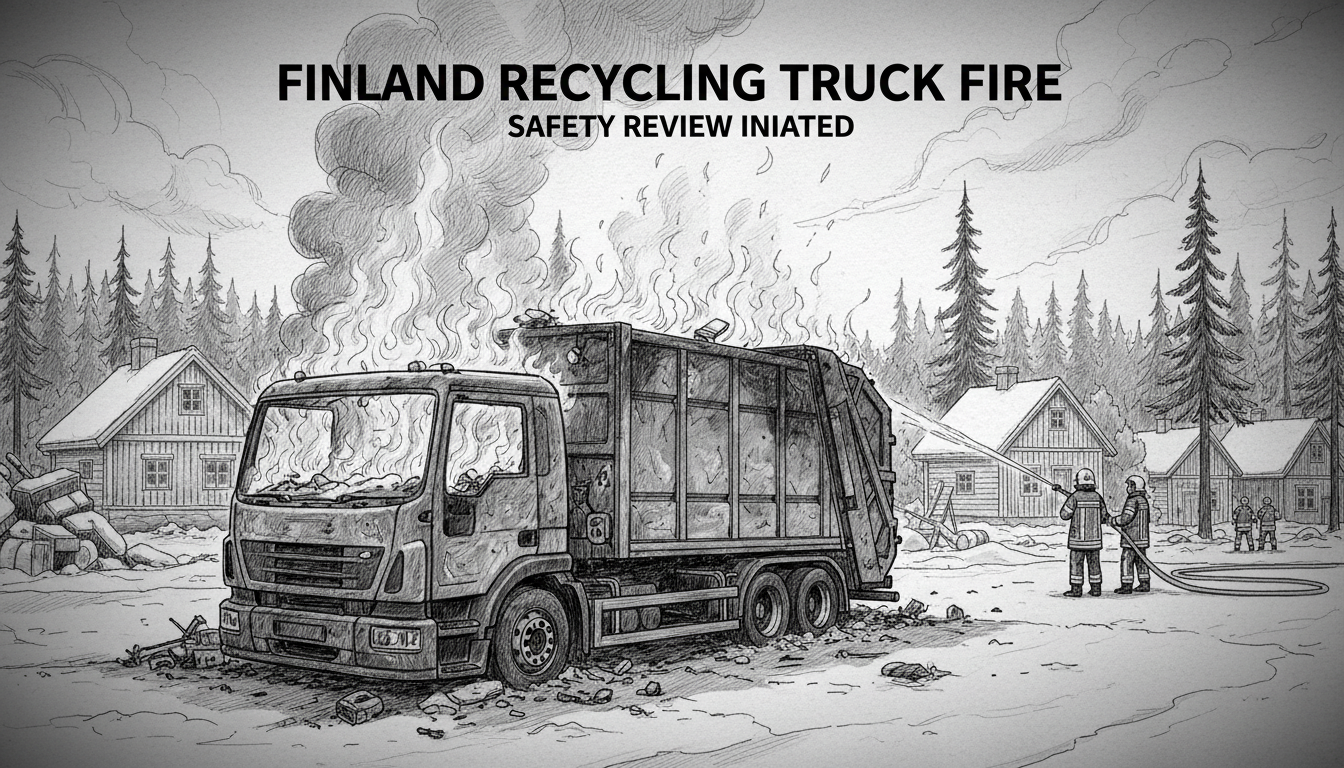
Finland’s paper recycling industry processes over 1.2 million tonnes annually, a system thrown into sharp relief when a collection truck's load began smoldering on a residential street in Jyväskylä. Emergency services rushed to Halmekatu around noon on Thursday after the truck, filled with collected paper, emitted thick smoke, prompting its driver to urgently dump the entire load onto the asphalt to prevent a full-blown fire. The incident halted local traffic and drew a multi-unit response from the Central Finland Rescue Department, highlighting a hidden risk within the nation's celebrated circular economy.
A Smoking Load on Halmekatu
Witnesses reported seeing smoke pouring from the compaction unit of the stationary truck. Following standard emergency protocols for suspected fires within loads, the driver activated the hydraulic system to tip the container, spilling tonnes of paper and cardboard onto Halmekatu. This swift action is designed to expose smoldering material to air in a controlled manner, allowing firefighters to extinguish it before flames can engulf the vehicle's fuel and hydraulic systems. Firefighters spent over an hour thoroughly dousing the pile with water and foam to ensure all hot spots were cold. No injuries were reported, but the clean-up operation blocked the street for most of the afternoon.
Jyväskylä municipal authorities confirmed the truck was operated by a local subcontractor for the city’s waste management company. An immediate investigation into the cause of the smoldering has been launched. Preliminary speculation centers on the possible inclusion of hazardous or flammable materials in the paper stream, a recurring challenge for collection crews. A city spokesman stated, “The driver followed safety procedures exactly. Our priority now is to determine what ignited within the load to prevent a repeat.”
The Hidden Danger of Spontaneous Combustion
This incident is not an isolated one in Finland or globally. Experts point to spontaneous combustion as a persistent, albeit managed, risk in waste and recycling collection. Professor Laura Saarivuori, a specialist in industrial safety at Tampere University, explains the science. “Compacted paper, especially if it contains certain chemicals, oils, or even damp organic material, can generate significant heat through bacterial decomposition or chemical reaction,” she said. “When tightly packed in an insulated container, that heat has nowhere to go. Temperatures can rise steadily until they reach the ignition point.”
Recycling industry guidelines strictly prohibit the disposal of hazardous items like batteries, aerosol cans, or chemical residues with paper. Despite public education campaigns, these contaminants routinely enter the waste stream. “A single lithium-ion battery crushed in the compactor can cause a catastrophic thermal runaway,” Professor Saarivuori added. “Every such incident is a stark reminder that public compliance with sorting rules is a critical component of operational safety.”
National System Under a Microscope
The Jyväskylä fire occurs as Finland pushes towards even more ambitious recycling targets aligned with the European Union’s circular economy action plan. Finland currently recycles approximately 85% of its paper and cardboard, a leading figure within the EU. The system relies on high public participation and efficient logistics. Incidents like this one test the resilience of that logistical chain. The Finnish Safety and Chemicals Agency (Tukes) monitors such events, collecting data to inform national safety guidelines for waste handling and transport.
Industry representatives emphasize that while dramatic, fires in collection vehicles remain statistically rare given the volume of material moved daily. The focus is on mitigation and response. Jukka Heikkilä, a director at the Finnish Waste Management Association, noted, “Driver training is paramount. They are the first line of defense. Knowing when and how to unload a smoking load is a drilled procedure. The goal is to protect life and prevent a vehicle fire that could spread to buildings or forests.”
Municipal Response and Policy Implications
In the aftermath, Jyväskylä’s environmental department is reviewing its contractor safety protocols and public communication strategy. The city may consider targeted informational campaigns in the Halmekatu area and across its districts, re-emphasizing what should and should not be placed in paper recycling bins. This local event feeds into a broader national conversation about product design and producer responsibility. Policymakers in Helsinki are examining how to reduce hazardous components in consumer goods to create a inherently safer waste stream.
Furthermore, the Finnish government is assessing new EU regulations on waste shipments and treatment standards. Any revisions to national policy stemming from these directives must factor in the practical safety of collection workers. The Eduskunta’s Environment Committee is slated to review related safety reports later this year, where data from incidents like the one in Jyväskylä will contribute to the evidence base.
A Clean-Up and a Look Ahead
Clean-up crews worked late into Thursday to remove the sodden, charred paper from Halmekatu. The contaminated material, now a mix of recyclable paper and fire-damaged waste, was transported to a dedicated treatment facility for assessment and proper disposal, likely through energy recovery. The cost of the response and clean-up will be tallied, potentially leading to insurance claims and contractual reviews between the city and its service provider.
The event serves as a gritty, real-world footnote to Finland’s green reputation. It underscores that a high-functioning recycling system requires constant vigilance at every stage, from the consumer’s bin to the processing plant. As Finland continues its ambitious environmental progress, the safety of the workers who physically handle that transition remains a paramount concern. The sight of a smoking paper pile on a quiet Jyväskylä street is a potent reminder that sustainable systems are built not just on policy, but on practical, daily safety.