
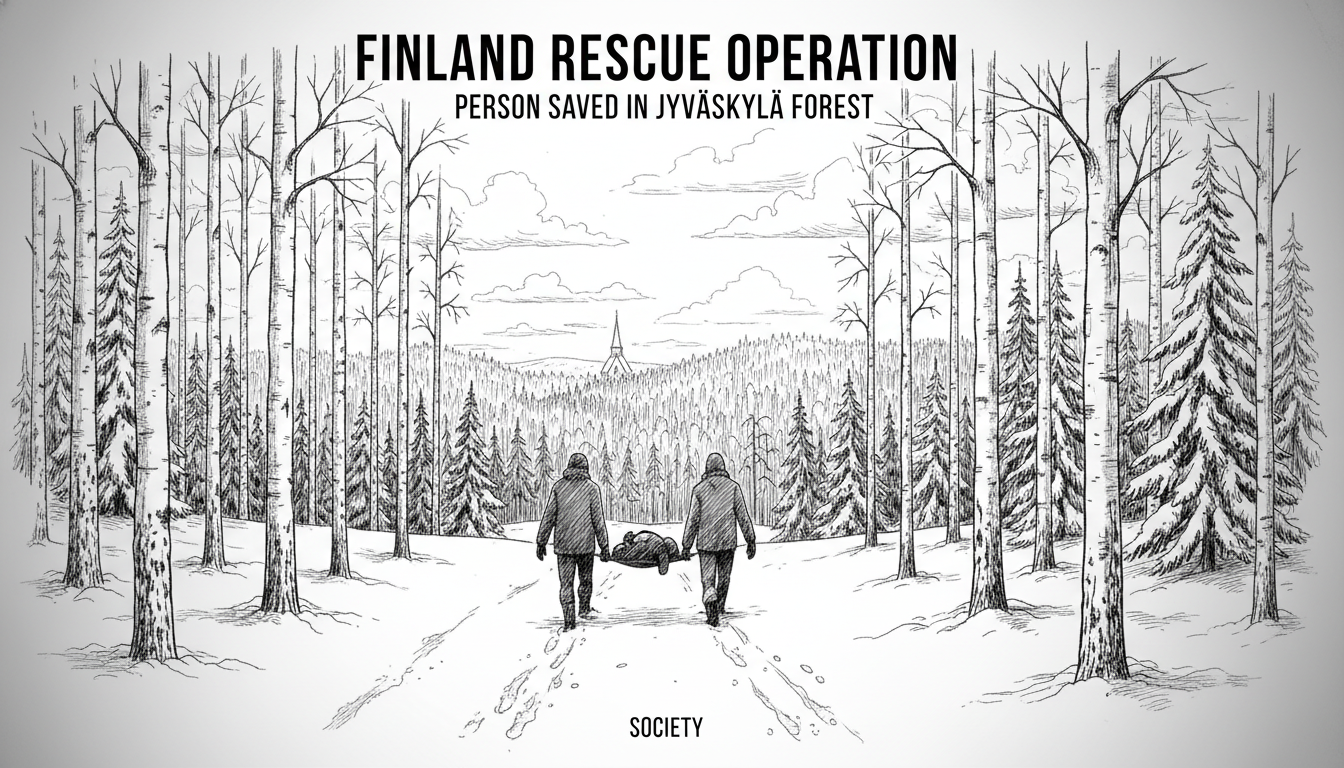
Finland's Central Finland Rescue Department launched a critical operation to save a person in the Kanavuori forest area of Jyväskylä on Wednesday afternoon. The emergency call came in at precisely 15:16, triggering a coordinated response between rescue services and local police. Two specialized rescue units were dispatched to assist police operations in the rugged, forested terrain known for its recreational trails and challenging landscape. Authorities have not released details about the individual's condition or the specific circumstances that led to the rescue call, citing an ongoing police investigation.
A Coordinated Response in Challenging Terrain
The operation highlights the standard Finnish protocol for wilderness rescues, where police and rescue departments work in close tandem. The Central Finland Rescue Department's role focused on technical rescue expertise, while police managed the overall scene and investigation. Kanavuori, a popular nature area within Jyväskylä's city limits, presents specific challenges with its forested hills and variable pathways. Such environments require responders trained in wilderness first aid and navigation, often using all-terrain vehicles or even helicopters in more severe cases. The swift logging of the call at 15:16 and immediate deployment suggests the situation was assessed as time-sensitive.
Rescue operations in Finnish forested areas follow well-rehearsed procedures developed from decades of experience. Finland's Everyman's Right, or jokamiehenoikeus, allows public access to natural areas like Kanavuori, which increases the likelihood of incidents requiring emergency response. The country's rescue services are municipally organized but can draw on regional and national resources for complex missions. The involvement of two dedicated units indicates a significant allocation of personnel and equipment to locate and extract the individual safely.
The Anatomy of a Finnish Wilderness Rescue
Finland's rescue services are among Europe's most efficient, with an average emergency response target of under 10 minutes in urban areas. In forested regions like Kanavuori, response times can lengthen due to terrain, but protocols are designed for rapid mobilization. The Central Finland Rescue Department, serving the Jyväskylä region, maintains specialized teams for water, height, and wilderness rescues. Their collaboration with police is standard; police secure the area and handle potential criminal aspects, while rescue personnel perform the physical extraction and medical stabilization. This dual-response model ensures both public safety and victim care are addressed simultaneously.
Experts note that autumn in Finland brings specific risks to outdoor enthusiasts. Diminishing daylight, colder temperatures, and wetter conditions can turn a routine hike into a dangerous situation. Kanavuori, while accessible, has areas where mobile phone coverage can be patchy, complicating emergency communications. The timing of the call, in the mid-afternoon, would have given rescuers several hours of daylight to complete their operation—a crucial factor for safety. Successful outcomes in these scenarios often depend on precise location data from the caller and the technical skill of the rescue teams navigating off-trail.
Policy and Preparedness in Finnish Rescue Services
This incident occurs against a backdrop of ongoing national discussions about resourcing Finland's rescue services. While highly effective, these services face pressures from an aging population and the need to cover vast, sparsely populated areas. The Finnish Ministry of the Interior periodically reviews rescue service legislation, with recent focuses on improving interoperability between different emergency response organizations. The seamless cooperation seen in Jyväskylä between the Rescue Department and police is a direct result of such policy frameworks and joint training exercises.
Finland's approach integrates municipal rescue services with voluntary organizations like the Finnish Red Cross and the Finnish Lifeboat Institution. This network provides a deep bench of resources for large-scale or complex incidents. For a single-person rescue in Kanavuori, the local municipal services are the first line of response. Their training includes not only technical rescue skills but also crisis management and communication with distressed individuals. The decision to deploy two units suggests a prepared response for scenarios that may require a stretcher carry-out or other labor-intensive extraction methods over difficult ground.
A Community Built for Safety
Jyväskylä, a university city in the heart of the Finnish Lakeland, is a community deeply connected to its natural surroundings. Incidents like the Kanavuori rescue are rare but underscore the importance of public safety infrastructure intertwined with nature accessibility. The city's layout, where urban areas quickly give way to forests and lakes, is typical of Finnish municipalities, demanding that emergency services be proficient in both urban and wilderness environments. The public's general awareness of outdoor safety is high, supported by national campaigns on preparing for hikes and checking weather conditions.
The lack of immediate public details from police is also standard procedure, balancing the public's right to information with the privacy of the individual involved and the integrity of any investigation. Updates, if released, will likely come from the Central Finland Police Department, which holds jurisdiction. The rescue itself, while a critical event for the individual and responders, represents the routine, professional execution of duty by Finnish emergency services. It is a system built on predictability, training, and inter-agency trust, designed to function efficiently when a citizen's call for help breaks the quiet of the forest.
What does it take to maintain a safety net so robust that a person in distress in a dense forest can be reached within minutes? Finland's answer lies in relentless preparation, community awareness, and a societal commitment to preserving the freedom to roam—and the promise of rescue if that freedom leads to peril. As daylight fades earlier over Kanavuori, this successful operation serves as a quiet testament to a system that works, often out of sight, until the moment it is desperately needed.