
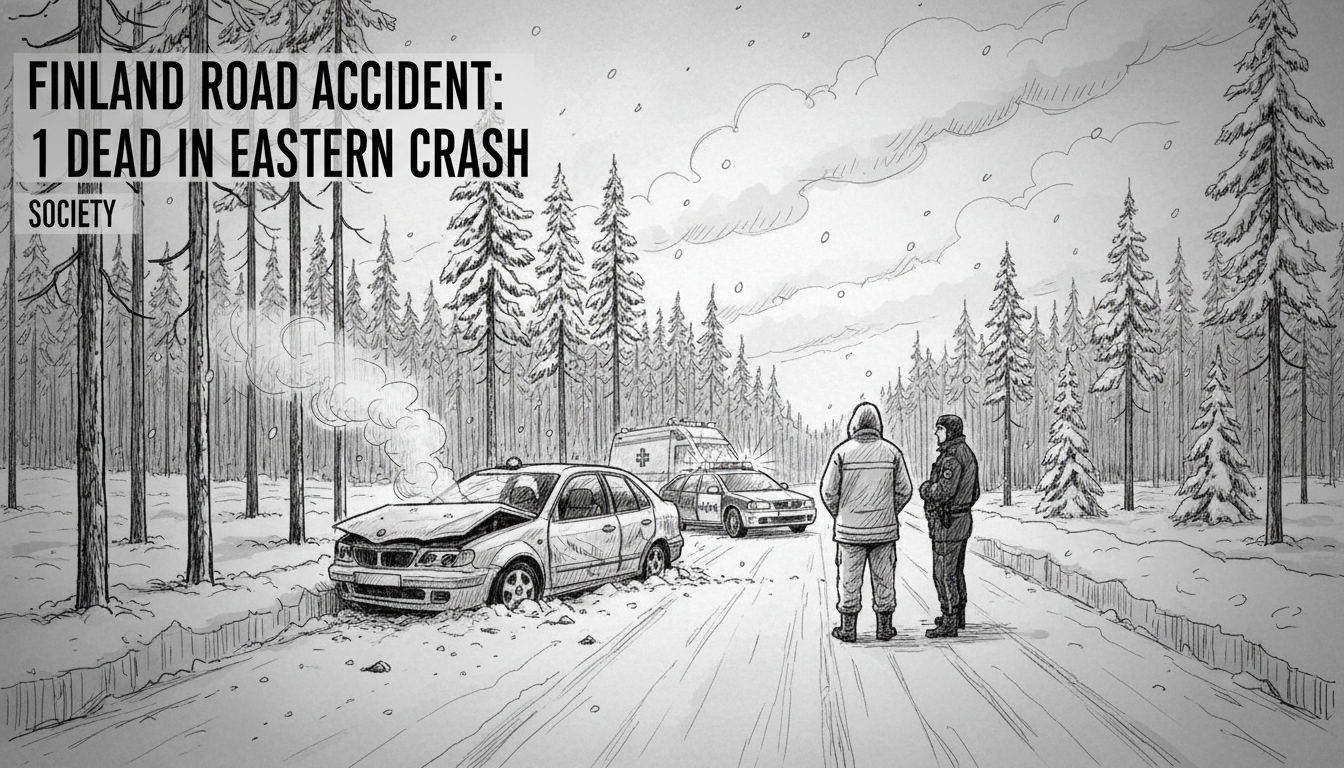
Finland road accident investigators are working to determine the cause of a fatal crash in Eastern Finland that left one young man dead. The single-vehicle accident occurred on Friday evening, with emergency services receiving the call at 21:50. According to a statement from the Itä-Suomen poliisilaitos (Eastern Finland Police Department), a car carrying four young people veered off the road and rolled into a ditch. The driver, a young man with a valid license, survived. A breathalyzer test administered at the scene showed a result of 0.0, ruling out alcohol as an immediate factor. The three passengers were transported to hospital with non-life-threatening injuries. The death marks another tragic entry into Finland's road safety statistics, coming amid a national strategy to eliminate traffic fatalities entirely.
A Friday Night Tragedy Unfolds
The precise location of the crash has not been disclosed, but the involvement of the Eastern Finland Police places it within a vast, often rural region where long, dark roads are common. The timing—a Friday night just before 10 PM—suggests the young occupants were likely returning from social activities. Police confirmed the driver was sober, immediately shifting the investigative focus toward other critical factors. These include excessive speed for the conditions, driver inexperience or distraction, potential vehicle failure, or the road environment itself. The involvement of the official road accident investigation board, the Tieliikenneonnettomuuksien tutkijalautakunta, underscores the seriousness with which authorities treat every fatal crash. This specialist team reconstructs accidents to provide technical analysis for both police and safety agencies.
The National Context of Road Safety
This incident occurs against the backdrop of Finland's ambitious Vision Zero policy, which aims to eliminate road deaths and serious injuries. The Finnish Transport Infrastructure Agency (Väylävirasto) leads infrastructure improvements, while Trafi, the Finnish Transport and Communications Agency, focuses on vehicle safety and driver education. The strategy is multifaceted, combining stricter enforcement, continuous road engineering upgrades, and public awareness campaigns. Despite these efforts, human tragedy persists. Preliminary data indicates 224 road deaths in Finland in 2023, a decrease from 241 the previous year. While the trend is cautiously downward, each number represents a profound personal and community loss. Young adults and young male drivers, in particular, remain a high-risk demographic in traffic safety profiles both in Finland and across the EU.
Expert Analysis on Probable Causes
Road safety experts contacted for perspective noted that when alcohol is eliminated as a factor, a cluster of other common causes comes to the fore. "A sober driver on a Friday night in a single-vehicle crash points investigators toward speed, fatigue, or distraction," said one Helsinki-based traffic safety researcher who requested anonymity as the investigation is active. "In Eastern Finland, you also must consider the road environment—animal collisions, sudden weather changes, or roadside obstacles. The vehicle's condition will be scrutinized meticulously." The expert emphasized that comprehensive investigations are not about assigning blame but about building a preventive knowledge base. Every detailed report on crash mechanics, seatbelt use, and road surface conditions feeds into safer road design, better driver training, and more targeted public safety messages.
The Grim Statistics and a Community's Loss
The loss of a young life has a ripple effect far beyond the official statistics. For the small communities typical of Eastern Finland, such a death is a deeply felt communal trauma. The police have not released the identities of those involved, respecting the family's privacy during their initial grief. The three survivors, while physically recovering from non-serious injuries, now face the psychological aftermath of the crash and the loss of their friend. This human impact is the stark reality behind Finland's road death figures. The decline from 241 to 224 deaths year-on-year is a positive sign for policymakers, but for the families and friends of the young man who died last Friday, it is a cold comfort. Their loss is absolute and irrevocable.
Investigation Aims to Prevent Future Deaths
The ongoing police and technical investigation will follow a meticulous protocol. Investigators will map skid marks, assess vehicle damage patterns, download any available data from the car's onboard systems, and thoroughly inspect the crash site. They will interview the survivors to understand the moments leading up to the vehicle leaving the road. The goal is to construct a definitive sequence of events. This forensic work is crucial. Its findings contribute to national databases that identify high-risk road sections, inform seasonal safety campaigns—like those targeting young drivers at the start of summer or during the dark autumn months—and can even influence future vehicle safety regulations at the EU level, where Finland actively participates in shaping continental standards.
A Look at Finland's Safety Infrastructure
Finland's approach to road safety is internationally respected, integrating engineering, enforcement, and education. The country employs widespread automatic speed camera networks and has some of Europe's strictest penalties for serious traffic offenses. Road engineering focuses on forgiving design: clear signage, improved lighting on high-risk routes, and barrier systems that prevent crossover collisions. For young drivers, the graduated licensing system is designed to build experience under lower-risk conditions. Yet, as this crash demonstrates, no system can entirely eliminate risk when human beings operate complex machinery at speed. The work of the investigation board is therefore a cornerstone of the safety cycle, turning tragedy into actionable data to protect others.
The Path Forward from Tragedy
As the community mourns and investigators work, the broader question for Finnish transport authorities remains: how to accelerate progress toward Vision Zero. Each fatal crash is analyzed not as an isolated event but as a systemic failure somewhere in the chain of driver, vehicle, and road. The data from Eastern Finland will be aggregated with other incidents to see if new patterns emerge. Perhaps it will highlight a specific type of rural intersection that needs redesign, or it may reinforce the need for renewed campaigns about seatbelt use in rear seats or the dangers of nighttime fatigue. The young man's death is a somber reminder that safety is a continuous effort, demanding vigilance from drivers, innovation from engineers, and unwavering commitment from policymakers. The ultimate memorial for any traffic victim is a road network where such a crash never happens again.