
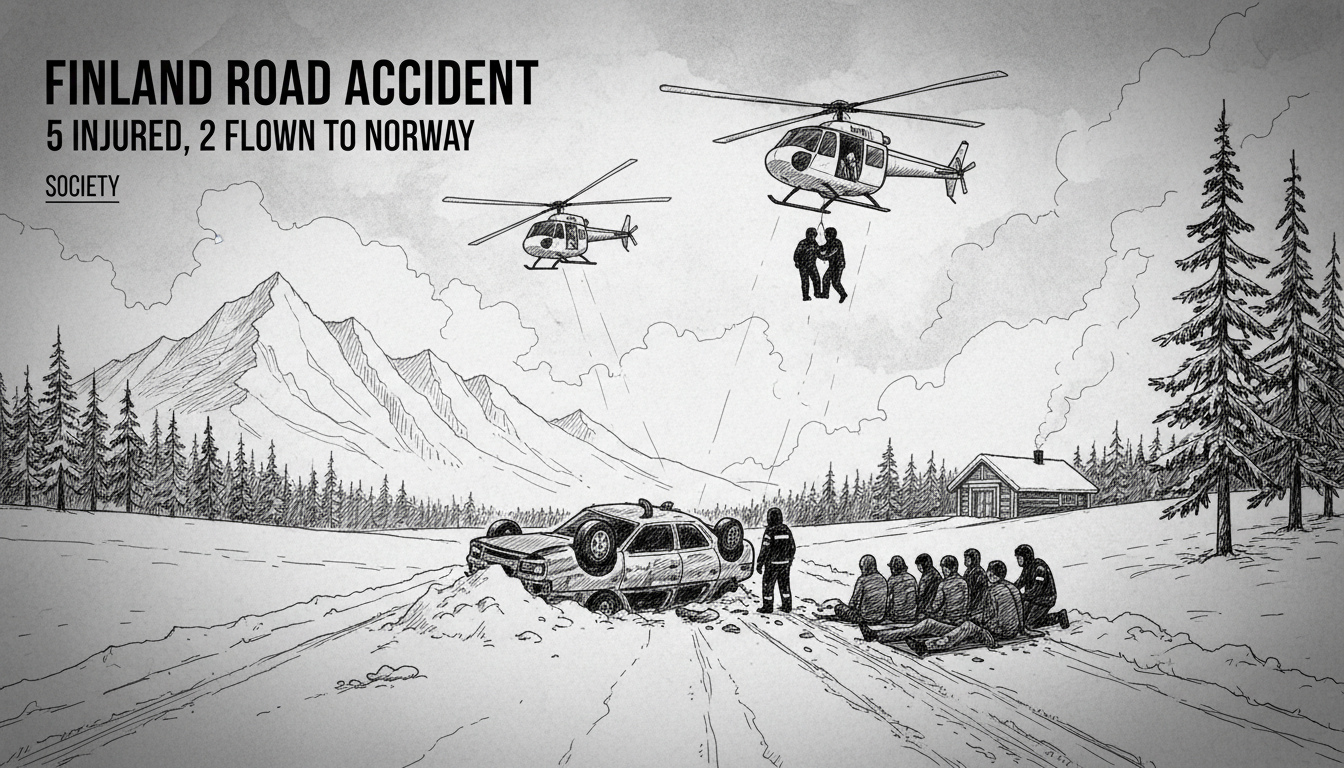
Finland's Highway 4 in Lapland became the scene of a severe collision early Saturday morning, sending two of the five injured victims by helicopter across the border to Norway for urgent medical care. The crash occurred before 5 AM at the remote intersection of Inarijärventie and Rahajärventie in the municipality of Inari, with snow falling at the time. Emergency services, including four first aid units and a police patrol, worked for hours to extract one victim who was trapped, requiring cutting equipment to free them from the wreckage. The response highlights the critical cross-border cooperation in the Nordic region and the persistent dangers of Finland's northern roads during winter conditions.
A Remote Crash and a Cross-Border Rescue
The two-vehicle collision on Nelostie, Finland's vital artery running from Helsinki to the far north, triggered a complex emergency response in one of Europe's most sparsely populated regions. With five people injured, first responders faced a critical triage decision. Two victims with the most serious injuries were airlifted by helicopter not to a Finnish hospital, but to medical facilities in Norway. This decision, while dramatic to outsiders, is a standard and vital protocol in the Arctic region. "In remote areas of Lapland, the closest specialized trauma center is often in Tromsø, Norway," explained a veteran Finnish rescue service coordinator familiar with Arctic operations. "The helicopter's range and speed, combined with the level of care available across the border, make this the fastest path to lifesaving treatment." The three other individuals involved were transported by road to Ivalo Health Centre. Highway 4 was closed for approximately two hours as rescue crews worked at the scene.
The Persistent Challenge of Finland's Winter Roads
This accident underscores a grim, familiar reality in Finland: despite world-leading road safety records, winter remains a deadly adversary. The country has cut annual road deaths dramatically since the 1970s, when fatalities regularly exceeded 1,000. Last year, 224 people died on Finnish roads, according to Statistics Finland. This long-term improvement is credited to systemic investments: better road engineering, strict drink-driving laws, relentless safety campaigning, and near-universal use of studded winter tires. Yet, the variables of the far north—extreme darkness, rapidly changing weather, icy surfaces, and vast distances between services—create a persistent risk profile. "The statistics show we are among the safest in Europe, but every accident in these conditions is a reminder that the environment here does not forgive inattention," said Dr. Eero Salmela, a traffic safety researcher at the University of Lapland. "A moment of fatigue, a patch of black ice, or reduced visibility can have catastrophic consequences when you are hundreds of kilometers from a major hospital."
The Lifeline of Nordic Cross-Border Cooperation
The helicopter flight to Norway is not an anomaly but a testament to deeply integrated Nordic emergency protocols. In Lapland, national borders are practical lines on a map, not barriers to emergency care. Finland, Norway, and Sweden have long-standing agreements for cross-border medical assistance, particularly for trauma cases in the Arctic. The Norwegian Air Ambulance service, with bases in places like Kirkenes and Tromsø, frequently responds to incidents on the Finnish side. This cooperation extends beyond health care to joint rescue exercises, shared communication systems, and coordinated police work. For residents of Finnish Lapland, knowing that advanced help can arrive from any direction is a crucial part of security. This system was activated seamlessly in the early hours of Saturday, prioritizing human life over bureaucratic procedure.
Analyzing the Factors Behind Northern Accidents
While the specific cause of the Inari collision is under police investigation, experts point to a confluence of typical risk factors present at that time and place. The accident happened before dawn, a high-risk period for driver fatigue. It occurred at a rural intersection on a major highway, where speed and crossing paths can be deadly. Critically, it was snowing. "Snowfall doesn't just make roads slippery; it creates a visual phenomenon called 'whiteout,' where depth perception and contrast disappear," Dr. Salmela noted. "A driver may not accurately judge the speed of an oncoming vehicle or the distance to an intersection." Combined with the monotony of a long, straight road like Highway 4, these conditions can lull drivers into a false sense of security. Authorities consistently emphasize the "three pillars" of Finnish winter driving: proper studded tires, speed appropriate to conditions (often well below the posted limit), and a greatly increased safety distance between vehicles.
The Human and Systemic Response in Sparsely Populated Areas
The response to the crash involved a significant mobilization of resources for the region. Four first aid units and a police patrol converging on a single location represents a major draw on Lapland's emergency services, which cover enormous territories with limited personnel. The need to cut a victim from the wreckage also indicates the severity of the impact. These realities shape public policy and funding debates in Finland. There is constant tension between maintaining a robust emergency response capability across the vast north and the high per-capita cost of doing so. Investments in helicopter services, roadside emergency telephones, and all-weather alert systems are justified by incidents like this one. The alternative—longer response times—directly translates to higher mortality rates. Every such accident renews discussions about road maintenance budgets, the placement of response units, and public awareness campaigns targeting both local residents and tourists unfamiliar with Arctic driving.
A Look at the Road Ahead for Finnish Safety
The tragic event on Highway 4 is a stark data point in Finland's ongoing journey toward Vision Zero—the goal of eliminating all traffic fatalities and serious injuries. The country's approach is multi-faceted: engineering safer roads, enforcing traffic laws, and educating drivers. In Lapland, this might mean more lighting at key intersections, improved road surface treatments, or enhanced signage warning of crosswinds and animal crossings. Yet, as this crash shows, the human element and the power of nature remain wild cards. The cross-border helicopter evacuation also points to the future. As climate change alters Arctic weather patterns, potentially leading to more volatile conditions with ice, rain, and snow mixtures, the need for such seamless international cooperation will only grow. The ultimate question for Finnish authorities is whether further technological advances, like better vehicle stability systems or smarter road sensors, can finally offset the inherent dangers of the northern winter, or if a certain level of risk is an inescapable part of life above the Arctic Circle. For the five people involved in Saturday's crash, that risk became a painful reality, mitigated only by a rescue system that stretched across an international border.