
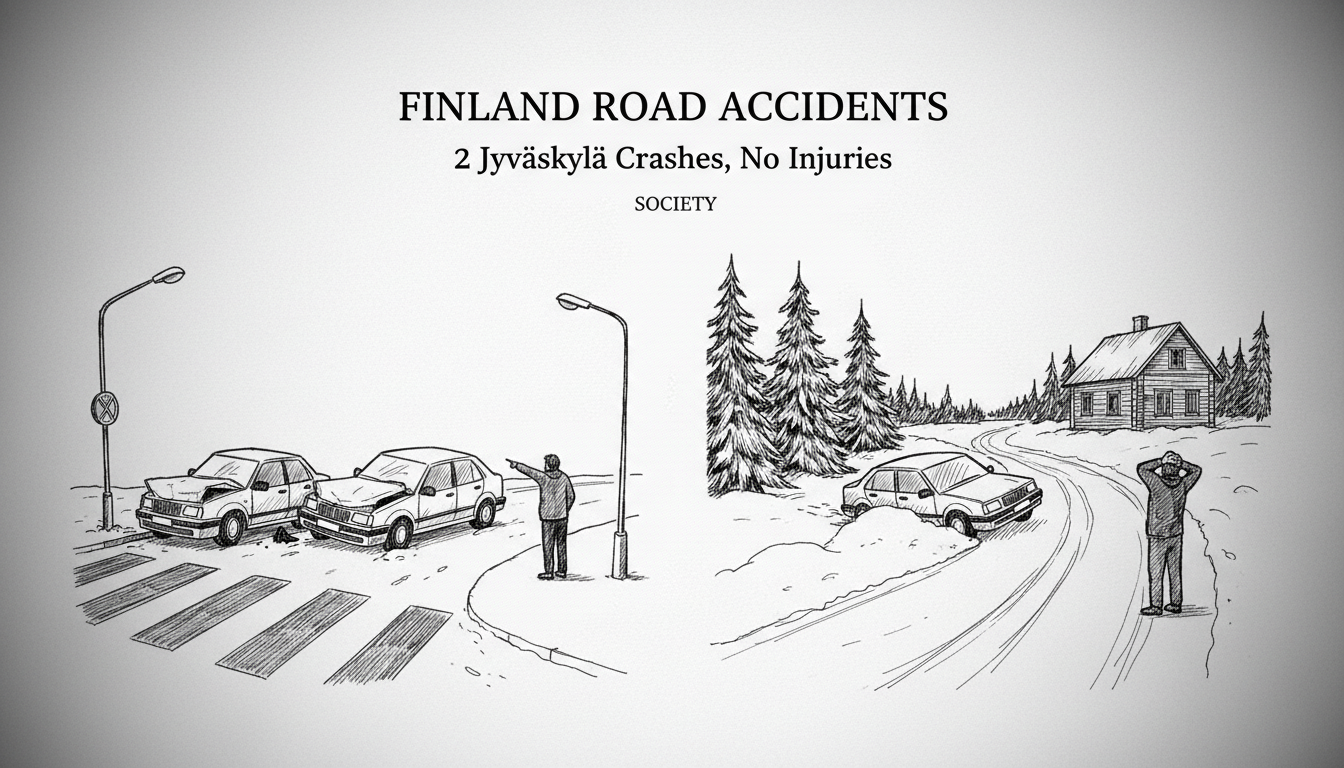
Finland road safety faced a routine test in Jyväskylä on Monday as two separate car accidents occurred within 30 minutes, yet both concluded without personal injuries. The first incident, recorded at 12:41 on Leppävedentie, saw a vehicle run off the road with two occupants who emerged unharmed. A second collision was logged at 13:08 on Highway 4 between Vaajakoski and Akkala, where a car hit a guardrail at low speed, sustaining only minor bodywork damage. By 13:30, emergency units from the Central Finland Rescue Department had cleared the scenes, highlighting a day where Finland's stringent safety systems prevented tragedy despite recurring hazards.
A Close Call on Leppävedentie
The initial alert reached emergency services just after midday. A car had departed the roadway on Leppävedentie, a key route in the Jyväskylä area. First responders arriving at the scene found a vehicle off the pavement but with no fluid leaks or immediate danger to other traffic. Crucially, both individuals inside the car were assessed and found to have no injuries. This outcome, while fortunate, points directly to the effectiveness of modern vehicle safety features like crumple zones and airbags, which are designed to protect occupants in such off-road events. The swift resolution meant traffic flow was largely unaffected, a minor disruption on an otherwise normal Monday.
Highway 4 Guardrail Impact
Before the first scene was fully cleared, a second report came in from the nation's main north-south artery, Highway 4, also designated as European route E75. Here, between the Vaajakoski and Akkala interchanges, another driver lost control, resulting in a collision with a roadside guardrail. Authorities confirmed the impact occurred at low speed. The result was predictable: minor dents and scratches to the car's body, but no harm to the driver. This type of accident is among the most common on Finnish roads, especially during transitional seasons when sudden ice patches or wet leaves can compromise traction. The guardrail performed its intended function, preventing a potentially more serious run-off or rollover.
The Broader Context of Finnish Road Safety
These two non-injury incidents in Jyväskylä are microcosms of a larger, positive national trend. Preliminary data from Statistics Finland shows a 6.8% decrease in road accidents causing personal injury in the first half of 2024 compared to the same period in 2023. This continues a decades-long improvement in road safety, though challenges remain. In 2023, 333 people lost their lives on Finnish roads. Each death is a stark reminder that the work is never complete. Experts consistently point to a multi-layered Finnish strategy for this success: rigorous year-round enforcement of traffic laws, a cultural and legal mandate for proper winter tires, and continuous investment in road maintenance and clear signage. The Jyväskylä cases, where damage was contained, reflect this infrastructure and cultural preparedness in action.
Expert Analysis: Why Finland Avoids Worse Outcomes
Road safety researchers highlight several reasons why incidents like those in Jyväskylä often end without serious consequences in Finland. "The Finnish approach is systemic," explains one traffic safety analyst familiar with Nordic policies. "It's not just about punishing speeders. It's about vehicle inspections ensuring cars are safe, road engineering that minimizes conflict points, and a driver education system that emphasizes hazard perception, especially for winter conditions." The mandatory use of winter tires from November to March, a deeply ingrained practice, provides critical grip during unexpected slippery conditions that can catch drivers off guard, even on seemingly clear days. Furthermore, the widespread adoption of Advanced Driver-Assistance Systems (ADAS), like automatic emergency braking and stability control, in newer vehicles acts as a digital safety net, potentially preventing collisions or reducing their severity.
The Human Factor in Routine Emergencies
While the statistics and systemic policies are crucial, the human element remains paramount. For the drivers involved in these Jyväskylä incidents, the day transformed from ordinary to alarming in a split second. The psychological impact of a crash, even a minor one, can be significant. The rapid response of the Central Finland Rescue Department also underscores the human infrastructure behind the numbers. Their efficient deployment and assessment ensured no hidden injuries were overlooked and that the vehicles were safely removed, restoring normalcy swiftly. These services operate on the principle that every callout is treated with maximum seriousness, regardless of the eventual outcome, ensuring public trust and consistent readiness for more severe emergencies.
Looking Ahead: Persistent Challenges
Despite the positive trends, Finnish authorities are not complacent. Key challenges persist, including distracted driving due to mobile phone use, ensuring older vehicle fleets are equipped with modern safety features, and adapting to new forms of mobility like e-scooters. Speeding and driving under the influence continue to be leading causes of severe accidents. The coming winter will be the next major test. While the snow and ice are managed through technology and habit, the reduced daylight hours and extreme weather events pose a constant risk. The goal, as stated in Finland's road safety strategy, is Vision Zero—the ambitious target of eliminating all traffic fatalities and serious injuries. Every accident-free outcome, like those in Jyväskylä, is a step toward that goal, but also a reminder of how much daily vigilance it requires from every road user.
Ultimately, the two Jyväskylä accidents serve as a potent, real-world drill. They tested the chain of response from driver awareness to emergency services deployment, and the system worked as intended. No one was hurt, and damage was minimal. Yet, they also quietly ask a question of every motorist: in a country that has built one of the world's safest road environments, is your own driving behavior fully aligned with that collective achievement? The next near-miss might not be so forgiving.