
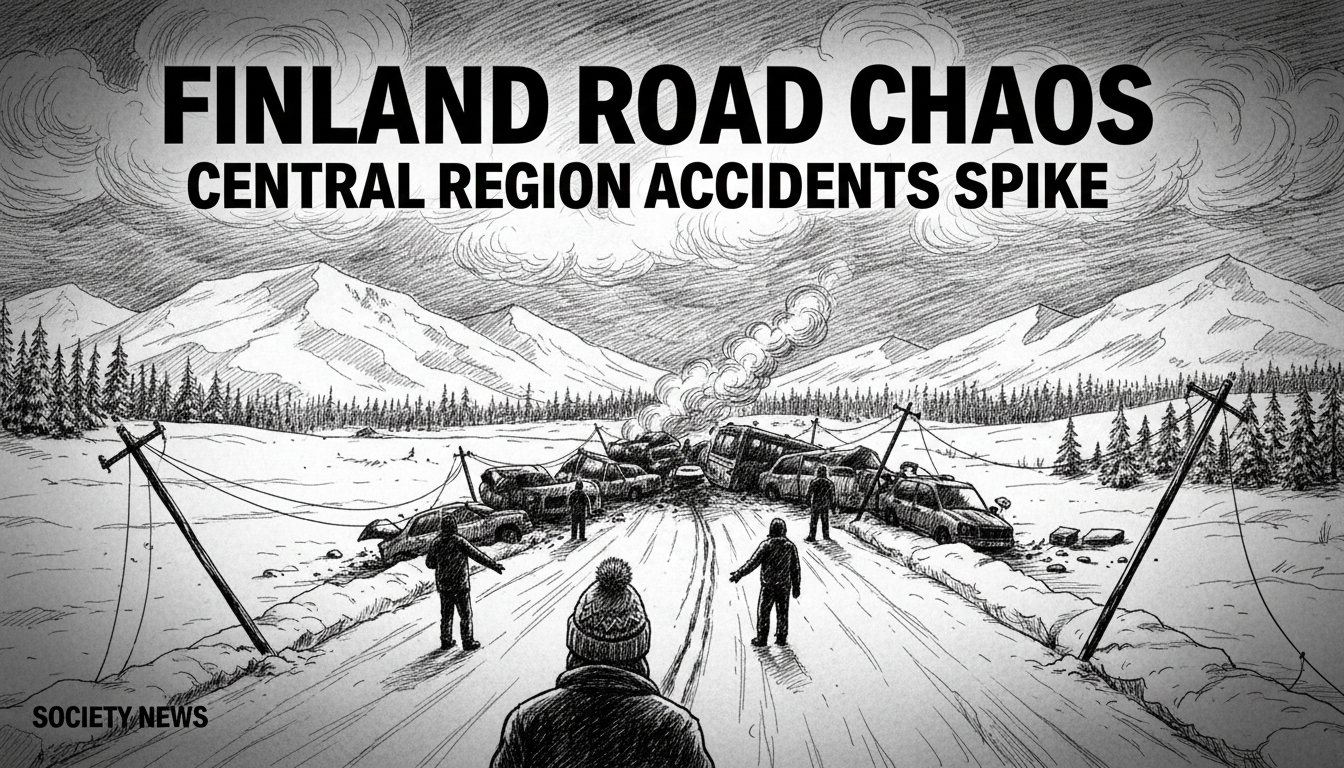
Finland road conditions turned treacherous across Central Finland on Wednesday evening, triggering a series of accidents as winter's grip tightened. A passenger car in Saarijärvi veered into the oncoming lane and landed in a ditch, one of multiple incidents reported by local emergency services. While the two occupants of that vehicle escaped injury, the cluster of crashes served as a stark reminder of the seasonal dangers that materialize with little warning. 'Remember to keep your composure in traffic,' urged on-duty fire chief Tinja Hännikäinen, encapsulating the official advice as visibility dropped and surfaces iced over.
This early winter episode highlights a perennial challenge in a nation where long, dark winters are a fact of life. The Finnish Meteorological Institute had issued warnings about deteriorating conditions, yet the suddenness of the change still caught some drivers off guard. Road maintenance crews were deployed across Keski-Suomi, but the sheer scale of the region and the speed of the weather shift made comprehensive treatment impossible. For residents, the evening's events were a familiar, if unwelcome, annual ritual marking the transition from autumn to full winter driving.
The Human Factor in Hazardous Conditions
Expert analysis consistently points to driver behavior as the critical variable in winter road safety. 'The right equipment is just the starting point,' explains Matti Järvinen, a veteran driving instructor based in Jyväskylä. 'Winter tires are mandatory, but they are not magic. The most important safety feature is the driver's adjustment to the conditions—reducing speed, increasing following distance, and avoiding sudden maneuvers.' In the Saarijärvi incident, preliminary reports suggest the driver lost control on a slick patch, a common occurrence when speeds are inappropriate for the grip available.
This human element is where public campaigns, like those run by the Finnish Road Safety Council (Liikenneturva), focus their efforts. Their message is simple: 'Aja sään mukaan'—Drive according to the weather. Yet, as Järvinen notes, complacency can set in, especially among experienced drivers who navigate these conditions for months each year. 'It's easy to become overconfident. One moment of inattention, one corner taken too briskly, and you are in the ditch or, worse, in the path of another vehicle.' The absence of serious injuries in Wednesday's incidents represents luck as much as anything, a point not lost on emergency responders.
Infrastructure and Policy: A Continuous Battle
Beyond individual caution, Finland's approach to winter road safety is a systemic one, involving significant investment in infrastructure and forecasting. The Finnish Transport Infrastructure Agency (Väylävirasto) manages a vast network of weather stations and road cameras to monitor conditions in real-time. Their data feeds into public services like the Traffic Weather service (Liikenneilmatieto), which offers detailed forecasts for road sections across the country. The goal is to provide drivers with the information needed to make safe decisions, perhaps to delay a trip or choose an alternative route.
However, the effectiveness of this system is tested during rapid-onset events like the one in Central Finland. Salting and plowing operations are highly efficient on main highways but cannot instantly cover every rural road. In regions like Keski-Suomi, with its mix of forests, lakes, and smaller municipalities, some roads may remain hazardous for hours after conditions worsen. This creates a patchwork of risk that demands heightened local awareness. Municipal fire and rescue services, like the one Fire Chief Hännikäinen represents, are often the first to see the consequences when that awareness falters.
The Statistical Reality of Winter Roads
While Wednesday's cluster of accidents was notable, it fits a predictable annual pattern. In 2023, Finland recorded 345 fatal road accidents, with a disproportionate number occurring during the winter months from November through March. The reasons are a confluence of factors: fewer daylight hours, precipitation that turns to ice, and temperatures that fluctuate around the freezing point, creating particularly slippery 'black ice.' These statistics are not just numbers for transport officials; they represent a public health challenge that is met with continuous policy evaluation.
The government's road safety strategy, updated regularly, sets concrete targets for reducing fatalities and serious injuries. This strategy encompasses everything from vehicle technical inspections and mandatory winter tire periods—from November to March, with tread depth requirements—to road design improvements that mitigate the impact of run-off-road accidents. The ditch in Saarijärvi, a standard feature of Finnish roadside engineering, is designed to safely cradle a vehicle that leaves the pavement, a design philosophy that likely prevented injury in this week's case.
A Cultural Adaptation to Inevitable Winter
Ultimately, navigating Finnish winters is a cultural skill as much as a technical one. From a young age, Finns are educated on the realities of their climate. Driving schools dedicate substantial curriculum time to winter driving techniques, and many new drivers opt for supplementary courses on slippery surfaces at dedicated test tracks. The societal expectation is one of preparedness and personal responsibility. Car ownership necessitates a second set of wheels—studded or friction winter tires—and a reliable battery heater, often plugged into an electrical outlet visible on the front of vehicles in parking lots.
This cultural adaptation is reflected in the public's generally high trust in official weather and road condition warnings. When the Meteorological Institute issues a bad weather alert, it is front-page news and leads television broadcasts. The incident in Central Finland, while localized, will be discussed in community forums and local media as a cautionary tale for the season ahead. It reinforces the collective memory of winter's hazards and the shared understanding that safety is a communal effort, requiring patience from every driver sharing the road.
Looking Ahead: Technology and Tradition
The future of road safety in Finland lies in a blend of advancing technology and the enduring wisdom of caution. Advanced driver-assistance systems (ADAS) like electronic stability control and autonomous emergency braking are becoming standard, offering a digital safety net. Researchers are also exploring 'smart road' technologies that could communicate directly with vehicles about icy patches. Yet, experts caution that technology should support, not replace, attentive driving. 'The car can help, but it cannot think ahead for you,' says instructor Matti Järvinen. 'It cannot see the shadowed curve where the sun hasn't melted the overnight frost.'
As the days shorten and temperatures fall, the message from Central Finland's emergency services is timeless. Fire Chief Hännikäinen's call for 'maltin'—composure, or cool-headedness—is the essential ingredient. It is the mental adjustment that precedes the physical actions of slowing down and steering gently. This week's accidents, thankfully without serious outcomes, serve as the season's first major drill, a wake-up call for the long winter ahead. The question for every driver now is whether that lesson will be remembered on the next dark, slick journey home.