
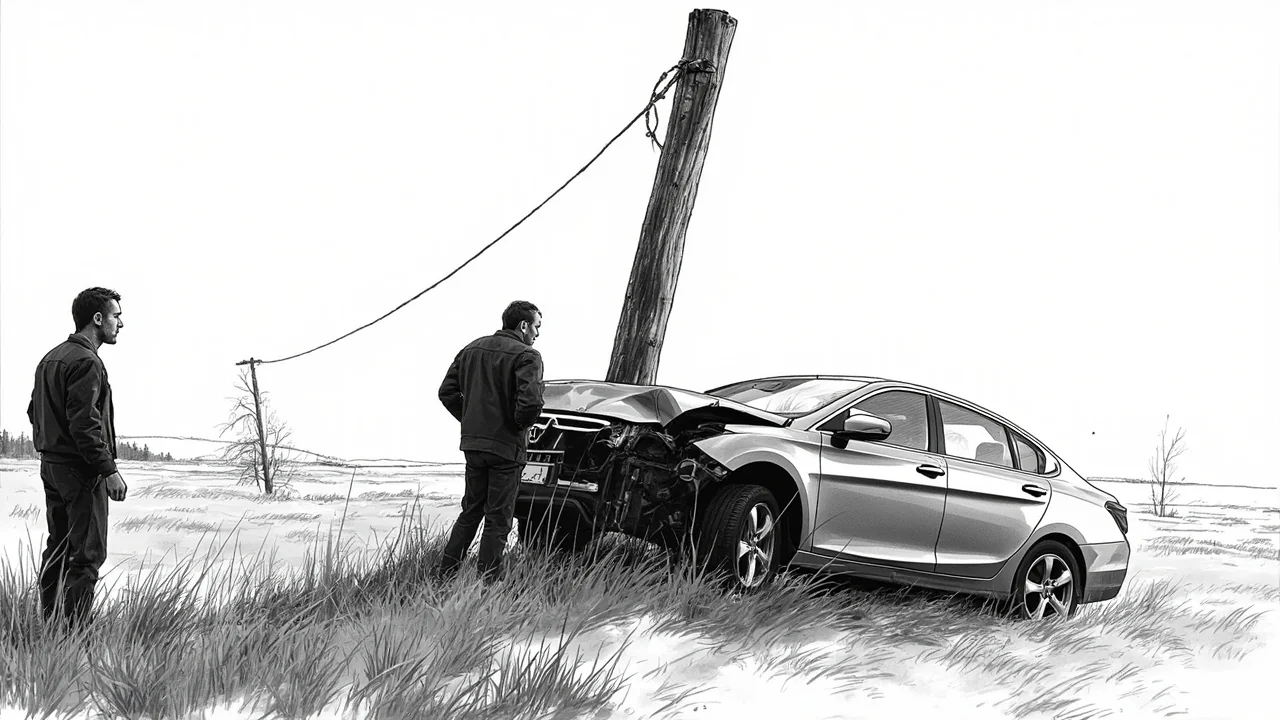
Finland's slippery winter roads were highlighted again by a single-vehicle incident in Karstula on Friday afternoon. A car slid off Humpintie road and collided with a lighting pole, causing the pole to fall. According to the Central Finland Rescue Department, slippery conditions were the likely cause. No personal injuries were reported, and the scene was cleared without significant traffic disruption.
This brief police report, a routine entry in Finland's winter traffic log, underscores a persistent national challenge. While the outcome was fortunate, the incident's common causes and potential for far worse consequences connect it to broader debates in Helsinki about infrastructure investment, driver responsibility, and the economic cost of winter.
A Routine Incident with National Resonance
The Karstula event is not an isolated case. Each winter, thousands of similar incidents occur across Finland where vehicles leave the road due to slipperiness. The Finnish Transport and Communications Agency, Trafi, records tens of thousands of traffic incidents annually where weather conditions are a contributing factor. What makes this case noteworthy for analysis is its very banality—it represents the typical, non-fatal winter incident that rarely makes national news but collectively defines the seasonal driving experience and carries significant cost.
“The primary risk during the transition seasons and winter is, of course, slippery road surfaces,” stated a senior advisor from the Finnish Transport Safety Agency, Trafi, in a recent annual review. The agency consistently emphasizes that adjusting speed to conditions is the single most effective action drivers can take. In Karstula, as in countless other municipalities, the local rescue services performed their duty efficiently, but the incident still required public resources for response and cleanup.
The Infrastructure and Economics of Slipperiness
Beyond the driver's moment of control loss lies a complex infrastructure system. The maintenance of Finland's vast road network, particularly regional and local roads like Humpintie, is a perennial topic in the Eduskunta, Finland's parliament. Municipalities bear a heavy financial burden for winter maintenance, including ploughing and sanding. The coalition government's budget negotiations consistently grapple with allocating funds for road upkeep amidst competing priorities for healthcare, education, and defense.
An overturned lighting pole represents a direct municipal cost for replacement. More broadly, the economic impact of winter-related vehicle damage, minor injuries, and traffic delays runs into hundreds of millions of euros nationwide each year. Insurance companies process a predictable surge in claims following the first major snowfall and during periods of freezing rain. This economic dimension transforms a single-car incident into a data point in national risk management and fiscal planning.
Policy Responses and Technological Aids
Finnish authorities employ a multi-layered strategy to mitigate winter road risks. The national weather institute, Ilmatieteen laitos, provides detailed forecasts that inform maintenance schedules. The Finnish Transport Infrastructure Agency deploys a network of road weather stations that monitor surface conditions in real time. This data is crucial for dispatching maintenance crews and for public information services.
On the policy front, Finland has long mandated the use of winter tires from December to February. Recent debates have focused on whether this period should be extended, given the increasing volatility of autumn and spring weather linked to broader climate patterns. Some members of parliament have proposed legislation to make studded tire use more conditional to reduce road wear and particulate emissions, though this remains contentious.
Technological solutions are also part of the conversation. Advanced driver assistance systems (ADAS), like electronic stability control, are becoming standard in new vehicles and can help prevent skids. Furthermore, the government's digital transport strategy promotes the use of real-time road condition apps, which are widely used by Finnish drivers to plan their routes.
The Human Factor in a Harsh Climate
Ultimately, technology and infrastructure meet the human element. Finnish driving education rigorously includes winter driving techniques, often on special slippery tracks. The national driving test requires demonstrating competence in vehicle control under adverse conditions. Yet, as traffic safety researchers note, complacency and routine can erode caution. A familiar commute on a familiar road, like Humpintie for a local resident, can lead to underestimating the day's specific risks, especially during transitional periods when black ice forms.
“The most dangerous situation is often the first slippery days of autumn, when drivers have not yet re-adjusted their summer driving habits,” explained a traffic psychology researcher from the University of Helsinki in a recent seminar. This psychological adjustment is a cultural as well as an individual process. Finns possess a collective, hard-earned expertise in winter survival, but this can sometimes border on overconfidence.
Looking Beyond the Fallen Pole
The Karstula incident concluded smoothly: no injuries, a cleared road, a pole to be replaced. It is a best-case scenario for a winter slide-off. However, it serves as a microcosm of Finland's enduring negotiation with its climate. As climate change introduces new weather extremes, including more frequent freeze-thaw cycles that create ideal conditions for black ice, the challenges for road maintenance and driver adaptation may intensify.
The incident also highlights regional disparities. Maintenance resources and response times can vary between major highways and rural roads in municipalities like Karstula. This equity of safety is a quiet but constant concern for regional policymakers. Will the government's future transport budgets ensure that rural roads receive proportionate attention and gritting services? The safety of drivers on Humpintie depends on it.
In the end, the story of one car and one pole in Central Finland is a reminder. It is a reminder of the silent, pervasive influence of nature on a modern society. It is a reminder of the intricate, costly systems built to counteract that influence. And it is a reminder that amidst all the policy, technology, and infrastructure, the final responsibility rests with the individual at the wheel, navigating the timeless Finnish winter, one careful kilometer at a time.