
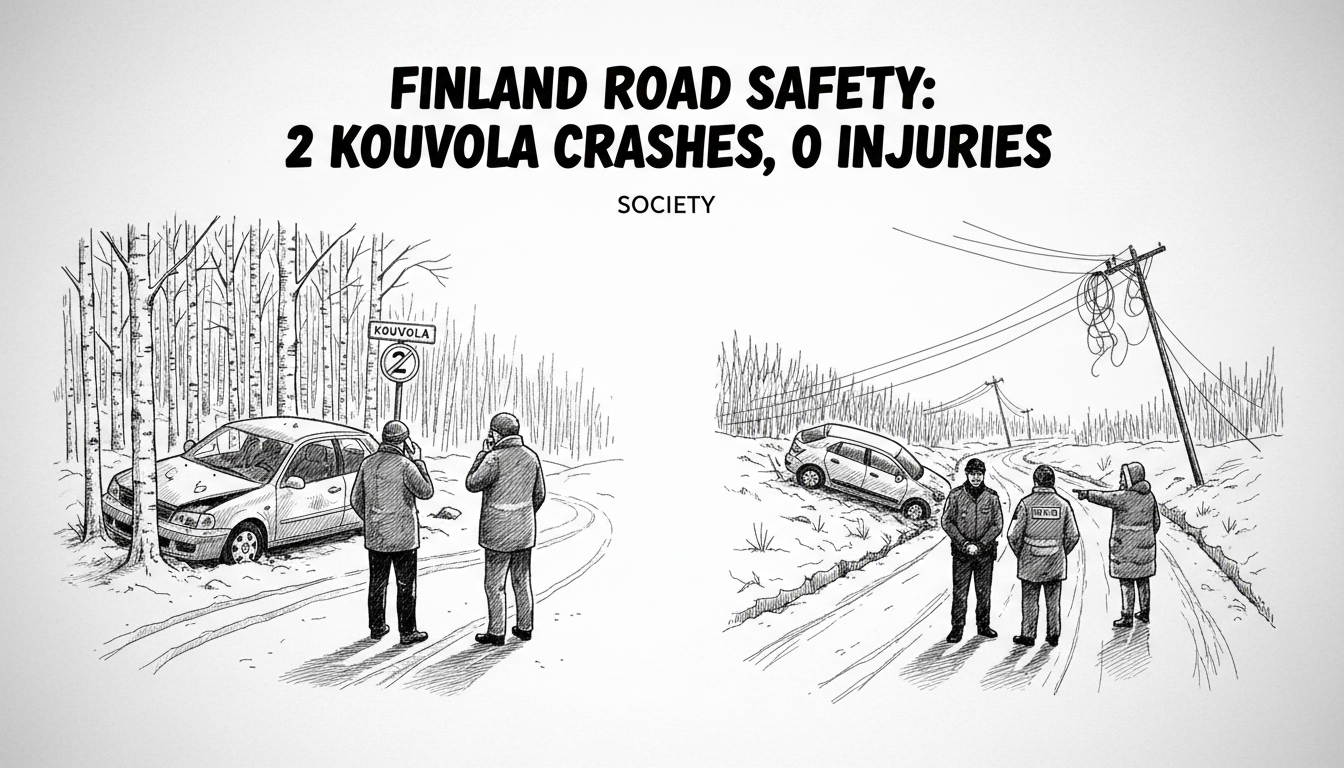
Finland traffic accident reports from Kouvola on Wednesday evening detailed two separate collisions that, while causing vehicle damage, resulted in no human injuries. The first incident, a three-car collision at the intersection of Tasankotie and Ojaäyrääntie, was reported to emergency services at 17:31. Southeast Finland Police confirmed the multi-vehicle crash but noted the absence of personal injuries. Less than an hour later, at 18:21, a second emergency call came from Anjalantie where a car had veered off the road into a ditch. Police arriving at that scene found the damaged vehicle unoccupied, with no immediate sign of the driver. These back-to-back incidents in the Kymenlaakso region highlight the ever-present risks on Finnish roads, even as the country maintains one of Europe's better safety records.
A Detailed Look at the Evening's Events
The sequence of events began during the early evening commute in Kouvola, a key transport hub in southeastern Finland. The intersection of Tasankotie and Ojaäyrääntie, where the first collision occurred, became the focus of police and emergency response. Initial reports indicated three passenger cars were involved. The precise mechanics of the crash—whether it was a rear-end collision that cascaded or a failure to yield at the intersection—remain under standard police investigation. The rapid confirmation of no injuries likely allowed responders to focus on traffic management and clearing the wreckage rather than urgent medical care. The second incident on Anjalantie presents a different puzzle for authorities. A single car found in a ditch, damaged from the impact, with no driver or passengers present upon police arrival, raises immediate questions. Standard procedure in such cases involves attempts to locate the vehicle's registered owner to ascertain if they were involved and if they require medical attention elsewhere.
Finland's Road Safety Context and Statistics
These Kouvola crashes occur against a backdrop of continuous national efforts to improve road safety. Finland recorded 221 road fatalities in 2023, a number that represents both tragic loss and the result of decades of progressive policy. The broader statistic of 4,173 injury accidents the same year underscores that while fatal crashes draw headlines, the vast majority of collisions result in property damage or minor injuries. The Finnish transport system is built for harsh conditions, with winter tires mandatory from December to February and extensive road maintenance operations. The Finnish Transport and Communications Agency, Traficom, alongside the police, runs constant campaigns focusing on speed limits, seatbelt use, and the dangers of distracted or impaired driving. The lack of injuries in the Kouvola incidents, while fortunate, is not entirely anomalous given modern vehicle safety standards like mandatory electronic stability control and widespread airbag systems.
Expert Analysis on Intersection and Single-Vehicle Crashes
Road safety experts often point to intersections as critical risk points. "Intersections are complex environments where driver decisions must be made quickly, often with limited visibility or under time pressure," explains a traffic safety researcher from VTT Technical Research Centre of Finland, who preferred not to be named as the investigation is ongoing. "The design of the junction, the clarity of signage, and driver adherence to right-of-way rules are all determining factors." For the single-vehicle crash on Anjalantie, different factors come into play. A car leaving the roadway and ending up in a ditch can indicate driver error, a medical episode, avoidance of a sudden obstacle, or even a deliberate act. "The absence of the driver at the scene is the primary concern for police in the Anjalantie case," the expert adds. "It necessitates a swift investigation to rule out hit-and-run scenarios, locate a potentially injured person who wandered away, or identify if the vehicle was simply abandoned after an earlier incident."
The Role of Infrastructure and Enforcement
Finnish municipalities and the state road authority, Väylävirati, continuously assess accident blackspots. Data from non-injury crashes like the Tasankotie collision is still collected and can influence future infrastructure projects. Potential remedies include improved lighting, clearer road markings, adjusted speed limits, or even redesigning the intersection layout. On the enforcement side, Southeast Finland Police will process both events. For the three-car crash, determining fault involves interviewing drivers and witnesses, examining vehicle damage, and possibly reviewing any available traffic or private surveillance camera footage. The outcome could lead to traffic violation fines or insurance determinations. The Anjalantie case requires first locating the driver. Once found, police will investigate why the crash occurred and why the scene was left. Penalties could range from fines for leaving the scene of an accident to more serious charges if impairment or reckless driving is proven.
A Comparative Look at Nordic Road Safety
Finland's road safety performance is strong within a Nordic region that is already among the safest in the world. The country's Vision Zero policy—aiming for no fatalities or serious injuries on the roads—aligns with similar strategies in Sweden and Norway. These countries share challenges: long, dark winters, vast rural road networks, and wildlife crossings. They combat these with similar tools: high levels of vehicle safety compliance, strict drink-driving laws with random breath testing, and significant investment in guardrails and clear signage. The Kouvola incidents, resulting in material damage only, reflect a common outcome in these nations where the safety system—from car design to driver behavior—often prevents injury even when accidents occur. However, experts caution against complacency. Every crash is a system failure that provides data to prevent future, potentially more serious, incidents.
The Human and Economic Cost of Property-Damage Crashes
While the lack of injuries is the positive headline, crashes like those in Kouvola carry real costs. They cause significant disruption, blocking roads during busy times and requiring police, rescue, and possibly tow truck resources. For the drivers involved, there is the stress, time lost dealing with insurance claims, and the potential loss of no-claims bonuses. From a societal perspective, the economic cost of property-damage-only crashes in Finland runs into hundreds of millions of euros annually when accounting for emergency services, repairs, insurance administration, and lost productivity. These events are a reminder that road safety is not just about saving lives but also about preserving quality of life and economic efficiency. They validate ongoing investments in advanced driver assistance systems (ADAS) like automatic emergency braking, which can prevent or mitigate low-speed intersection collisions.
Looking Ahead: Investigation and Prevention
The immediate next steps lie with the Southeast Finland Police. Their final reports on both crashes will close these specific cases. More broadly, the data will feed into national statistics and local safety planning. For Kouvola city planners and road managers, a pattern of similar incidents at the Tasankotie intersection would trigger a safety review. The Anjalantie case may remain an isolated mystery or highlight a need for better roadside barriers on that stretch. The ultimate goal, echoed by Traficom and safety advocates, is to move beyond reacting to crashes and instead create a transport system where human error does not lead to catastrophic outcomes. The evening in Kouvola, thankfully without tragedy, serves as a routine stress test of that system. It prompts a necessary public reflection: in a country celebrated for its safety, how do we respond when the near-misses occur, and what do they teach us about preventing the next one?