
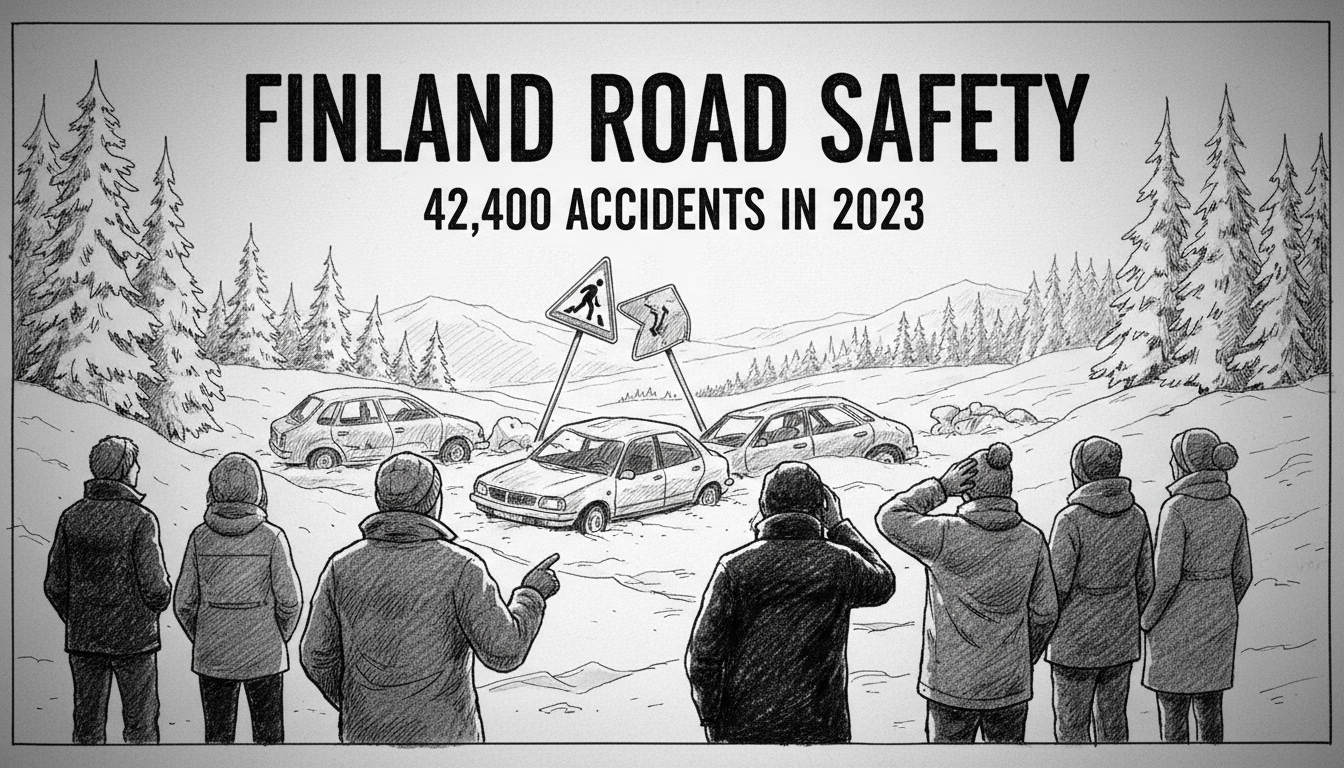
Finland traffic accident statistics for 2023 reveal a persistent challenge on the nation's roads, even as a minor rear-end collision in Jyväskylä this week ended without injury. Two vehicles collided on Highway 4 near the Vaajakoski district, a common type of incident that forms part of a larger national picture. The event, which caused no personal injuries and only minor vehicular damage, was cleared by the local rescue service by 3:00 PM, but it underscores the continuous effort required to improve Finnish road safety.
While this specific incident was minor, it occurred on a critical arterial route. Highway 4, known as Nelostie, is a vital north-south corridor connecting Helsinki to Lapland. The Vaajakoski intersection where the crash happened is a familiar point of congestion and potential conflict. Rear-end collisions at such junctions are frequently cited by traffic experts as preventable, often stemming from insufficient following distance, distracted driving, or misjudgment of speed.
The National Picture Behind a Local Fender-Bender
The Jyväskylä incident is a microcosm of a nationwide issue. Official statistics show that in 2023, Finland recorded 42,400 reported road traffic accidents. Within that large number, 343 were fatal, resulting in loss of life. These figures, provided by Finnish transport authorities, indicate that while Finland's roads are among the safest in Europe, the journey towards zero fatalities and serious injuries continues. Every minor crash, like the one in Vaajakoski, represents a near-miss and a learning opportunity for drivers and planners alike.
Traffic safety researchers emphasize that the majority of these accidents, particularly rear-end collisions, are not caused by poor infrastructure but by human factors. "The three-second rule for following distance is not a suggestion, it's a fundamental requirement for reaction time," explains a senior advisor from the Finnish Transport Safety Agency, Trafi. "In urban areas and at intersections, attentiveness is paramount. A moment's glance at a phone or a distraction can erase the safety margin."
Infrastructure and Enforcement: The Finnish Dual Approach
Finnish authorities combat traffic accidents through a dual strategy of engineering and education. Road design continuously evolves, with intersections like the one in Vaajakoski regularly assessed for safety improvements. This can include better signage, improved lighting, and roundabout design modifications to naturally slow traffic. On Highway 4 and other major routes, variable speed limit signs that adjust for weather and congestion are becoming more common, aiming to smooth traffic flow and prevent sudden braking.
Simultaneously, police enforcement focuses on the primary killers: speeding, driving under the influence, and failure to use seatbelts. While a rear-end collision might result in a fine for careless driving, the broader campaign aims to catch riskier behavior before it leads to tragedy. The Finnish government also invests heavily in public awareness campaigns, especially targeting young male drivers, who are statistically overrepresented in serious accidents.
The Human Factor in a High-Tech Nation
Finland is a leader in vehicle technology, with a high penetration of modern safety features like automatic emergency braking (AEB) and lane-keeping assist. These systems are designed specifically to prevent or mitigate the severity of common crashes, including rear-end collisions. However, experts caution that technology is an aid, not a replacement, for vigilant driving. "The car's systems are the last line of defense," the Trafi advisor notes. "The first and most important system is the driver's focus on the road ahead, the mirrors, and the surrounding traffic."
This week's Jyväskylä crash, where both vehicles remained drivable, likely involved low speed. It serves as a perfect, low-stakes example of the chain of events leading to a collision: one driver decelerates to enter the roundabout, the following driver's attention lags for a second, and impact occurs. In different conditions—higher speed, wet pavement, or a motorcycle ahead—the outcome could have been severe.
Looking Beyond the Statistics to Cultural Shifts
The raw number of 42,400 accidents can feel abstract. The real work in Finnish road safety involves changing driver culture and expectations. This includes normalizing slower speeds in urban areas, completely eliminating acceptance of even mild alcohol impairment before driving, and designing communities where walking and cycling are safe and attractive alternatives to short car trips. Cities like Helsinki have actively promoted this "mobility shift," which, if successful, could reduce the total volume of traffic and thus the potential for collisions.
For now, the focus remains on protecting those in vehicles. The Finnish goal, aligned with the EU's Vision Zero, is to eliminate road deaths and serious injuries entirely. Each year's data is scrutinized to identify trends: Are accidents shifting from rural highways to city streets? Are certain age groups becoming more vulnerable? The minor crash in Jyväskylä is a data point in that ongoing analysis, a reminder that safety is a daily practice.
The Road Ahead for Finnish Traffic Safety
As Finland moves forward, the integration of better data will be key. Detailed crash reports help engineers identify problematic intersections for redesign. The push for connected vehicle technology, where cars communicate with each other and infrastructure, promises another leap forward in preventing common collision types. A connected vehicle could warn a driver of sudden braking by a car several vehicles ahead, long before their own eyes see the brake lights.
Yet, for the foreseeable future, the responsibility rests largely with the person behind the wheel. The 42,400 accidents in 2023 represent 42,400 failures of that responsibility, ranging from minor lapses to catastrophic errors. The story from Jyväskylä is a best-case scenario within a troubling statistic: no one was hurt, traffic flowed again quickly, and both drivers drove away. It is a warning delivered without consequence, a chance for everyone on the road to remember that the distance to the car in front is the distance between a normal day and a call to the rescue services. Will the steady number of accidents finally push a cultural shift towards greater caution, or will drivers continue to rely on luck and last-minute braking?