
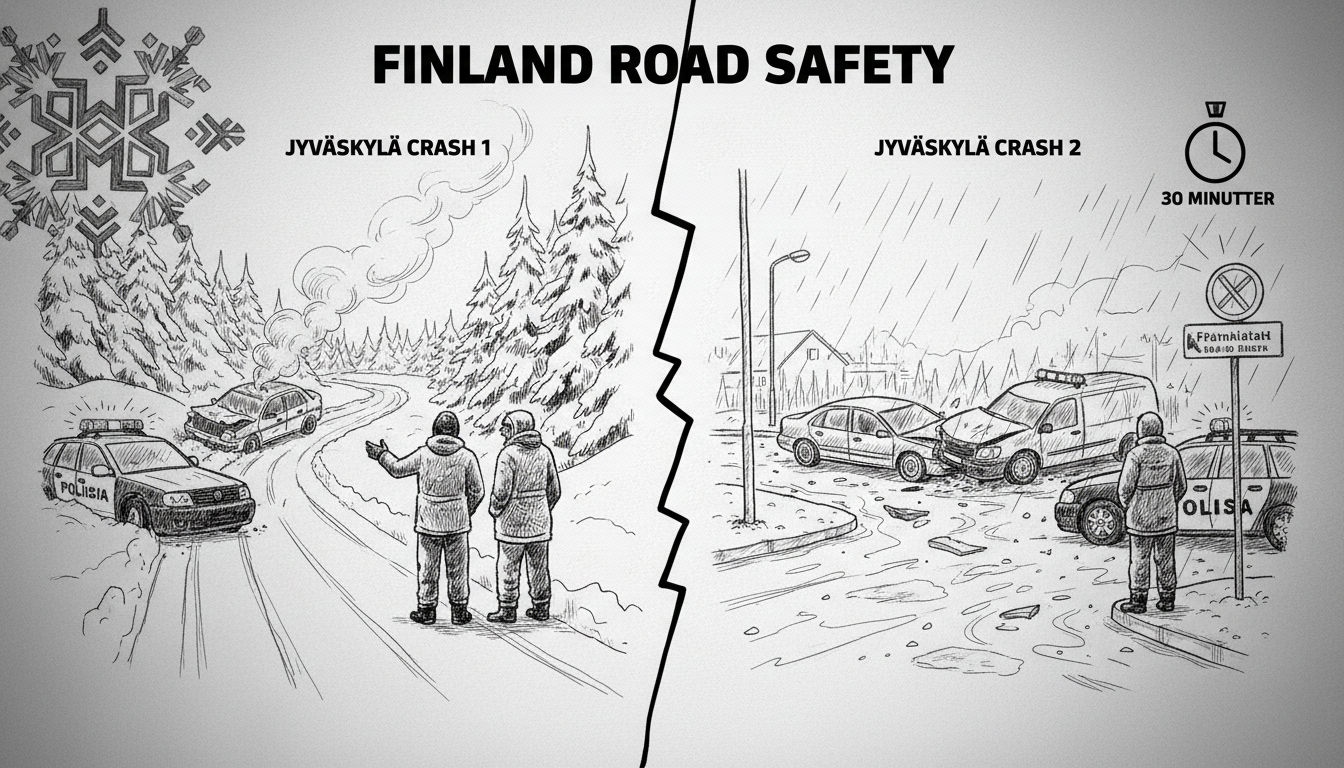
Finland's road safety record faced a stark reminder in Jyväskylä Wednesday evening as two separate intersection collisions occurred within a single half-hour period. The incidents, which took place just 30 minutes and a few kilometers apart, resulted in no serious injuries but have reignited discussions on urban traffic safety in Finnish cities. Emergency services responded to both scenes, highlighting the constant pressure on municipal resources from preventable accidents.
A Dangerous Half-Hour in Central Finland
The first collision was reported around 7:30 PM at the intersection of Vesangankatu, where Laajavuorentie transitions into Savelankatu in the Savela district. The crash involved two passenger cars. While no one was seriously hurt, paramedics performed a precautionary check on one individual at the scene. The accident caused immediate traffic disruption in the area, a common consequence that strains local commutes and emergency response logistics.
Almost precisely 30 minutes later, at approximately 8:00 PM, a second two-vehicle collision occurred at the intersection of Kauppakatu and Vaasankatu, closer to the city center. Three people were across the two vehicles involved. Police confirmed that none sustained injuries in this second crash, though it too created temporary traffic problems during the evening hours. The close timing and similar nature of the incidents are statistically notable for a city of Jyväskylä's size.
The Persistent Challenge of Intersection Safety
Traffic safety experts point to intersections as persistent risk zones in urban environments. 'Intersections are complex environments where multiple streams of traffic and different user priorities converge,' explains a Finnish traffic engineering consultant familiar with central Finnish road design. 'Even in a country with a generally strong safety culture like Finland, these are the points where human error, momentary distraction, or environmental factors most commonly align to cause a collision.'
The design of the specific junctions in Jyväskylä will likely come under scrutiny. The transition point where Laajavuorentie becomes Savelankatu, the site of the first crash, represents a type of road configuration that can sometimes confuse drivers, especially visitors or those less familiar with the area. Visibility, signage, and lighting are all standard factors examined in a post-accident review.
Analyzing the Human and Systemic Factors
While the police investigation into the specific causes of Wednesday's crashes is standard procedure, the broader context is critical. Finland has long invested in road safety campaigns, strict drunk-driving laws, and winter tire mandates, achieving a historically strong safety record compared to global averages. However, urban areas present unique challenges. Distraction from mobile devices, increasing traffic volumes, and the mix of cars, cyclists, and pedestrians create a dynamic hazard landscape.
'These two non-fatal incidents are a useful warning signal,' says a researcher from a Finnish traffic safety institute. 'They force us to ask whether our infrastructure keeps pace with current traffic behavior. Every near-miss or minor crash is a data point that can prevent a future tragedy. The goal is proactive safety engineering, not just reactive response.'
The fact that both crashes happened in the evening, during the autumn period of diminishing daylight in Finland, may also be a relevant factor. Reduced visibility after sunset increases risk, making well-lit and clearly marked intersections even more vital.
Jyväskylä's Place in the National Safety Picture
Jyväskylä, a major university city and hub in central Finland's Lakeland region, is not an outlier in terms of traffic risk. Its mix of arterial roads, local streets, and high student population creates a typical urban traffic profile. The city's administration, like all Finnish municipalities, operates under national traffic safety programs which set ambitious goals for reducing serious accidents.
These national programs, often spanning several years, emphasize the 'Vision Zero' philosophy that aims to eliminate all fatal and serious traffic injuries. This approach moves beyond blaming driver error and instead focuses on designing a traffic system that accommodates human mistakes without lethal consequences. It encompasses everything from road geometry and speed limits to vehicle safety technology and public education.
The Path Forward: Data, Design, and Vigilance
The response to such clustered incidents typically involves multiple agencies. Local police will complete their reports. City engineers may review the accident locations for potential low-cost improvements, such as adjusted signage or road markings. The data from these crashes feeds into national statistics, helping shape future policy and investment.
For residents, these events are a personal reminder of the importance of defensive driving, especially at junctions. Adhering to speed limits, avoiding distractions, and exercising extra caution at twilight are individual actions that contribute to collective safety. The minor outcome of these particular crashes should not lead to complacency.
Finland's journey toward safer roads is continuous. Each season brings new challenges, from icy winter pavements to the increased pedestrian activity of summer. The incidents in Jyväskylä show that even on an ordinary Wednesday evening, the complex equation of human, vehicle, and road can falter. The real test for the system is not just in preventing accidents, but in learning from every single one to build a more resilient network. As Finnish cities continue to grow and evolve, will the design of our shared spaces evolve fast enough to protect everyone who uses them?