
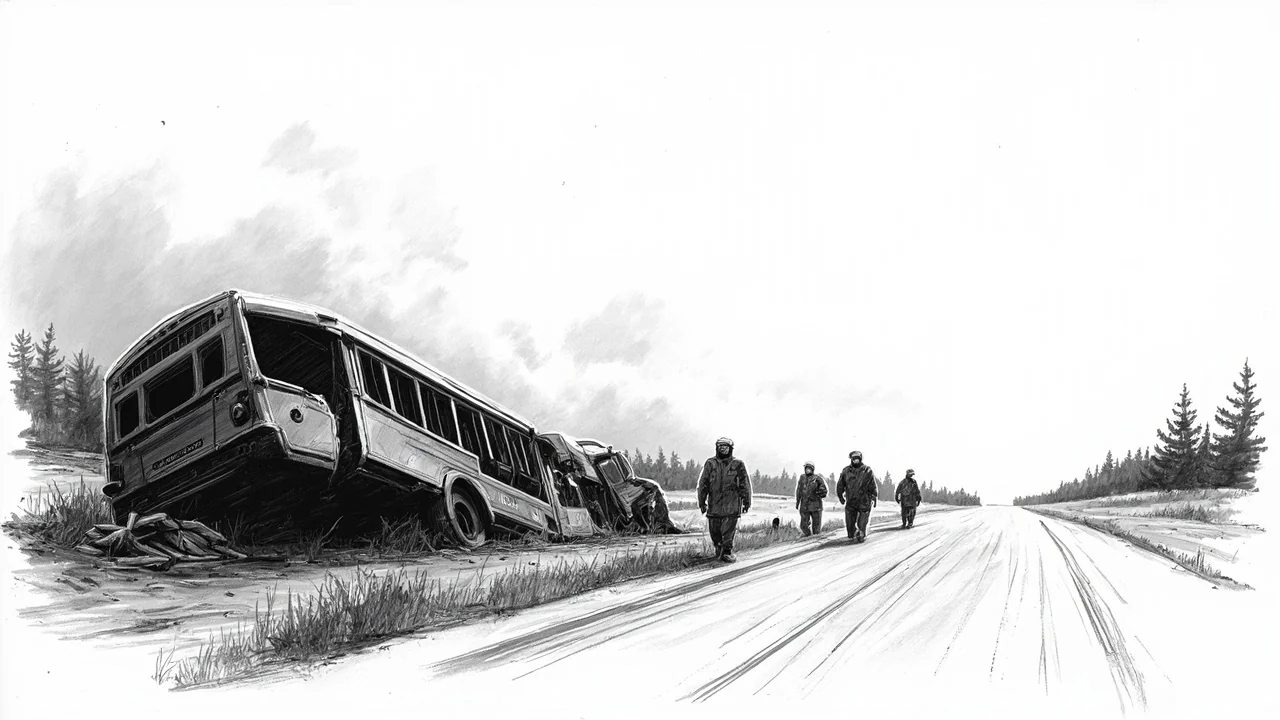
Finland's road maintenance system faces scrutiny after a formal warning was issued to contractor Destia over dangerously icy conditions linked to a school bus crash in Konginkangas. The Central Finland Centre for Economic Development, Transport and the Environment confirmed that Liimattalantie road failed to meet its quality requirements at the time of the December accident. This incident has triggered a wider examination of winter road maintenance protocols and the effectiveness of forecasting across Finnish municipalities.
A Formal Warning and a Failed Forecast
The regional authority, known as the Elinvoimakeskus, received a detailed report from Destia outlining the actions taken, their timing, and the prevailing weather conditions before the crash. Project manager Tomi Kujala stated the road contractor's analysis was insufficient to prevent the hazardous situation. "The road did not meet the quality requirements set by the development centre at the moment of the accident," Kujala concluded. The core failure identified was a critical error in anticipation—the Finnish concept of 'ennakointi'—where pre-emptive salting or sanding based on weather forecasts did not occur adequately. This highlights a potential systemic vulnerability where even contracted experts can misjudge rapidly deteriorating winter conditions.
Finland's harsh climate makes reliable winter road maintenance a non-negotiable public safety issue. Municipalities and regional agencies like the Elinvoimakeskus typically outsource this work to specialized firms through competitive tendering. Contracts stipulate strict response times and treatment standards based on weather warnings. The Konginkangas case suggests a breakdown in this chain, where the forecast did not trigger the mandated contractor response with enough urgency or precision. The Finnish Transport Infrastructure Agency (FTIA) sets national guidelines, but local implementation rests with regional authorities and their partners.
The Broader Context of Finnish Infrastructure Management
This incident does not occur in a policy vacuum. Finland's road network, particularly in rural areas like Central Finland, is under constant pressure from budget constraints and an increasing frequency of extreme weather events linked to climate change. The model of outsourcing critical public services like road safety to private contractors is common across the Nordic region, designed to drive efficiency and expertise. However, it creates a chain of accountability where the public authority ultimately bears responsibility for contractor performance. The formal warning to Destia is a regulatory tool, but it follows a serious incident rather than preventing it.
Political responsibility for transport safety filters through several ministries. The Ministry of Transport and Communications oversees the FTIA, while the Ministry of the Interior is concerned with emergency response and overall safety. Local MPs from the affected region, regardless of party affiliation, will be pressured to seek answers and assurances from the government. This case may prompt questions in the Eduskunta's Transport and Communications Committee about the adequacy of national monitoring systems for contracted road services. Does the current model provide enough real-time oversight to prevent similar failures?
Comparatively, Sweden and Norway employ similar public-private partnership models for winter road maintenance. Scandals or major accidents often lead to tightened contract specifications, higher penalties for non-compliance, and investments in more granular weather monitoring technology. Finland's response to the Konginkangas crash will be watched closely by its neighbours as a test case for regulatory enforcement. The EU's overarching road safety directives, which aim to halve serious injuries and fatalities by 2030, also provide a backdrop, pushing member states to examine every accident for preventable systemic causes.
Accountability in the Aftermath of an Accident
The issuance of a warning, rather than a fine or contract termination, indicates the authority's initial finding may point toward procedural failure rather than wilful negligence. Finnish contract law and public procurement regulations provide a framework for such disciplinary actions. A formal warning serves as a documented first step, escalating the seriousness of any future breach. For Destia, one of Finland's largest infrastructure service companies, this public reprimand carries reputational risk, potentially affecting its chances in future tender processes across other municipalities.
For the families and community in Konginkangas, a warning may feel like an administrative footnote to a traumatic event. The human impact of the crash—the shaken children, the distressed parents, the driver—remains the most significant consequence. While the official investigation focuses on the material failure of the road surface, the psychological and social toll underscores why these standards exist. It tests public trust in the systems meant to guarantee safe passage, especially for society's most vulnerable members like schoolchildren.
A Path Forward for Winter Road Safety
The probe into the Konginkangas crash will likely yield specific recommendations. These could include mandating more conservative treatment thresholds in forecasts, deploying IoT sensors on high-risk road sections for real-time friction monitoring, or revising response-time requirements for contractors around schools and bus routes. The Finnish Meteorological Institute's role as the primary data source for these decisions may also be reviewed for how its warnings are integrated into operational decision-making by contractors.
This incident presents a critical moment for Finnish infrastructure governance. Will it result in mere procedural tweaks within the existing outsourcing model, or could it spur a more fundamental debate about resourcing and direct public management of core safety services? The coming months will show if the Eduskunta and the government see a need for legislative scrutiny. The budget process offers a key lever; MPs could push for earmarked funding for enhanced winter maintenance monitoring or pilot projects for new technologies.
Finland prides itself on reliability and safety, cornerstones of the Nordic model. A slippery road that leads to a school bus accident strikes at the heart of that self-image. The warning to Destia is a start, but the true measure of the response will be whether it makes every other road in Finland safer this winter. As climate change brings more unpredictable winter weather, the nation's famed 'sisu' (perseverance) must be applied not just to enduring the cold, but to perfecting the systems that protect citizens from it. Can Finland's renowned operational excellence adapt fast enough to meet this new challenge on its icy roads?