
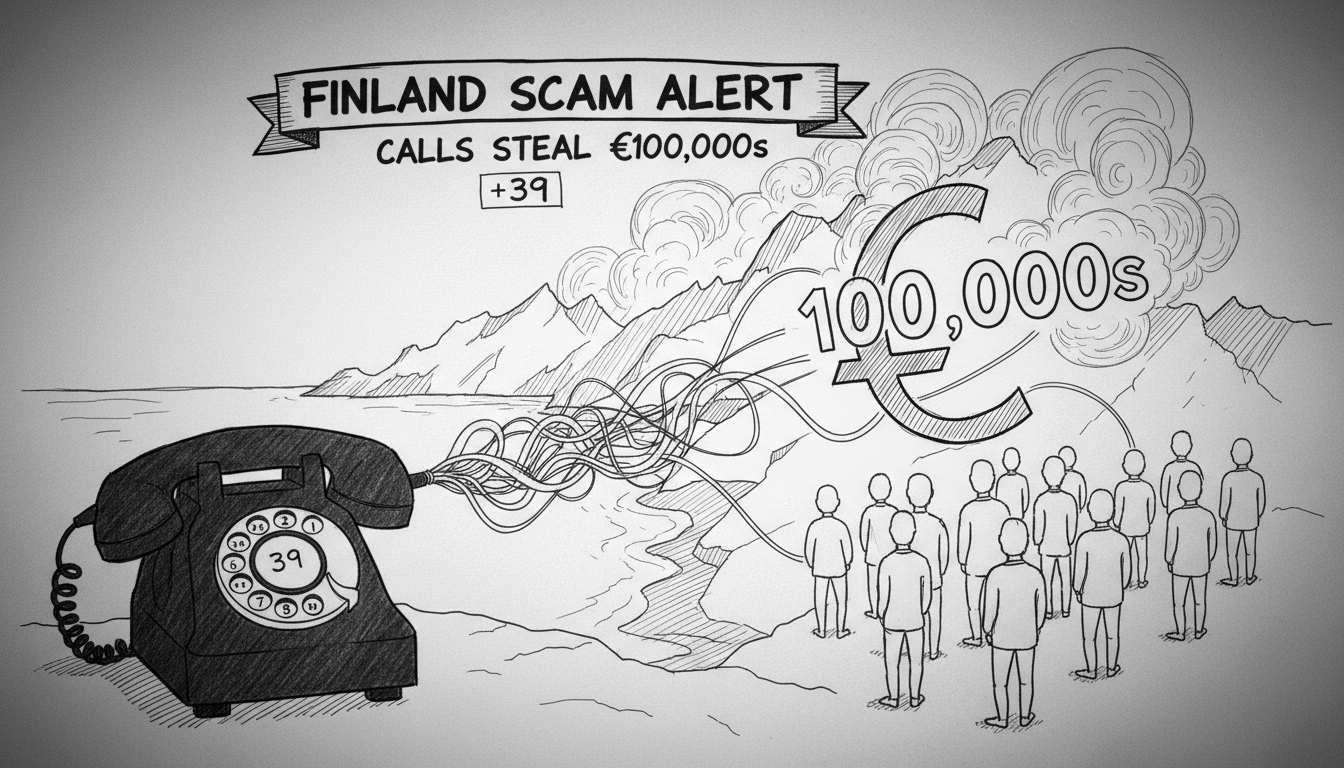
Finland's police are issuing a stark warning about a surge in sophisticated phone scams that have already stripped victims of hundreds of thousands of euros. The Eastern Finland Police Department reports numerous criminal complaints linked to fraudulent calls, often originating from Italian (+39) phone numbers, where criminals posing as bank officials manipulate victims into surrendering their online banking credentials.
These are not random, brief calls. The scams involve elaborate social engineering, with perpetrators spending significant time on the phone to build false trust and create a manufactured crisis. A recorded message may initially instruct the target to press zero to connect to 'customer service.' From there, a live scammer, impersonating a bank employee, claims the victim's account is under threat or that unauthorized transactions are occurring. The solution they offer is a trap: to 'secure' the account or 'reverse' the fake payments, the victim must hand over their login details and confirm transactions that actually drain their own funds.
'Do not give your online banking credentials to outsiders or confirm transactions concerning your account unless you are completely sure of their origin. If you doubt the reliability of the call, cut the connection immediately,' advises Crime Commissioner Janne Sievänen of the Eastern Finland Police Department in the official bulletin. The police stress that legitimate Finnish banks never use foreign phone numbers or WhatsApp for customer contact, and they will never ask a customer for their online banking passwords.
The Anatomy of a Modern Scam Call
The technical and psychological execution of these scams marks a dangerous evolution from simpler phishing attempts. Criminals are exploiting international calling codes to add a veneer of legitimacy or to complicate tracing efforts. The use of WhatsApp, particularly if a call from a foreign number drops and the scammer reconnects via the messaging app, is a new twist designed to bypass suspicion. The core of the attack, however, remains psychological manipulation.
The scammer's script is carefully crafted to induce panic and short-circuit logical thought. By announcing a false security breach or unauthorized payment, they create an urgent problem that demands an immediate solution. The victim, concerned about their life savings, is placed in a state of stress. The scammer then positions themselves as the helpful, authoritative guide through this crisis. This 'guidance' involves the victim actively logging into their own bank account and, under the scammer's direction, transferring funds or approving payments under the false belief they are blocking a criminal.
'These are not crimes of hacking, but of persuasion,' explains a cybersecurity consultant familiar with the Finnish landscape, who requested anonymity due to their work with financial institutions. 'The security chain's weakest link is often the human element. These criminals are adept at building rapport, exploiting trust in institutions, and creating such a compelling narrative of threat that the victim feels compelled to act against their own better judgment.'
A Persistent Threat in a Digital Society
Online fraud is a persistent challenge in Finland, a nation with one of the world's highest rates of digital banking adoption. While Finnish banks invest heavily in technical security like strong two-factor authentication, criminals continuously adapt their social engineering tactics to exploit human psychology. Previous waves have included phishing emails, fake investment schemes, and text message scams. This current wave of aggressive, voice-based fraud represents a more direct and personal form of attack.
The choice of the +39 Italian country code is notable. It may be used to lend a false sense of legitimacy, perhaps suggesting a call from a bank's 'European security center,' or it could simply be a technical workaround using VoIP (Voice over Internet Protocol) services that allow criminals to operate from anywhere in the world. The police bulletins do not specify if the criminals are operating from Italy or merely using spoofed numbers, highlighting the cross-border nature of modern cybercrime that complicates law enforcement efforts.
Finnish authorities, including the National Bureau of Investigation (NBI) and the Finnish Transport and Communications Agency (Traficom), have run repeated public awareness campaigns. They emphasize the golden rules: your bank will never call to ask for your passwords or PINs; never give remote access to your computer or phone to an unsolicited caller; and if in doubt, hang up and call your bank back using the official number from their website or your bank card.
Why These Scams Succeed and How to Fight Back
The success of these scams lies in their sophisticated blend of technology and psychological manipulation. They prey on a fundamental human desire to resolve threats quickly and a deep-seated trust in banking institutions. When a confident, seemingly knowledgeable person calls claiming to be from your bank and says your money is at risk, the instinct to cooperate can override caution. The scammers are skilled at overcoming initial skepticism, often using technical jargon or referencing partial personal data gleaned from previous data breaches to sound authentic.
Experts stress that verification is the most powerful defense. 'The moment any unsolicited caller creates a sense of urgency around your finances, that is the biggest red flag,' says the cybersecurity consultant. 'A real bank security issue does not require you to divulge your credentials to solve it. The correct action is always to terminate the call and independently contact your bank through verified channels. Take control of the communication timeline back from the scammer.'
Financial institutions are also adapting. Some Finnish banks have implemented systems that flag unusual transaction patterns or logins from new devices, potentially stopping fraud even if credentials are stolen. However, these systems are not foolproof, especially if the scammer talks the victim into approving the transactions in real-time, making them appear 'legitimate' to automated monitoring systems.
A Call for Vigilance Beyond Individual Action
While individual vigilance is crucial, the scale of the losses—hundreds of thousands of euros in this recent spate alone—points to a broader societal issue. The police bulletins serve as a critical early-warning system, but addressing the root causes requires continuous cooperation between law enforcement, telecommunications providers, and the banking sector. Tracing the financial flows and the digital footprints of these international criminal operations is a complex task.
The European Union's framework for cross-border judicial and police cooperation, through agencies like Europol, is essential in these investigations. However, the speed at which scammers adapt often outpaces the slower mechanisms of international law. This reality places a premium on prevention through education. Community organizations, particularly those working with elderly populations who may be targeted more frequently, play a key role in spreading practical advice.
The ultimate question is whether public awareness can keep pace with criminal innovation. As long as there is money to be stolen, scammers will continue to refine their methods. The fight, therefore, is not to achieve a final victory but to build a resilient society where citizens are equipped with the knowledge and confidence to say 'no' to a convincing lie, hang up the phone, and protect their hard-earned assets. The responsibility is shared: by individuals to be skeptical, by institutions to communicate clearly, and by authorities to pursue these criminals relentlessly across digital borders.