
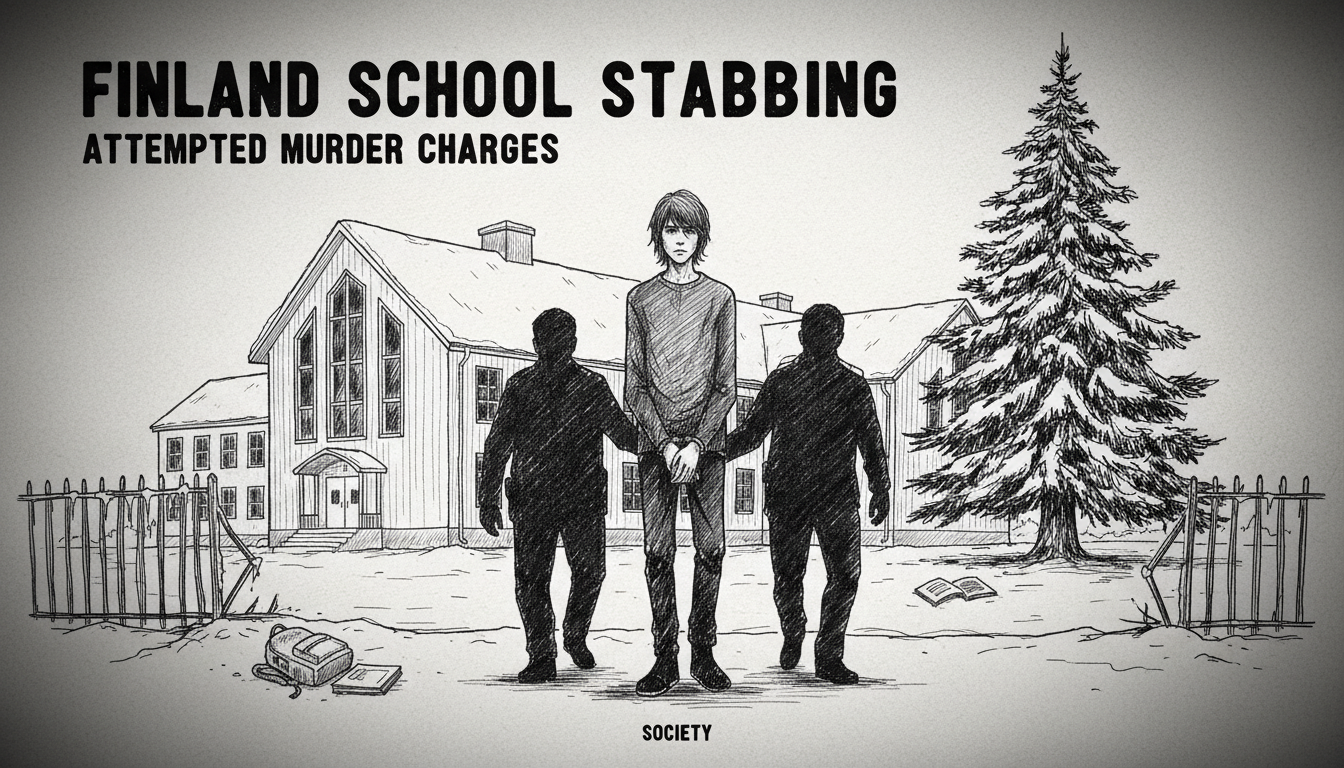
Finland school stabbing case at Pirkkala's Vähäjärvi school has reached a critical legal juncture. A 16-year-old boy now faces formal charges of three counts of attempted murder for the May attack that injured three 14-year-old girls. The Pirkanmaa District Prosecutor's Office confirmed the indictment, setting the stage for a December 19th trial in Tampere that will scrutinize one of the country's most disturbing incidents of school violence this year.
The attack shattered the ordinary school day at Vähäjärvi school in the municipality of Pirkkala. According to the charges, the suspect, a student at the school, targeted three fellow students. All three girls sustained injuries described by authorities as serious but not life-threatening. The swift response from school staff and emergency services prevented a greater tragedy in the community located near Tampere.
A deeply troubling element of the case emerged immediately after the stabbing. The suspect allegedly published a personal manifesto and a video recording of the violent act on the same day. This digital footprint, now central to the prosecution's case, points to a premeditated action intended for public consumption. Police arrested the boy in May on strong suspicion of the attempted murders, and he has remained in custody since.
A Community and Nation Confronting School Safety
The Pirkkala incident has forced a renewed national conversation about safety in Finnish schools. While statistically rare, such violent episodes create profound shockwaves. Finland's education system is globally admired for its equity and high results, making attacks within its schools particularly jarring. The community of Pirkkala, a growing suburban municipality, represents the kind of ordinary Finnish environment where such events feel most incongruous.
Local authorities and school leadership in Pirkkala initiated immediate support measures for students and staff following the May attack. These efforts focused on psychological first aid and restoring a sense of security. "The priority has been the well-being of the children and the entire school community," a municipal official said in a statement earlier this year. The long-term impact on the victims and witnesses continues to be assessed by social and healthcare professionals.
The Legal Path to a December Trial
The Pirkanmaa District Court in Tampere will host the trial starting December 19th. Finnish law treats suspects under 18 years old with specific procedures designed for young offenders. The court process will likely involve expert testimony from forensic psychologists and youth psychiatrists to evaluate the suspect's mental state and motives. The prosecution's evidence is expected to heavily feature the digital manifesto and video, analyzing their content for clues about radicalization or planned violence.
Under Finnish criminal law, attempted murder carries a significant prison sentence. However, for a 16-year-old, the focus of sentencing would combine punitive measures with intensive rehabilitation. The court must weigh the severity of the acts against the principle of focusing on the suspect's resocialization given his age. The trial will be conducted largely behind closed doors to protect the identities of the young suspect and the victims, in line with standard practice for juvenile cases.
Expert Analysis on Prevention and Root Causes
Security experts and child psychologists point to this case as a complex interplay of individual psychology and potential systemic gaps. "No single factor explains such an act," said Dr. Elina Saari, a clinical psychologist specializing in adolescent behavior. "We must look at the individual's access to mental health support, their social connections, and also the channels through which they might consume harmful ideologies. The online dimension is critical."
The publication of a manifesto suggests an ideological or grievance-based motivation, aligning with patterns seen in some international school attacks. Researchers note that while Finland has robust programs for early intervention and student welfare, known as oppilashuolto, identifying isolated individuals who are actively concealing their plans remains a formidable challenge. The case may prompt reviews of how schools monitor online behavior and address extremist content consumption among students.
Finland's Broader Context of School Violence
Finland has experienced a handful of deadly school shootings, most notably in Jokela in 2007 and Kauhajoki in 2008. Those tragedies led to concrete reforms, including tightened gun legislation and enhanced national protocols for school safety and threat assessment. The Pirkkala stabbing, while different in method and scale, reactivates the same national nerves about the sanctity of educational spaces.
Current safety measures in Finnish schools vary by municipality but often include locked doors during school hours, staff training for crisis situations, and cooperation plans with local police. The focus has traditionally been on preventing unauthorized entry rather than violence originating from within the student body. This incident may shift that focus, encouraging schools to refine systems for reporting concerning behavior among peers.
The Road Ahead for Pirkkala and Finnish Schools
As the December trial date approaches, the legal process will seek accountability. Beyond the courtroom, the Finnish National Agency for Education and the Ministry of the Interior routinely analyze such incidents to update national guidelines. The dialogue often centers on balancing a safe, open school environment with necessary security measures, a challenge familiar to education systems worldwide.
The victims and their families continue their recovery, a private process supported by Finland's comprehensive healthcare and social services. The community's healing is gradual, marked by a collective determination to not let the act define their school. For the nation, the Pirkkala case serves as a somber reminder that vigilance, early support, and open communication with youth are perpetual necessities, even in societies with strong social safety nets. The ultimate test will be how effectively this painful event translates into actionable improvements that prevent future tragedies.