
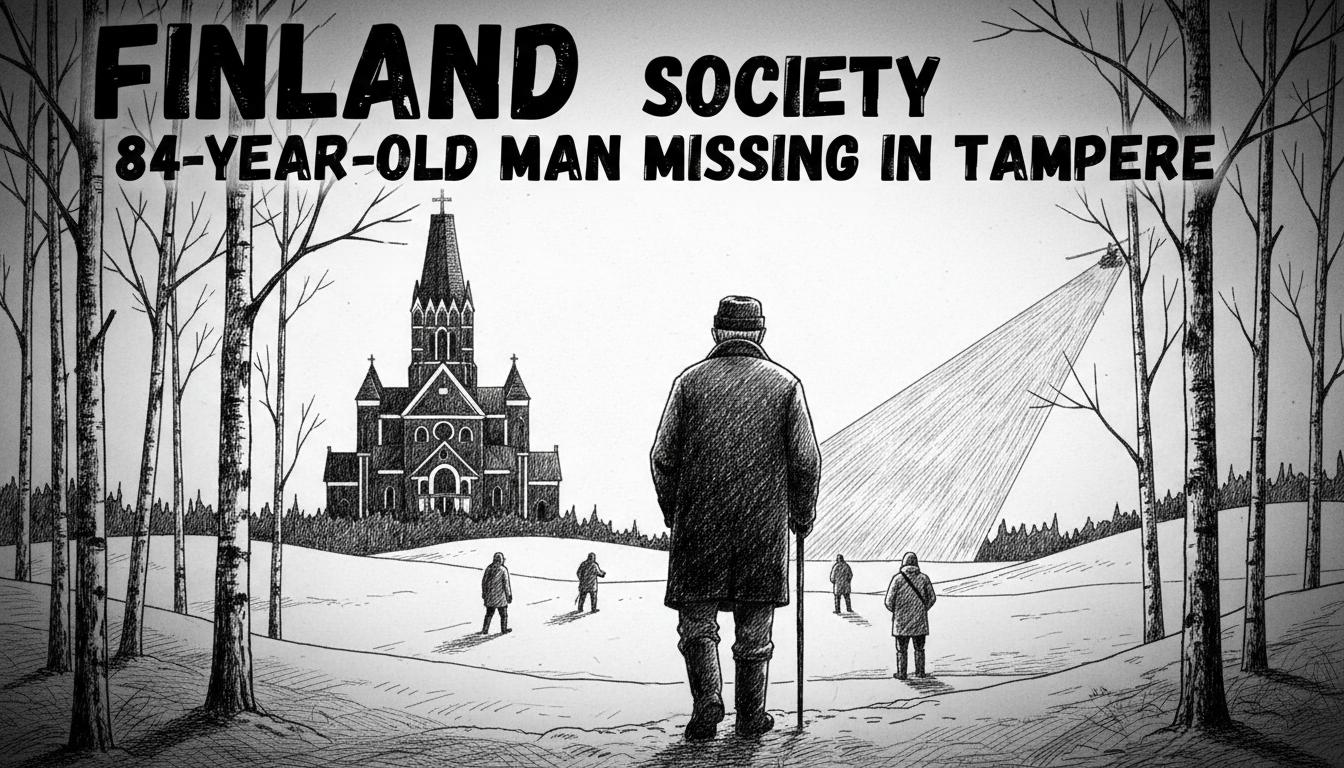
Finland missing person search is underway in Tampere for an 84-year-old man who vanished from the Lamminpää district. He was last seen on Saarikorventie street Sunday at 5 PM, wearing a blue windbreaker, beige pants, a white beanie, and carrying a distinctive white duffel bag. Police describe his walking pace as brisk and have mobilized resources, urging the public to report any sightings immediately to the emergency number 112.
The case has triggered a coordinated response from the Finnish police's national missing persons unit. This unit specializes in high-risk disappearances, particularly involving vulnerable groups like the elderly. Authorities are treating the search with urgency due to the man's age and the potential for underlying health concerns. The autumn weather in Tampere, with cooling temperatures and darkness falling earlier, adds significant risk to his wellbeing.
A High-Risk Disappearance
An 84-year-old vanishing without a trace represents one of the most urgent categories for Finnish police. Elderly individuals, especially those potentially experiencing cognitive decline like dementia or Alzheimer's, are at extreme risk when they go missing. Time is a critical factor; the first 48 hours are often decisive in search and rescue outcomes. The Tampere police have not publicly confirmed any specific medical conditions but are operating on the assumption that this is a high-risk situation. The description of a "brisk" walking pace suggests mobility is not the primary concern, potentially shifting focus to orientation or confusion.
Finland's search protocols for missing elderly persons are comprehensive. They typically involve ground teams of police and trained volunteers from organizations like the Finnish Red Cross, dog units specialized in tracking human scent, and aerial support if the area warrants it. The terrain around Lamminpää, a suburban district, includes residential areas, patches of forest, and proximity to Lake Pyhäjärvi, all of which require different search strategies. Coordinators must quickly decide where to deploy their finite resources for maximum effect.
The Mechanics of a Finnish Search Operation
When a person over 65 is reported missing in Finland, the response mechanism activates swiftly. The national missing persons unit provides support and coordination, ensuring local police have access to specialized expertise and resources. Investigators immediately begin retracing the individual's last known steps, interviewing family, neighbors, and any potential witnesses. They analyze personal routines, medical needs, and recent behavioral changes.
In this Tampere case, the specific last sighting on Saarikorventie provides a crucial starting point. Police will have canvassed the area, checked local security camera footage from businesses and public transport, and mapped potential routes. The presence of the white duffel bag is a key identifier; it suggests the man may have been on an errand or a specific outing. Determining what that intention was could be central to predicting his direction of travel. Search efforts often expand in concentric circles from the last known point, accounting for how far a person could reasonably travel on foot given the time elapsed.
The Broader Context of Elderly Safety
This disappearance touches on a significant societal issue in Finland, a nation with one of Europe's most rapidly aging populations. Safeguarding the elderly, particularly those living independently, is an ongoing challenge for social and health services. Municipalities run safety programs, including check-in services and locator technology for at-risk individuals, but these are often voluntary. A missing person case exposes the fragile line between independence and vulnerability.
Experts in geriatric care note that incidents like the one in Tampere are not merely police matters but public health concerns. "When an elderly person with potential cognitive issues goes missing, it is a race against the clock," says a specialist in elderly care at the University of Helsinki, who asked not to be named as they are not directly involved in the case. "Hypothermia is a grave danger even in moderately cool temperatures. Dehydration and untreated medical conditions can quickly become life-threatening. The community's eyes and ears become an essential part of the rescue network."
Community Role and Public Appeal
The Finnish police's public appeal for information is a standard but vital component of such searches. It transforms the public into a vast, distributed search party. Residents in Tampere and surrounding areas are asked to check their properties, outbuildings, garages, and any secluded spots. Motorists who were in the Lamminpää area on Sunday evening are urged to recall if they saw a man matching the description. Sometimes the smallest detail—a person seen resting on a bench or appearing disoriented at a bus stop—can provide the breakthrough.
This collective effort reflects a strong community ethos in Finland. In rural and suburban areas, neighbors often keep a informal watch over elderly residents. The formal police appeal systematizes this instinct. Sharing the official description and photograph across social media platforms extends the search's reach exponentially, though police caution the public to report directly to authorities rather than start independent searches that could disturb potential evidence.
What Happens Next
As the search continues, the operation will evolve. If initial ground searches prove unsuccessful, police may scale up by deploying more specialized units or re-evaluating the search area based on new analytical models. Family and close contacts will be interviewed again for any missed clues about state of mind or unmentioned habits. The investigation will also look into the man's personal history, including familiar routes from his past, like previous homes or workplaces, which individuals with dementia sometimes try to revisit.
The coming hours are crucial. Every passing moment increases the risks associated with exposure. The police response in Tampere demonstrates Finland's structured approach to such crises, blending professional emergency services with an appeal for civic responsibility. For the family of the missing 84-year-old, the wait is agonizing. For the community, it is a stark reminder of the vulnerability that can accompany advanced age, even in one of the world's safest societies. The outcome now depends on a combination of disciplined police work, expert search tactics, and a piece of critical information from a vigilant member of the public. The white duffel bag remains the most visible symbol of a hope that he will be found safe, a single, clear detail in an otherwise worrying unknown.