
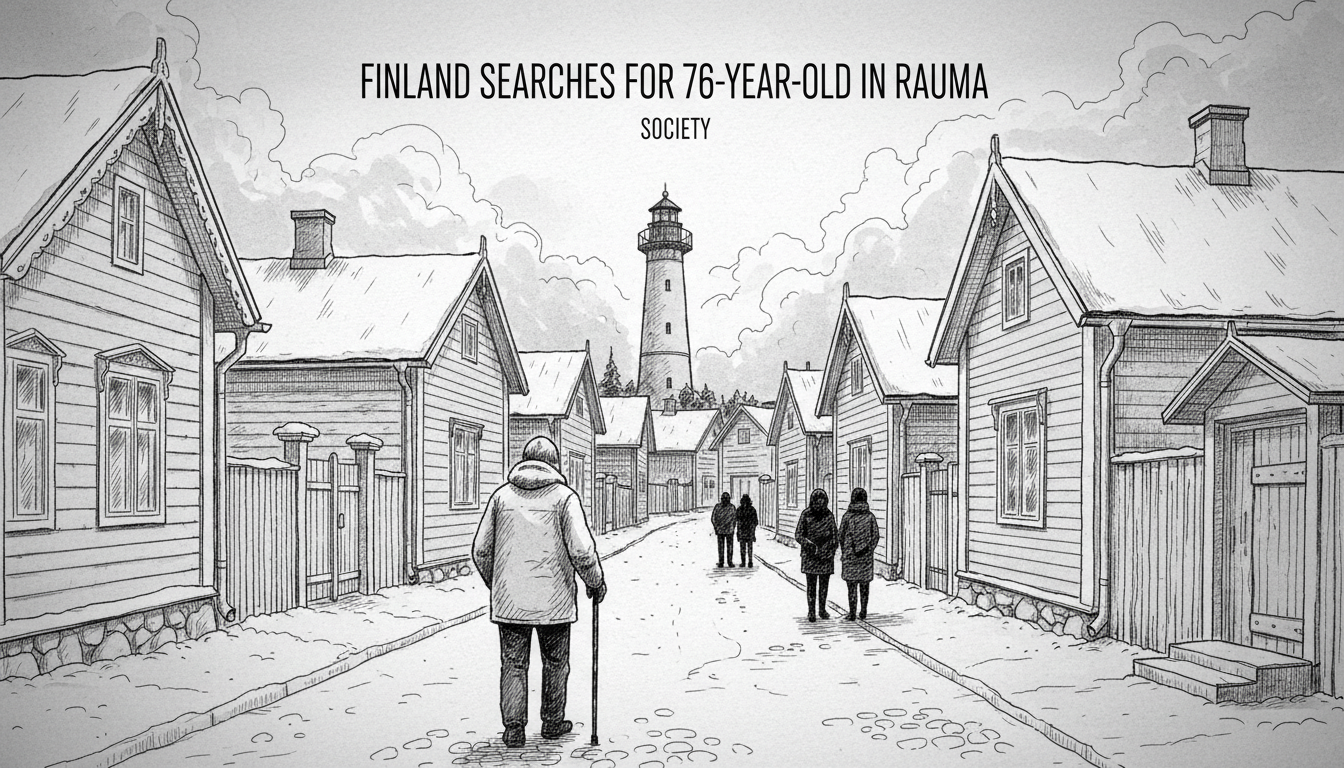
Finland's search and rescue teams are urgently seeking a 76-year-old woman missing from the old cemetery in the coastal town of Rauma. The woman was last seen on Tuesday, December 23rd, before 6 PM local time on Kaunisjärventie. Lounais-Suomen police describe her as 158 cm tall, wearing glasses, black jeans, a light-colored beanie, and a light green winter jacket. Authorities are asking anyone with information to call the emergency number 112 immediately.
A Search in the Historic City
The disappearance has triggered a significant response in Rauma, one of Finland's oldest towns. Founded in 1442, its UNESCO-listed old town is a maze of wooden houses, but the search is focused on the cemetery area. Winter in coastal Satakunta brings early darkness and cold, compounding concerns for the missing woman's welfare. The involvement of the Vapaaehtoinen pelastuspalvelu (Vapepa), the Volunteer Rescue Service, was confirmed within hours. This mobilization underscores the standard Finnish protocol for missing persons cases, especially those involving vulnerable individuals.
“Every hour is critical in these conditions,” a police spokesperson said in their initial bulletin, highlighting the urgency of the winter search. Nighttime temperatures in the region can fall well below freezing in late December. The specific clothing description—the light green jacket and light beanie—has been widely circulated by local media and community social networks. This public appeal is a standard and often effective tool in Finnish search operations.
The Mechanics of a Finnish Search
Finland's approach to search and rescue relies on a deeply integrated system. The police lead the operation, coordinating all official efforts and investigation. They are swiftly supported by volunteer organizations like Vapepa, which provides trained personnel and local knowledge. For larger-scale or wilderness operations, the Finnish Border Guard or Defence Forces might be called upon.
The use of volunteers is not a sign of limited resources but a reflection of a strong civic culture. Vapepa members are trained for precisely these scenarios, from urban searches to forest and water recoveries. Their participation expands the search capability significantly and quickly. This model is common across the Nordic region, where volunteer organizations form a vital part of the public safety infrastructure.
“The integration between police and volunteer rescuers is well-practiced and efficient,” explains Jari Lindberg, a former safety official familiar with rescue coordination. “The volunteers bring a network of community awareness that is impossible for authorities to replicate alone. In a time-sensitive case like this, that local mobilization is invaluable.”
Community and Context in Coastal Finland
The case has gripped the local community in Rauma, a tight-knit town of around 40,000 people. News spreads quickly, and residents are likely keeping a vigilant eye on their properties and surrounding areas. The location adds a particular gravity; a cemetery visit so close to Christmas Eve carries an emotional weight that resonates deeply in Finnish culture, where the holidays are a strongly family-oriented time.
Winter safety for the elderly is a recurring topic in Finnish public discourse. Icy conditions pose a high risk of falls, and disorientation can set in rapidly, especially after dark. While Finland has excellent social and healthcare services, an immediate disappearance in a public space triggers this specific, all-hands response. The police have not speculated on potential causes but are treating the search with maximum priority.
This operation also highlights the logistical challenges of winter searches. Daylight is scarce, requiring the use of powerful lights and thermal imaging equipment. Ground conditions could be icy, snowy, or both, complicating foot patrols. The volunteer rescuers are equipped and trained for these environmental factors, making their role even more critical.
The Path Forward and Public Role
As the search continues, the public's role remains paramount. Police reiterate that the single most important action is for anyone with any information, no matter how insignificant it may seem, to contact 112. A car seen parked unusually, a figure in the distance, or any recollection of activity near the old cemetery on Tuesday evening could provide the crucial clue.
The description of the woman is precise: her height, glasses, and distinct jacket and hat combination. Authorities urge people to check their properties, outbuildings, and summer cottages in the area. Sometimes, a missing individual may seek shelter in an unexpected place. Community cooperation often proves decisive in resolving these tense situations.
The coming hours will determine the scale and direction of the operation. If the initial concentrated search does not yield results, the perimeter may be expanded. Additional resources, including canine units or drones, could be deployed. The police will continue to provide updates to the public, whose assistance is considered an integral part of the mission.
For now, the people of Rauma and the dedicated search teams face a anxious wait, hoping for a safe conclusion against the backdrop of a dark Finnish winter. The story is a stark reminder of the vulnerability that can touch any community and the collective effort mobilized in response. It underscores a fundamental Finnish principle: public safety is a shared responsibility, answered by the swift, coordinated action of professionals and volunteers alike.