
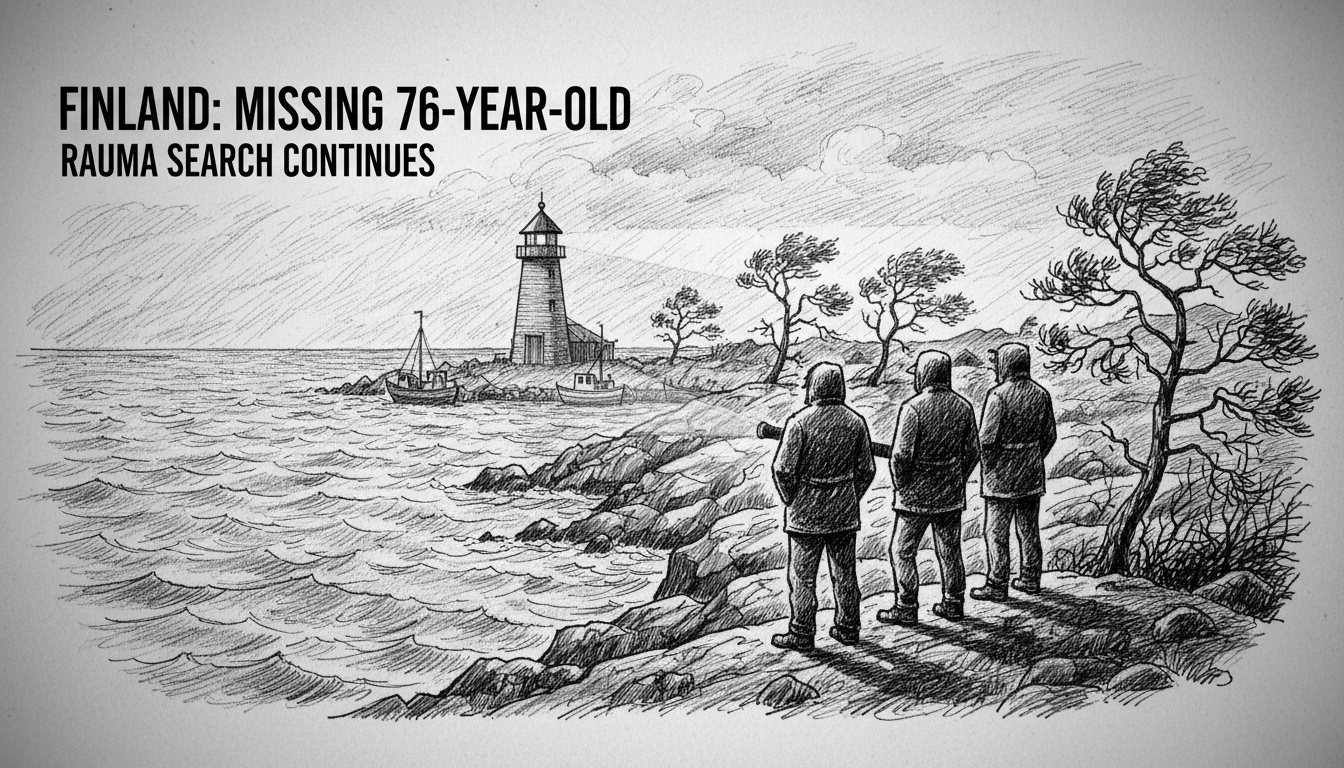
Finland's police and rescue services are conducting an extensive search for a 76-year-old woman who disappeared from the Old Cemetery in Rauma on Christmas Eve. The woman was last seen around 6 PM on Tuesday, December 23rd, prompting a large-scale operation involving multiple authorities and volunteers through the night and into Christmas Eve day.
Based on tips from the public, the search has concentrated on areas south of Rauma, specifically the districts of Kortela and Unjala. Additional search efforts are underway in Sampaanala, Monna, Koijärvi, and Vasarainen. Police are urging local residents to check their own properties, including yards, sheds, and outbuildings, for any sign of the missing person.
The woman is described as 158 centimeters tall. She was last seen wearing black jeans, a light-colored beanie, a light green padded winter jacket, and glasses. Authorities note she walks briskly and could have covered a significant area.
A Christmas Eve Disappearance
The timing of the disappearance adds a layer of urgency and poignancy to the search. The woman vanished on jouluaattoaatto, the day before Christmas Eve, a time when families across Finland are gathering. The last sighting at the Old Cemetery on Kaunisjärventie road occurred as daylight was fading on the west coast. Rauma, with its historic wooden center, is a UNESCO World Heritage site, but its surrounding areas include a mix of residential neighborhoods, forest, and coastline that present challenges for searchers.
Temperatures in the Satakunta region have hovered around freezing, with typical December conditions including dampness and limited daylight. For an elderly person spending a night outdoors, the risk of hypothermia is a primary concern for rescue coordinators. The police statement's specific detail about her brisk walking pace suggests she may be mobile and disoriented, rather than immobilized by injury.
The Mechanics of a Finnish Search Operation
When a person goes missing in Finland, it triggers a coordinated response protocol. The police lead the operation, but they are swiftly joined by volunteer rescue organizations. The Finnish Red Cross Search and Rescue (REDNET) is often mobilized, along with local volunteer fire departments and sometimes the Border Guard, depending on the terrain. In rural or semi-rural areas like those south of Rauma, these volunteers are crucial. They possess local knowledge of the landscape—forest paths, shorelines, and property lines—that is invaluable for systematic ground searches.
Public involvement is another key pillar. The police appeal for residents to check their properties is a standard and effective tactic. Garden sheds, summer cottages closed for winter, boat storage areas, and garages can provide temporary shelter for a confused individual. By asking the community to conduct these initial checks, authorities can quickly eliminate potential hiding spots near the last known location and focus professional resources on wider areas.
The shift of the search to southern Rauma, based on public tips, illustrates this dynamic. Witness accounts, even if uncertain, provide vectors for the operation. The listed districts—Kortela, Unjala, Sampaanala—represent a mix of residential and more open rural land, requiring different search techniques.
The Context of an Aging Population
This case highlights a broader societal reality in Finland. The country has one of Europe's most rapidly aging populations. With a high proportion of elderly citizens living independently, incidents involving missing persons with age-related conditions like dementia are a growing focus for social and health services, as well as police.
Many municipalities have preventative programs, such as safe-wander systems or GPS locators offered to families. The Finnish police also maintain a national missing persons registry. The speed of the response in Rauma reflects the high priority given to such cases, where every hour is critical due to weather exposure and the individual's potential vulnerability.
While the police have not released information on the woman's medical history, the public description focuses on her clothing and physical capability. This suggests the search is currently open-ended, treating her as a missing person who may simply be lost, rather than explicitly linking the disappearance to a specific medical condition. This approach avoids assumptions and keeps the public alert for anyone matching the visual description.
Community and Continuation
As Christmas Eve progresses, the search effort continues. For the volunteers and professionals involved, it means time away from their own family celebrations. This sacrifice is a common feature of Finnish civil society, where a strong ethos of communal help persists, especially in times of crisis. The dark, cold Finnish winter presents a clear and present danger, binding the community's response together.
The Old Rauma cemetery, from where she disappeared, is a place of quiet history. The search now spans from that historic point to the modern suburbs and forests beyond. The contrast between the peaceful, snow-dusted graves and the urgent, organized activity radiating from the site is stark. It underscores how quickly normalcy can fracture.
Authorities continue to request that anyone with information, no matter how minor it may seem, contact the emergency number 112 directly. A specific detail—a glimpsed figure in a light green jacket, an open gate that is usually closed, a faint sound—could provide the crucial link. In extensive search operations, public vigilance often proves to be the decisive factor.
The coming hours will be decisive. Search teams will be racing against the clock, the cold, and the further fading of memory and trail. The hope of the community, the police, and the nation is for a resolution that brings a missing grandmother home, especially on this of all nights.
A Nation Holds Its Breath
Finland is a country where independence and resilience are deeply valued, but so is collective care. The image of an elderly woman, briskly walking but lost, dressed for the winter cold yet vulnerable to it, resonates deeply. It taps into a fundamental concern for safety and well-being that transcends the holiday season. The efficient, broad response is a testament to the systems Finland has built for such moments. Yet, it also reveals how fragile individual safety can be against the vastness of the landscape and the misfiring of one's internal compass.
As search teams comb through the districts south of Rauma, the entire country is subtly reminded of its social contract. The story is no longer just about a single missing person notice; it is about the network of people who respond when one thread goes loose. The outcome remains unknown, hanging in the balance between the organized efforts of the many and the precarious situation of one. Will the combination of technology, local knowledge, and human concern be enough to overcome the winter dark?