
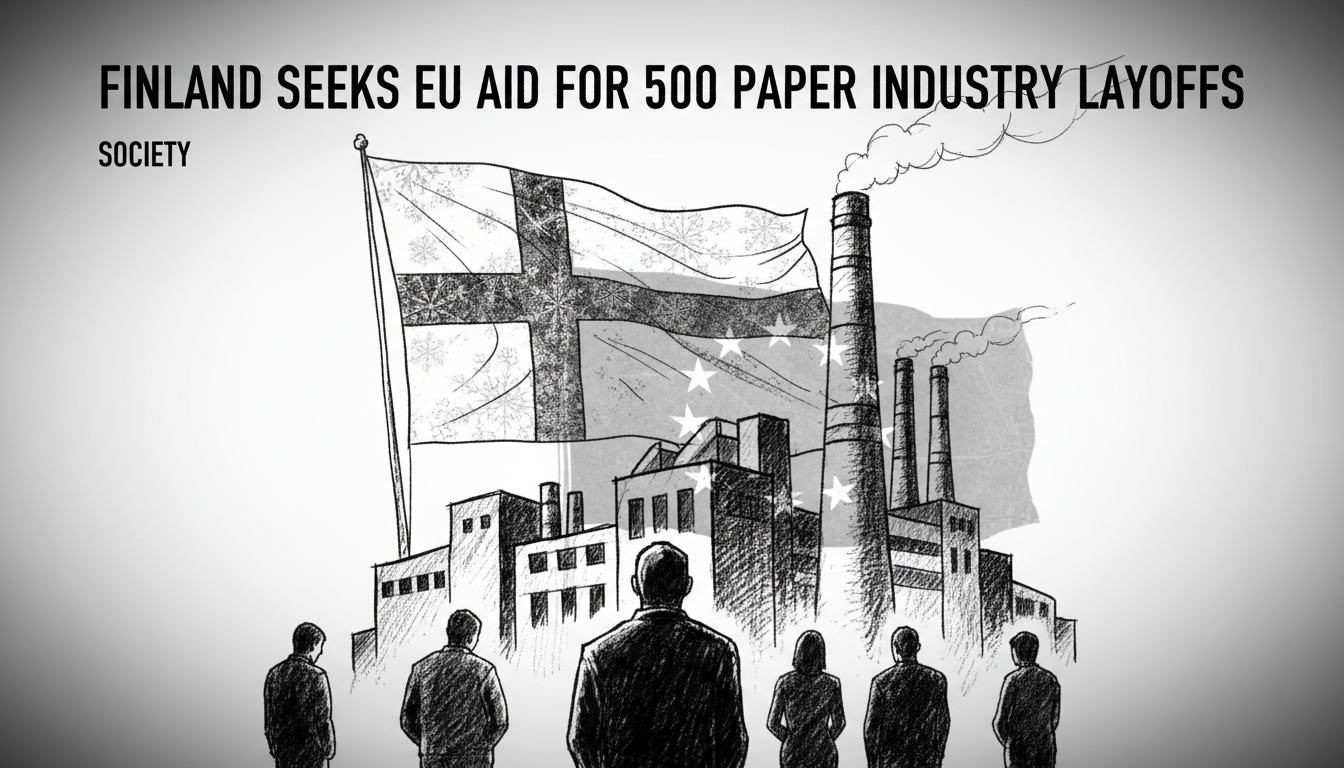
Finland is seeking urgent European Union funding to help hundreds of paper industry workers laid off in the Etelä-Karjala region find new jobs. The Ministry of Economic Affairs and Employment confirmed it is preparing an application to the European Globalisation Adjustment Fund (EGF) following layoff announcements made in October. This move highlights the continuing structural crisis in Finland's traditional forestry sector and the government's reliance on EU mechanisms to manage regional economic shocks.
A Lifeline from Brussels for South Karelia
The requested funding would finance active labor market measures specifically for workers dismissed from paper mills in South Karelia, a region bordering Russia. The EGF can cover up to 60% of the costs for projects aimed at rapid re-employment, which can include vocational training, career coaching, support for entrepreneurship, and relocation allowances. The exact number of affected workers and the requested sum will be detailed in the formal application, but it targets those impacted by the October dismissal notices. For the Finnish government, tapping into this EU fund is a standard yet critical procedure to mitigate the social impact of industrial decline in a mono-industrial region.
“The aim is to accelerate the re-employment of the dismissed paper industry workers,” a ministry representative said in a statement, underscoring the program's focus on speed. The European Commission and the European Parliament must approve the Finnish application. Historically, Finland has been a successful applicant to the EGF, having received support for workers in the ICT, metal, and retail sectors in previous years. This existing track record within the EU bureaucracy is likely to smooth the process.
The Persistent Decline of a National Engine
This application is not an isolated event but part of a long-term trend. Finland's paper industry, once a global powerhouse and a cornerstone of its export economy, has faced decades of pressure. Declining demand for traditional paper products, rising energy and raw material costs, and intense global competition have forced continuous restructuring. Mills have closed or reduced capacity across the country, with regions like South Karelia, where the local economy is deeply intertwined with a single mill, feeling the effects most acutely.
The situation exposes a central challenge for Finnish economic policy: transitioning industrial communities built around a single employer. While the EGF offers a temporary financial buffer, it does not create new jobs or industries. The fund's interventions typically last 24 months, providing a bridge for workers but not a permanent solution for the region. The success of such measures depends heavily on whether the new skills taught align with actual vacancies in the growing sectors of the Finnish economy, such as clean technology, health services, and digital industries.
Expert Analysis: Retraining is Only the First Step
Economic analysts point to the mixed results of large-scale retraining programs. “The EGF is a vital social instrument that demonstrates European solidarity, but its effectiveness is ultimately determined by what happens after the training ends,” says Dr. Laura Saarelma, a senior researcher at the Labour Institute for Economic Research. “The real test is whether there are viable companies in or near South Karelia ready to hire these retrained workers. Otherwise, we risk training people for jobs that exist only in theory, or in cities far from their homes.”
This geographic mismatch is a key concern. South Karelia's remote location in southeastern Finland complicates economic diversification. Encouraging entrepreneurship through EGF-funded startup grants is one pathway, but creating a sustainable ecosystem for new businesses requires broader regional development policies beyond the scope of the EU fund. Furthermore, automation continues to reshape manufacturing, meaning that even if new industrial investment arrives, it may not employ the same number of people as the old paper mill.
The EU's Role in National Labor Crises
The European Globalisation Adjustment Fund represents a tangible, if limited, aspect of EU social policy. Established to help workers affected by globalization-related trade shifts, it allows member states to share the financial burden of adjustment. For Finland, a net contributor to the EU budget, applying for EGF support is also a way to recoup some European funds to address a domestic crisis exacerbated by international market forces. It frames a national industrial decline within a common European narrative of managing globalization's downsides.
The process also involves strict EU oversight. Finland's application must prove the layoffs are directly linked to major structural changes in global trade patterns and involve a significant number of jobs. It must then submit a detailed co-financed action plan showing how the money will be spent, with regular reporting on outcomes. This EU-level scrutiny adds a layer of accountability, ensuring the funds are used for active labor market policies rather than passive income support.
Looking Beyond the EU Funding Cycle
The Finnish government's next steps will be closely watched. While securing EGF money is the immediate administrative task, policymakers in Helsinki face mounting pressure to develop a long-term strategy for regions like South Karelia. This likely involves integrating EU-funded worker support with national initiatives for business development, infrastructure investment, and research & development incentives aimed at these areas.
Some experts advocate for a more radical place-based economic policy. “We need to stop trying to retrain paper mill workers solely for jobs in the tech sector in Helsinki,” argues Professor Mikko Valtakari of the University of Eastern Finland. “The focus should be on identifying and supporting the inherent strengths and potential new specializations of the region itself—whether in circular bioeconomy, sustainable tourism, or specialized manufacturing. The goal is to build resilient local economies, not just relocate workers.”
The coming months will reveal the scale of the planned support package for South Karelia. As the Ministry of Economic Affairs and Employment finalizes its application to Brussels, the affected workers are left in a precarious position, relying on a complex EU mechanism to help navigate a profoundly personal career crisis. The outcome will serve as another case study in whether European solidarity can effectively cushion the blow of global economic shifts for communities whose identities are tied to fading industries.