
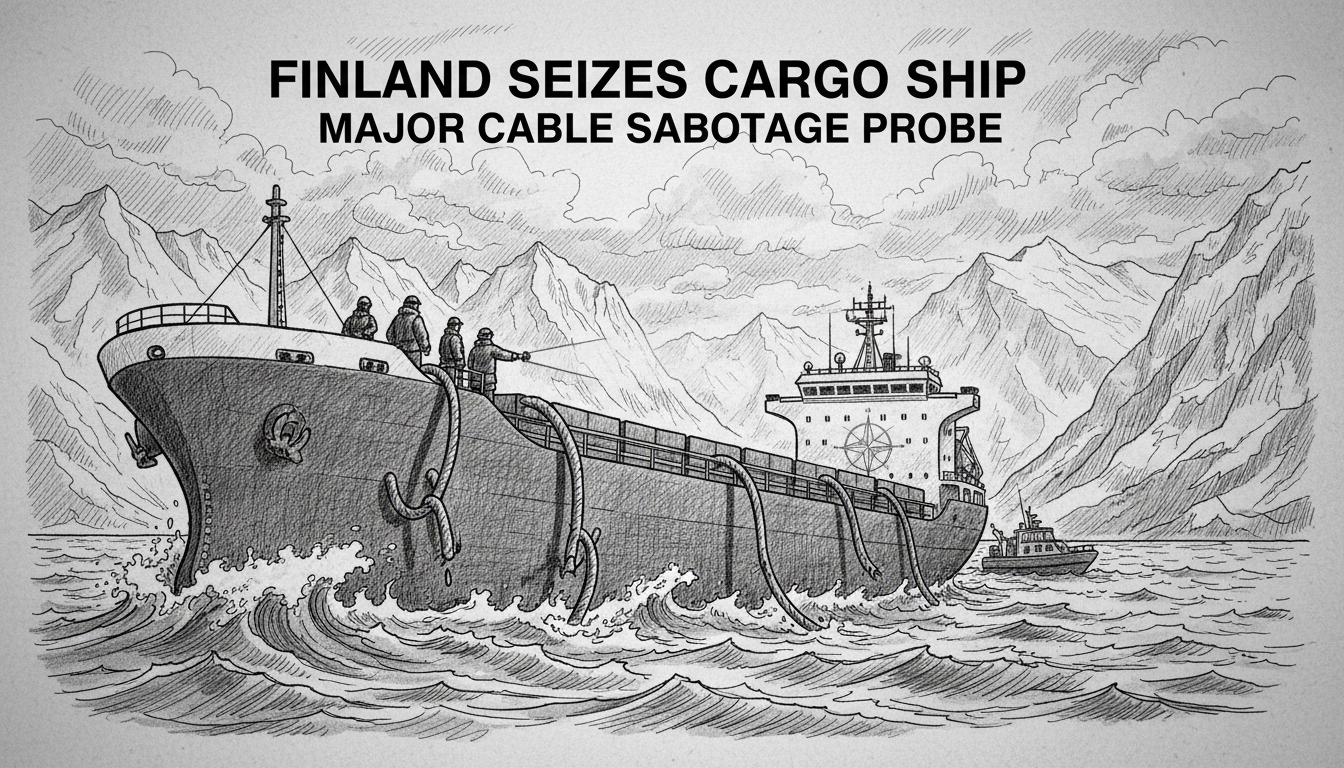
Finland's Central Criminal Police (KRP) has seized a 92-meter cargo vessel at the heart of a probe into the sabotage of critical undersea infrastructure. The KRP confiscated the Hong Kong-flagged MV Fitburg on Wednesday morning as part of an escalating investigation into deliberate damage to a vital Elisa telecommunications cable in the Gulf of Finland. This move marks a significant escalation in a case that has put the Nordic nation's digital security and maritime borders under intense scrutiny.
A Coordinated Seizure and Suspected Sanctions Bust
The seizure, which began at 8:00 AM local time, enables forensic technicians to conduct a detailed examination of the vessel. Police will simultaneously question the crew. 'The seizure is necessary at this stage for the pre-trial investigation,' a KRP spokesperson confirmed. Prior to the police action, Finnish Customs had already placed an administrative hold on the ship's cargo—a load of steel products—amid suspicions of 'aggravated sanctions offences.' This dual-track investigation suggests authorities are probing both potential trade embargo violations and a grave act of infrastructure sabotage.
The criminal inquiry currently focuses on three specific offences: suspected aggravated damage, attempted aggravated damage, and aggravated disruption of telecommunications. Authorities have taken decisive action against the crew. One individual has been formally arrested and remanded into custody, while three other crew members are under strict travel bans, prohibiting them from leaving Finland.
Echoes of Balticconnector: A Region on Edge
This incident sends a chilling echo of events from October 2023, when the Balticconnector subsea gas pipeline and another telecoms cable between Finland and Estonia were damaged. That event, still under investigation, triggered a profound reassessment of critical undersea asset protection across the Baltic region. The war in Ukraine and a series of mysterious offshore incidents have turned this shallow, busy sea into a focal point for NATO's defensive planning. The Fitburg case intensifies concerns that commercial vessels could be used as platforms for hybrid warfare operations targeting energy and data networks.
Finnish and Estonian authorities are treating the matter with utmost seriousness, establishing a joint investigative team to coordinate efforts. The damaged cable is owned by Elisa, a leading Finnish telecommunications operator serving over 6.8 million customers across Finland and Estonia. Damage to such infrastructure can cause significant data flow disruption and incur massive repair costs, often running into millions of euros.
The Tactics of Undersea Vulnerability
'The Baltic Sea is one of the world's most concentrated areas for subsea energy and data infrastructure, yet it remains notoriously difficult to monitor,' explains Dr. Laura Saarikoski, a maritime security analyst at the Finnish Institute of International Affairs. 'An anchor drag from a large vessel like the Fitburg can cause catastrophic damage, whether intentional or accidental. The immediate priority for investigators is forensic analysis of the ship's equipment and voyage data to establish intent.'
Technical examination will likely focus on the vessel's anchor system, hull markings, and electronic chart data. Investigators will seek to determine if the cable strike matches a plausible accidental track or suggests a deliberate maneuver. The concurrent sanctions investigation into the steel cargo adds a complex layer, raising questions about the vessel's operators and its recent ports of call.
Impact on Finnish Tech and Security Policy
The incident directly touches Finland's technology sector, which relies on resilient data connectivity. Helsinki is a major hub for gaming giants like Supercell (with over $2 billion in annual revenue) and Rovio, as well as a thriving startup ecosystem in districts like Kalasatama and Otaniemi. Reliable, high-speed international data transfer is the lifeblood of these industries. 'Any threat to the physical backbone of our internet is a threat to the core of our digital economy,' notes Mikael Rautanen, a director at the Federation of Finnish Technology Industries. 'This isn't just a security issue; it's a business continuity issue.'
For the Finnish government and its intelligence services, the Fitburg seizure represents a proactive, public application of legal tools to address hybrid threats. It signals a shift towards more assertive maritime policing. The case will also test international legal cooperation, given the vessel's Hong Kong flag and the multinational composition of its crew.
A Long and Challenging Investigation Ahead
While the seizure is a major development, the path to conclusive findings is long. Subsea forensic work is slow, painstaking, and heavily dependent on weather conditions. Determining criminal intent beyond a reasonable doubt in a maritime environment presents unique legal hurdles. The involvement of Estonian police underscores the cross-border nature of both the infrastructure and the investigation required to protect it.
The coming weeks will reveal whether the evidence points to a deliberate act of sabotage, a tragic accident compounded by potential sanctions evasion, or a more ambiguous scenario. The outcome will resonate far beyond this single vessel, influencing NATO's posture in the Baltic Sea and the security protocols for thousands of kilometers of subsea cables that underpin global communications. As Finland integrates deeper into NATO, its handling of this case is being closely watched as a test of Western resolve and technical investigative capability in defending critical infrastructure.