
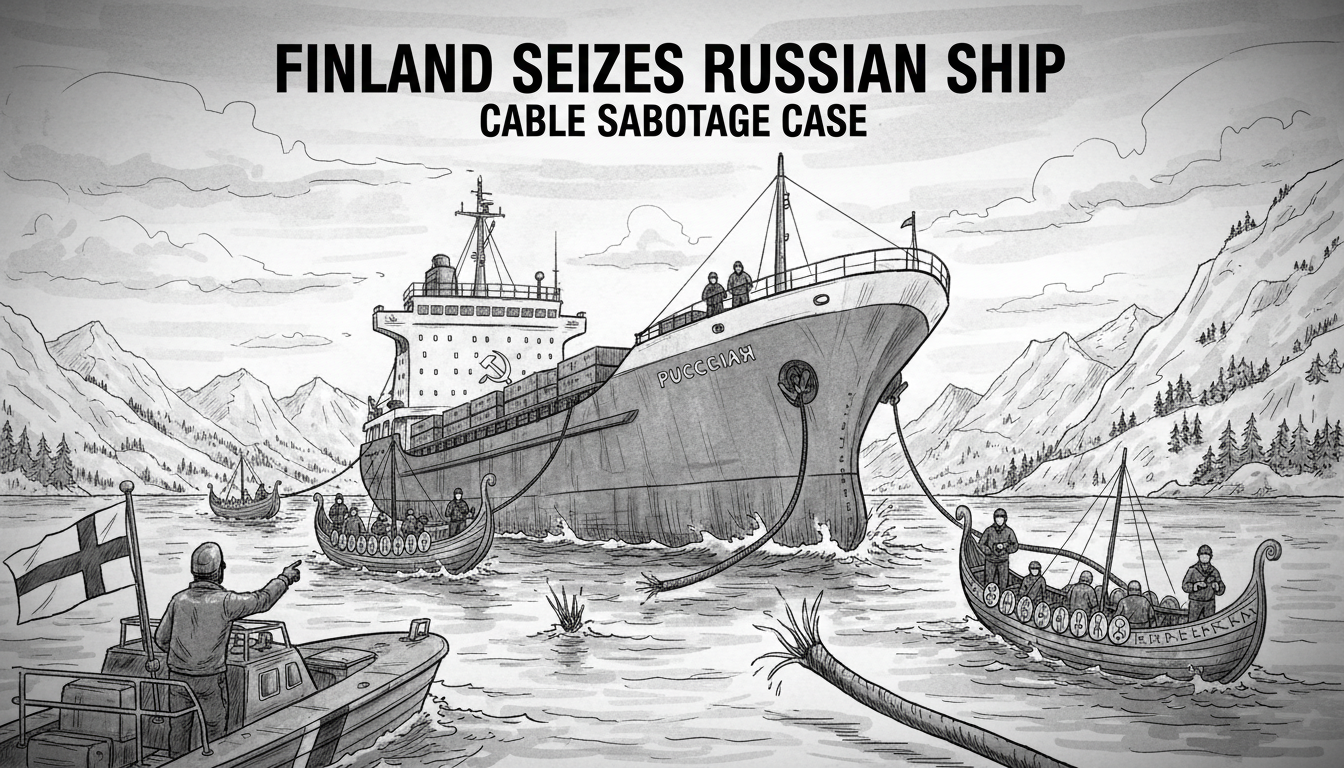
What does the seizure of a Russian ship in Finnish waters signal for the security of the Baltic Sea's critical infrastructure? Finland seized a vessel sailing from Russia on January 1, 2026, on suspicion of sabotaging an undersea telecoms cable linking Helsinki to Tallinn, Estonia. This incident marks a direct escalation in hybrid threats facing the Nordic nation since its NATO accession. Finnish police, acting on intelligence, intercepted the ship in the Gulf of Finland and launched a criminal investigation into potential damage to the vital data link. The move immediately reverberated through government corridors in Helsinki and NATO headquarters in Brussels, underscoring the fragile state of regional security.
This is not an isolated event. It follows a pattern of concerning incidents targeting subsea assets in these strategically crowded waters. The seizure places intense focus on Finland's enhanced maritime surveillance capabilities and its willingness to act decisively against perceived threats. For the Finnish government, protecting these invisible lifelines has become a paramount national security objective. The incident tests the resilience of alliances and the practical implementation of Article 5 deterrence in the maritime domain.
A Pattern of Subsea Sabotage Emerges
The January 1st seizure directly echoes damage discovered in October 2023 to the Balticconnector gas pipeline and a separate telecommunications cable between Finland and Estonia. That earlier incident, which Finnish authorities linked to external activity, served as a stark wake-up call. It exposed the vulnerability of energy and data networks fundamental to Nordic and European stability. The Balticconnector, with a capacity to carry 2.6 billion cubic meters of gas annually, was offline for months, highlighting economic and security dependencies.
Undersea cables form the backbone of global communication, carrying over 95% of intercontinental data traffic. The cables crisscrossing the Baltic Sea connect Nordic nations to each other and to continental Europe. They facilitate everything from financial transactions to government communications. Their protection is now a top-tier defense priority. The repeated targeting suggests a deliberate strategy to probe weaknesses and sow uncertainty. Finnish Defense Minister Antti Häkkänen stated recently that "the defense of critical infrastructure is integral to our national defense."
Finland's NATO Membership Changes the Calculus
Finland's accession to NATO on April 4, 2023, fundamentally altered the Baltic Sea's security architecture. It turned the entire Gulf of Finland into NATO waters, significantly complicating adversarial operations. This new reality means any attack on Finnish infrastructure is an attack on the Alliance. The seizure of the Russian vessel is among the first major tests of this post-accession environment. It demonstrates Finland's proactive stance within the NATO framework, moving from a policy of restraint to one of active interdiction.
The Finnish Border Guard and Navy have substantially increased patrols and underwater monitoring since 2023. Investments in seabed surveillance technology have been prioritized in recent defense budgets. This incident validates those expenditures. From the government district in Helsinki, officials coordinate closely with NATO's maritime command. The message is clear: Finland will not tolerate tampering with its sovereignty or its critical links to allies. This operational shift is supported by a political consensus across the Eduskunta, Finland's parliament.
Expert Analysis: A Deliberate Signal and a Test
Security analysts interpret the cable incident as a multifaceted hybrid threat. "This is a classic gray-zone tactic," said a senior fellow at the Finnish Institute of International Affairs, who spoke on background. "It creates plausible deniability for the actor while sending a clear message of capability and intent. The goal is often disruption and intimidation, not necessarily all-out conflict." The difficulty of definitive attribution complicates the response. Finnish authorities have not publicly named a state sponsor, focusing on the judicial process, but the vessel's origin points unequivocally eastward.
Experts emphasize that such acts test NATO's cohesion and response protocols. "It probes where the red lines are for Article 5 implementation in non-kinetic scenarios," the analyst added. The situation demands a calibrated response that deters further action without escalating unnecessarily. For Finland, balancing a firm judicial response with diplomatic channels is crucial. The incident also highlights the need for deeper regional cooperation on seabed protection with Estonia, Sweden, and other Baltic states. Joint monitoring and rapid response agreements are likely to be accelerated.
The Path Forward: Hardening Defenses and Alliance Solidarity
The immediate solution lies in continued investigation and hardening of defenses. Finland is expected to push for a coordinated NATO strategy on protecting critical undersea infrastructure. This includes shared surveillance, standardized threat assessments, and clear protocols for incident response. The European Union is also activating its toolbox, with the 2023 EU Directive on the resilience of critical entities providing a framework for member states. Finland will advocate for its stringent application in the maritime domain.
Technologically, this means more investment in autonomous underwater vehicles, sonar networks, and satellite monitoring. Politically, it requires sustained commitment from all Baltic Sea NATO members. The Finnish government's resolve, demonstrated by this seizure, sets a precedent. Future security discussions in Brussels will heavily feature undersea cable and pipeline protection. The cost of inaction is too high, given the region's reliance on these assets for its digital economy and energy security.
A New Era of Vigilance in the Baltic
Finland's decisive action on January 1st marks a new chapter in Baltic Sea security. It moves the conflict from the abstract realm of cyber threats to the tangible, physical world of maritime law enforcement. The seized ship is now evidence in a legal process that could have significant geopolitical ramifications. This incident underscores that security in the Nordic region is no longer just about territorial borders but about protecting the hidden infrastructure that sustains modern society.
The ongoing investigation will shape Finland's future policy and its relations with Russia. It reinforces the necessity of Finland's NATO membership and the collective defense principle. As the Baltic Sea grows more contested, such vigilance becomes the norm rather than the exception. The fundamental question remains: can the alliance develop effective systems to deter and defend against these covert attacks without triggering a wider confrontation? The answer will define security in Northern Europe for years to come.