
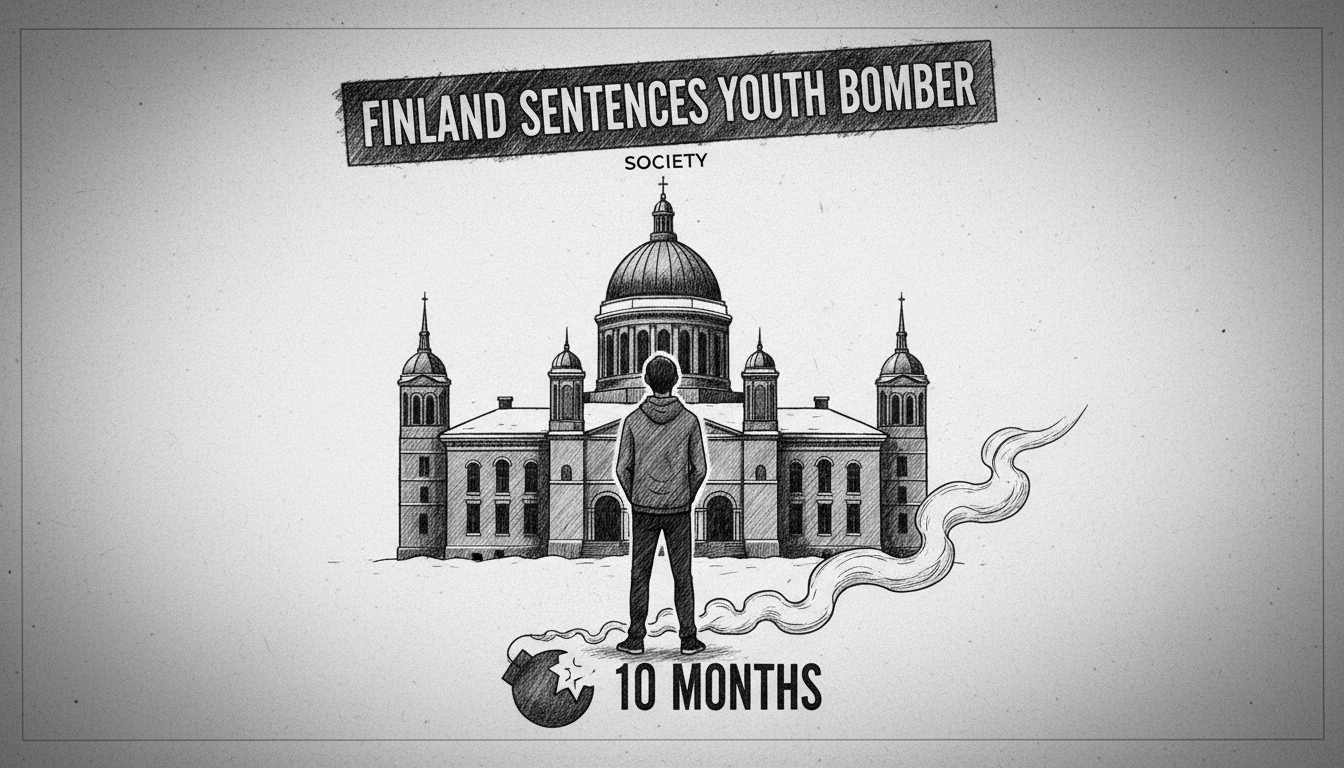
Finland's justice system has sentenced a 17-year-old to a 10-month suspended prison term for planting a functional bomb disguised as a gift at a family's mailbox in Kouvola. The Kymenlaakso District Court handed down the verdict for a series of offenses, highlighting what judges called the youth's "persistent intent to cause harm" and a complete indifference to how many people might be injured. The explosive device failed to detonate only because the glue on a string in the trigger mechanism failed when the package was opened.
A Package of Peril
The case centered on events in Kouvola during May and June of last year. According to the court documents, the then-17-year-old male wrote the name and address of a resident on a cardboard box containing the bomb. He then placed the package, disguised as a gift, at the family's mailbox during the night. A family member discovered it the next day, carried it inside their home, and opened the lid. The court established that the explosive was operational and dangerous. Its failure was purely mechanical, averted by a faulty adhesive bond on the triggering cord.
Beyond the explosives offense, the youth was convicted of reckless handling of dangerous materials, causing danger, attempted assault, and possession of sexually explicit images of a child. The court's characterization was severe. It stated the act was executed in a manner that showed the perpetrator was "completely indifferent to how many people would be injured" in an explosion.
Rehabilitation Over Incarceration
The sentence reflects Finland's foundational principles regarding young offenders. The focus is overwhelmingly on rehabilitation and societal reintegration rather than punitive incarceration. The 10-month prison term is conditional, meaning the youth will not serve time in a prison cell unless he commits another crime during a set probation period.
The more significant component is the 15 months of court-ordered supervision. This measure involves regular monitoring by a criminal sanctions agent. The supervisor's role is to guide the young person, ensure they adhere to set conditions, and support their positive development. Conditions often include adhering to a set schedule, attending school or work, and possibly participating in mandated programs aimed at addressing the root causes of criminal behavior.
"The Finnish system operates on the understanding that a young person's brain and decision-making capabilities are still developing," explains a Helsinki-based legal scholar familiar with juvenile justice. "The goal is to interrupt a path toward a criminal career, not to solidify it through exposure to a prison environment. Supervision is the key tool, providing structure and support while holding the individual accountable."
This approach is embedded in Finnish law, which requires courts to consider the offender's age, maturity, and personal circumstances explicitly. For severe crimes, secure juvenile institutions exist, but their ethos is treatment and education. The Kouvola bomb case, while alarming, did not meet the threshold for such institutional placement, given the device's failure to explode and the offender's age.
A Dark Digital Influence
The court documents revealed a disturbing element that informed the perpetrator's motives. Based on internet search history, the youth had demonstrated a specific interest in violence and, notably, in the figure known as the "Unabomber." This refers to Theodore Kaczynski, the American mathematician who conducted a nationwide mail bombing campaign in the United States over nearly two decades.
This detail adds a complex, modern layer to the case. It points to the potential role of online radicalization or the consumption of violent ideologies in shaping criminal intent. For experts, it underscores a challenge facing rehabilitation efforts: addressing not just behavior but the consumption of harmful digital content that may have fueled it. The supervision period will likely involve efforts to understand and counter these influences.
Weighing Severity and Second Chances
Public reactions to such cases often involve questions about sentencing leniency. The potential harm was catastrophic—a functional bomb brought into a family home. Legal experts acknowledge this tension but point to the system's long-term outcomes.
"The court must weigh the gravity of the act itself against the age and rehabilitative potential of the offender," the legal scholar notes. "A conditional sentence with strict supervision is not an absence of consequence. It is a consequential intervention designed to be transformative. The alternative—an unconditional prison sentence for a 17-year-old—can be a recipe for creating a more hardened, socially excluded adult offender."
Finland's recidivism rates for young offenders processed through its community-based sanctions are among the lowest in Europe. This statistic is a central pillar of the justice philosophy. The system prioritizes preventing the next crime over punishing the last one with maximal severity.
The Road Ahead Under Supervision
The convicted youth now enters a critical phase. For the next 15 months, his life will be under official scrutiny. The success of this intervention hinges on the quality of supervision and the youth's engagement with the process. Authorities will work to ensure he continues his education or finds employment, factors strongly linked to desistance from crime.
Simultaneously, the support systems must address the psychological factors that led to such a dangerous act. This includes the fascination with extremist violence and the possession of illegal imagery. Failure to comply with the terms of supervision could lead to the suspended prison sentence being enforced.
For the targeted family in Kouvola, the event leaves a lasting psychological impact. Knowing that a functional explosive entered their home, however briefly, creates a profound sense of violation. The court's verdict may offer some legal closure, but the emotional aftermath persists.
This case sits at the intersection of juvenile justice, digital-age radicalization, and community safety. It tests the boundaries of Finland's rehabilitative model against a crime of terrifying potential. The system has placed its bet on guidance and oversight. The coming months will reveal whether that bet leads a young man away from violence and toward a responsible future, or if the indifference noted by the court proves too deep to reach.
The final measure of this sentence will not be found in its duration but in its outcome: whether supervision can succeed where a failed detonator cord fortunately did.