
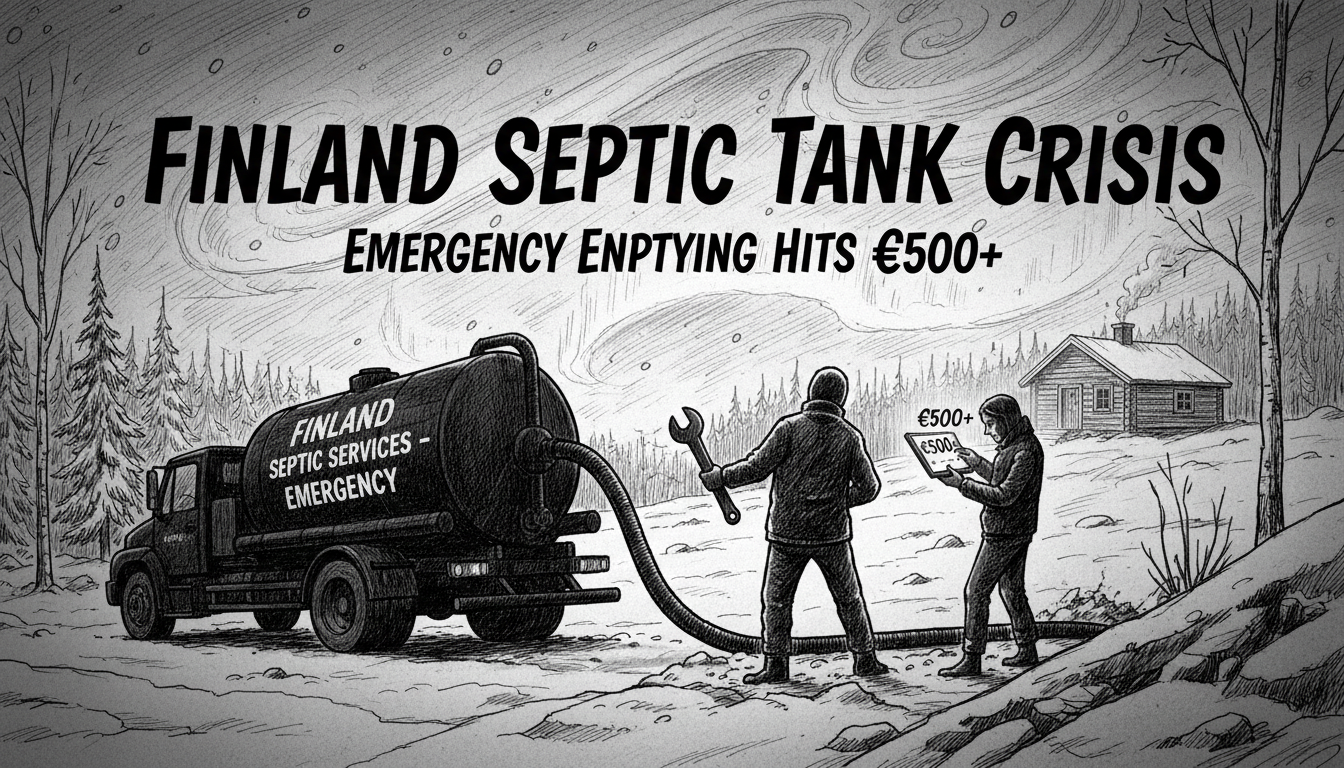
Finland's wastewater management costs are surging for thousands of rural homeowners. The Uusimaa waste management board has introduced new emergency service fees for septic and closed tank emptying in five municipalities, with urgent calls now potentially exceeding 500 euros. This policy shift, affecting Sipoo, Askola, Pornainen, Porvoo, and Loviisa, places a significant new financial burden on residents who rely on private wastewater systems and failed to anticipate an urgent weekend call-out.
A Sudden Price Shock for Rural Homeowners
The decision, ratified by the Uusimaa Waste Management Board (jätelautakunta), represents a direct move to offset the high operational costs of providing on-demand, out-of-hours service. For properties not connected to municipal sewer networks—a common scenario in more spread-out areas of these municipalities—septic tanks (saostuskaivo) and closed tanks (umpisäiliö) are essential infrastructure. These require professional emptying typically once every one to three years, a routine cost factored into household budgets. The new emergency fee transforms a manageable planned expense into a potential financial shock. A family facing a suddenly overflowing tank on a Friday evening or during a public holiday now confronts a bill that could be double or triple the standard rate.
This change highlights the growing economic pressures on regional waste management services across Finland. Fuel costs, labor expenses, and maintenance for specialized vacuum tanker trucks have all risen sharply. The board's rationale is that the standard waste tariff, paid by all residents, should not subsidize the premium cost of emergency interventions for individual property owners. Instead, those requiring immediate service must bear the full cost of mobilizing a crew outside normal working hours. The policy is framed as a matter of fairness, but its implementation feels punitive to those on the receiving end.
The Mechanics of Mandatory Waste Management
To understand the impact, one must grasp Finland's structured approach to waste. The Environmental Protection Act mandates proper wastewater treatment to safeguard groundwater and surface water quality. Municipalities are responsible for organizing this service, often delegating operational planning to regional waste boards like the one in Uusimaa. These boards set the waste fees (jätemaksu) that appear on every property tax bill, covering the cost of organized waste collection, recycling centers, and often, a baseline subsidy for septic emptying.
The system is designed for predictability. Homeowners are expected to monitor their tank levels and schedule emptying during regular business hours. The new emergency fee is a deterrent, aiming to reduce non-essential out-of-hours calls and encourage proactive maintenance. However, malfunctions are not always predictable. A sudden failure of a pump, an unexpected influx of guests, or a rapid frost thaw can precipitate a crisis requiring immediate action to prevent environmental contamination and health hazards.
Expert Analysis: Efficiency vs. Equity
Environmental and municipal finance experts are divided on the policy's merits. Some analysts support the board's logic. "From a pure cost-recovery standpoint, this is a rational decision," says a Helsinki-based consultant specializing in municipal infrastructure, who asked not to be named as they work with several waste boards. "Emergency services consume disproportionate resources. Assigning that cost directly to the user creates a clear economic signal to avoid emergencies through better planning."
Other experts warn of unintended consequences. Dr. Laura Heikkilä, a researcher in rural policy at the University of Eastern Finland, argues the policy overlooks socioeconomic realities. "We are not talking about luxury service here; we are talking about basic sanitation. A fee over 500 euros is a substantial sum, particularly for elderly residents on fixed incomes or young families in their first homes," Heikkilä notes. "The risk is that people will delay calling for service even in a genuine emergency, leading to worse environmental damage and higher public clean-up costs down the line. It also exacerbates the urban-rural divide, where rural residents pay directly for services that are invisibly included in urban water bills."
Heikkilä points out that the fee structure may be perceived as penalizing residents for infrastructure choices that are often not a preference but a necessity due to a property's location. The policy shift in Uusimaa could set a precedent, prompting other regional waste boards across Finland to implement similar emergency surcharges as they grapple with tightening budgets.
Municipal Response and Resident Reactions
Reactions in the affected municipalities have been mixed. Local officials in Porvoo and Loviisa have acknowledged residents' concerns but stress the decision was made at the regional board level, where municipalities are represented. They advise homeowners to familiarize themselves with their tank systems, know the signs of nearing capacity, and schedule emptying well in advance of any potential problems.
On community social media forums, the response is less measured. Many residents express frustration, feeling blindsided by a significant cost hike for an essential service. "This is like charging a massive fee for calling the fire department," wrote one Askola resident online. "We pay the annual waste fee faithfully. What is it for if not to cover the service when we actually need it?" Others share practical tips, recommending specific companies known for reasonable rates or suggesting forming local cooperatives to negotiate better service contracts.
A Look Ahead: Policy Ripples and Prevention
The Uusimaa decision is more than a local fee adjustment; it is a test case for the financing of rural utilities in Finland. As infrastructure ages and climate change brings more volatile weather, the strain on decentralized systems like septic tanks will likely increase. Policymakers will be watching to see if the emergency fee successfully reduces call-outs without causing negative public health or environmental outcomes.
Alternatives exist. Some experts propose a tiered warning system, where a first emergency call in a multi-year period incurs a smaller fee, with steeper penalties for repeat occurrences. Others advocate for increased state or municipal subsidies for the installation of modern, alarm-equipped tank systems that provide early warnings, preventing most emergencies before they start.
For now, the message to homeowners in Sipoo, Askola, Pornainen, Porvoo, and Loviisa is starkly clear: mark your calendar for regular septic maintenance. The cost of forgetting has just been priced, and it starts at over 500 euros. The broader question remains whether making essential sanitation a financial gamble is a sustainable path for Finland's countryside.