
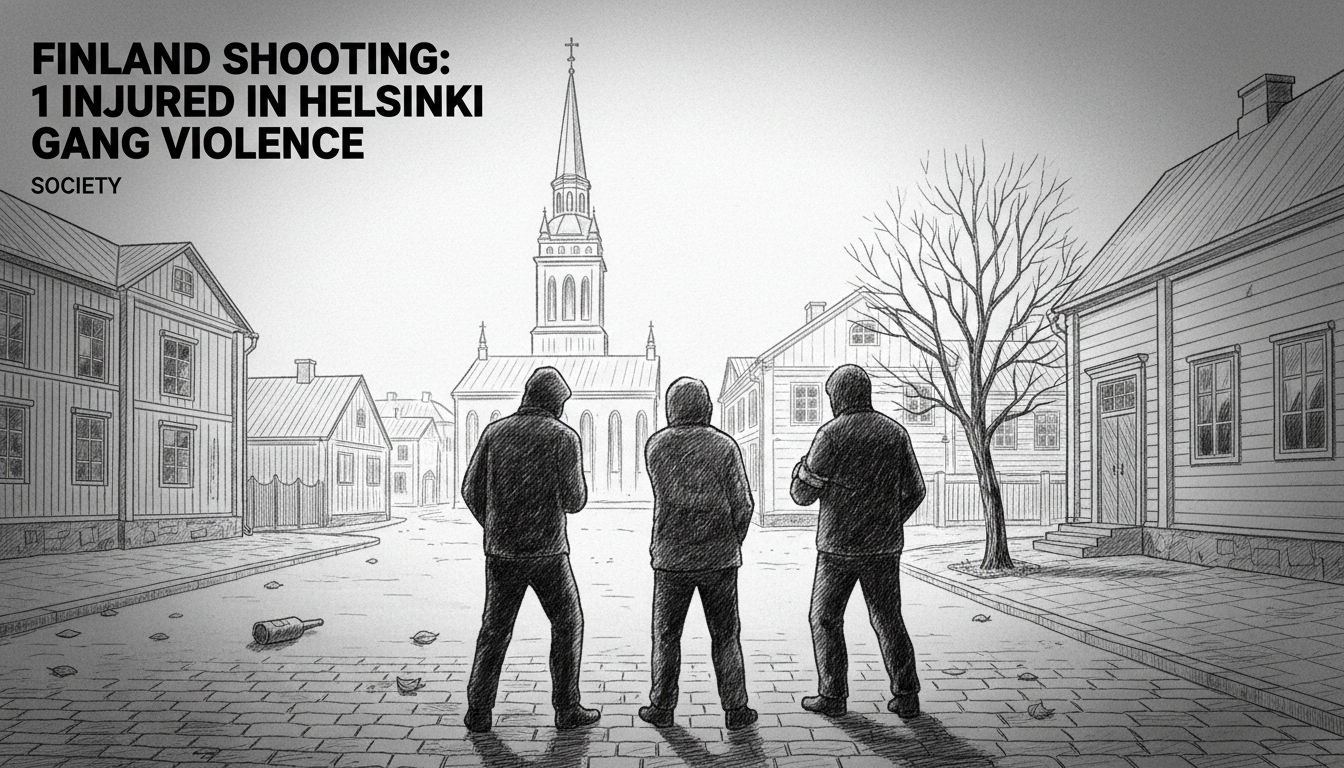
Finland's capital Helsinki was shaken by a shooting in the Vesala district on the night of December 7th, leaving one person injured by gunfire. Police are investigating the incident as a suspected clash between two rival groups traveling in separate cars, a violent episode that punctures the city's typically calm atmosphere. The shooting occurred just hours after Finland's Independence Day celebrations concluded, casting a shadow over a national holiday.
Helsinki Police Department has launched a major investigation, appealing directly to the public for witnesses. "We ask persons who have themselves seen the situation described above or otherwise know about the matter to contact us," the department stated. Authorities provided a dedicated phone number and email address for tips, indicating the seriousness with which they are treating the case. The call for public assistance underscores the challenge of gathering evidence in such rapidly unfolding street violence.
A Violent End to Independence Day
The timing of the shooting, in the early hours following Independence Day, is particularly jarring for Finns. December 6th is a solemn day of national reflection and unity, marked by official ceremonies and the traditional Presidential Independence Day Reception. For violence to erupt so soon after underscores a disconnect between national ideals and street-level realities. Vesala, a residential suburb in northeastern Helsinki, is not typically associated with high-profile violent crime, making the incident more alarming for local residents.
Police have released few details about the victim's condition or the specific circumstances that led to the gunfire. The core of their theory, that two carloads of individuals were involved, points squarely towards a targeted conflict rather than a random act. This pattern is familiar to criminologists studying organized crime in the Nordic region. "When you have a shooting involving moving vehicles and specific targets, it almost always indicates a pre-existing dispute between groups," says Dr. Lasse Kivivuori, a professor of criminology at the University of Helsinki. "These are rarely spontaneous events."
Finland's Gun Landscape and Gang Dynamics
Finland maintains some of Europe's strictest firearm regulations, requiring a license for ownership that is predicated on a stated purpose like hunting or sport shooting. With an estimated 1.5 million privately owned firearms in a nation of 5.6 million people, the country has a high rate of legal gun ownership. However, the guns used in gang-related shootings like the Vesala incident are frequently illegal, smuggled into the country or converted from legal models.
The incident fits into a concerning pattern observed by the Finnish National Police Board. While overall homicide rates remain low by international standards, the nature of violence is shifting. In 2022, Statistics Finland recorded 35 homicides involving firearms. A significant portion of these are linked to criminal networks operating in the Helsinki metropolitan area, particularly groups involved in the drug trade. These networks often recruit young people, and conflicts over territory or debts can quickly turn violent.
"The legal framework for firearms is robust, but it is designed to control legal ownership," explains Senior Superintendent Pekka Heikkinen from the National Police Board. "Our ongoing challenge is intercepting the illegal trade and preventing legally held weapons from drifting into the criminal underworld. Incidents like the one in Vesala demonstrate that this challenge persists." Police operations in recent years have focused on disrupting the supply chains for illegal weapons, with increased cooperation across Baltic Sea borders.
Community Impact and Police Response
For residents of Vesala, the shooting transforms familiar streets into a crime scene. The presence of police tape and forensic teams in a residential neighborhood creates a palpable sense of insecurity. While Finland's overall crime rate is low, concentrated incidents of gang violence can disproportionately affect community morale. Local politicians often face pressure to increase visible police patrols and social interventions in the aftermath of such events.
The Helsinki Police response follows a now-standard protocol for serious violent crime. Securing the scene, collecting ballistic evidence, and canvassing for CCTV footage from homes and businesses are immediate priorities. The public appeal for witnesses is a critical component, as bystander accounts can help establish the sequence of events and identify the vehicles involved. The effectiveness of this investigation will be a test of both police resources and community trust.
Success in solving such cases is not just about making arrests. It is about demonstrating that this type of violence will be met with a determined and competent response. A swift resolution can deter future acts, while a stalled investigation may embolden criminal groups. The pressure on investigators is significant, balancing the need for thorough evidence collection with the public's demand for answers and safety.
A Broader View of Nordic Security
This shooting in Helsinki invites comparison with its Nordic neighbors. Sweden has grappled with a significant increase in gang-related shootings and explosions in recent years, a crisis that dominates political debate. Norway and Denmark have also seen episodes of gang violence, though often on a smaller scale. Finland has generally been viewed as an exception to this troubling regional trend, with lower levels of organized criminal violence.
The Vesala incident prompts a sobering question: is Finland an exception, or merely lagging behind? Criminologists caution against drawing sweeping conclusions from a single event. However, they note that the underlying conditions—profitable drug markets, marginalized youth populations, and the availability of illegal weapons—exist in Helsinki as they do in Stockholm or Copenhagen. "No Nordic country is an island in this regard," Dr. Kivivuori notes. "Criminal networks are transnational. Methods of conflict, including the use of firearms in public places, can be copied and adopted. The key is whether the societal and policing structures can contain and suppress these patterns."
Finland's approach has combined proactive policing with strong social welfare systems aimed at prevention. The country invests heavily in youth services, education, and social inclusion, theories that addressing root causes is the best long-term defense against organized crime. Yet, as this shooting shows, no system is impervious. The challenge for policymakers is to assess whether current prevention and enforcement strategies need recalibration in the face of evolving criminal tactics.
Looking Ahead: Safety and Scrutiny
The immediate aftermath of the Vesala shooting will focus on the criminal investigation and the victim's recovery. The longer-term conversation will inevitably turn to policy. Opposition politicians are likely to question whether the government is doing enough to combat gang crime. The governing coalition, led by Prime Minister Petteri Orpo, will point to ongoing police initiatives and cross-border cooperation. Minister of the Interior Mari Rantanen will face questions in the Eduskunta about urban safety and resource allocation for police.
This incident also arrives amidst broader European Union discussions on harmonizing gun control measures and improving intelligence sharing on organized crime. Finland, currently implementing the EU's revised Firearms Directive, may find its domestic experience contributing to those wider talks. The directive focuses on tightening rules on deactivated firearms and improving tracing, measures directly relevant to disrupting the black market.
For now, Helsinki residents are left with unsettling questions. Was this a isolated confrontation, or a sign of escalating tensions? The police investigation holds the answers. Its findings will determine whether Vesala returns to quiet normality or becomes a symbol of a new, more volatile chapter for security in the Finnish capital. The peaceful image of Finland, so central to its national identity, now bears a fresh crack.