
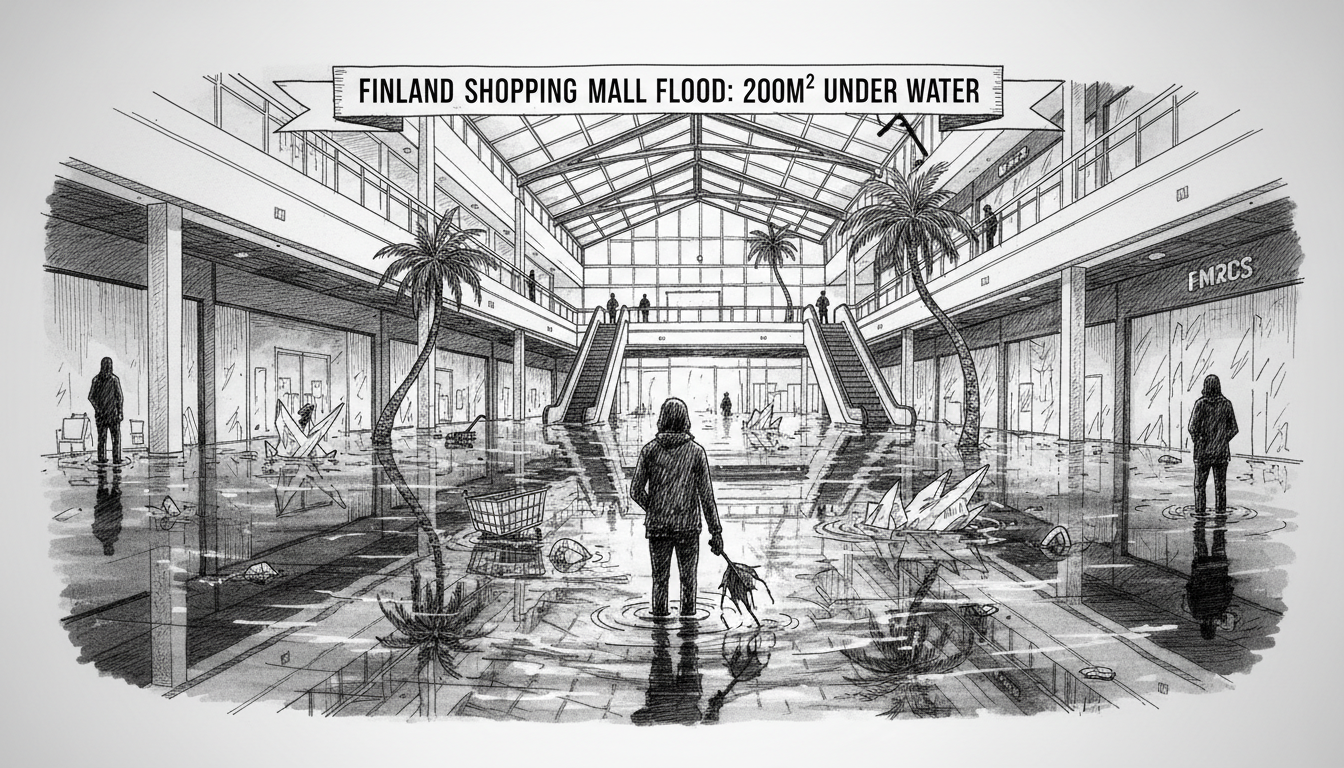
Finland's Ainoa shopping center in Espoo faced significant disruption today as a pipe leak sent water flooding across approximately 200 square meters of the commercial space. The Espoo Rescue Department responded to a medium-sized damage control alert, deploying multiple units to the scene after reports indicated a one-centimeter layer of water had spread through the affected area. Rescue services are now working alongside the mall's maintenance team to pump out the water and assess the full extent of the damage to the popular retail hub.
This incident highlights the vulnerability of large, complex commercial structures to sudden infrastructure failures. Shopping centers like Ainoa serve as critical community and economic nodes in Finnish urban areas, particularly in growing cities like Espoo. A water leak, while seemingly minor at one centimeter deep, can trigger a cascade of operational shutdowns, safety inspections, and costly repairs for individual tenants and the property owner.
Emergency Response in the Helsinki Metro Area
The Espoo Rescue Department classified the call as a medium-sized damage control task, indicating a significant but contained incident requiring coordinated resources. Multiple rescue units were dispatched to the Ainoa shopping center, located in the district of Tapiola, a central hub in Espoo. Their immediate priority was to stop the source of the leak and begin water removal operations in collaboration with the mall's technical staff.
Such a rapid response is standard protocol for the well-regarded Finnish rescue services, but it underscores the serious implications of water intrusion in public spaces. "Our first task is to secure the area and prevent further damage," a rescue department spokesperson said in a statement. "We work methodically with the property management to mitigate the impact." The presence of several units suggests a focus on both water extraction and ensuring there were no electrical or structural safety hazards created by the flooding.
The Economic Ripple Effect of a Mall Flood
While the physical water depth was reported as minimal, the economic and logistical depth of the problem for retailers is potentially severe. Ainoa shopping center houses numerous stores, restaurants, and service providers. Water damage can ruin inventory, damage flooring and fixtures, and force businesses to close temporarily during cleanup and repairs. For smaller tenants, even a day of lost revenue can be a serious financial blow.
Insurance experts point out that incidents like this test both the building's infrastructure and the business continuity plans of its tenants. "A pipe leak in a common area triggers a complex chain of liability and insurance claims," explains Martti Koskinen, a Finnish risk management consultant specializing in commercial property. "The property owner's insurance will address the building damage, but each tenant must file separate claims for their own lost income and damaged stock. The speed of the initial response is crucial to limiting those secondary losses."
Furthermore, modern shopping centers are dense with electrical systems, data cabling, and ventilation ducts often located in false ceilings or under floors—all vulnerable to water exposure. The true cost often lies not in the water itself, but in the necessary inspections, drying procedures, and potential mold prevention treatments that follow.
Espoo's Growing Reliance on Commercial Hubs
This incident occurs in a city where shopping centers play a vital role. Espoo, Finland's second-largest city and part of the capital region, has experienced consistent population growth. Districts like Tapiola, with its iconic Ainoa center, are designed as walkable urban centers where retail, services, and public transport converge. These hubs are not just places to shop; they are social spaces and essential service points for residents.
The disruption at Ainoa therefore has a community impact beyond mere commerce. It may affect people's daily routines, access to services, and the planned use of public space. For the city of Espoo, maintaining the reliability and safety of these key infrastructures is integral to urban functionality. The event will likely prompt internal reviews of maintenance schedules and emergency protocols within the city's major commercial properties.
Maintenance and Climate Pressures on Urban Infrastructure
The pipe leak at Ainoa raises broader questions about the maintenance of Finland's extensive network of indoor public spaces, especially as buildings age. Many successful shopping centers from the late 20th and early 21st centuries are now entering periods where core systems require renewal. Proactive maintenance is economically challenging but far less costly than reactive repairs following a failure.
Additionally, while this incident was an internal pipe failure, it connects to wider discussions on urban resilience. Finland is experiencing wetter autumns and winters due to climate change, increasing the general water load on urban systems. "We must consider water management holistically, from external rainfall to internal plumbing," says architect and urban planner Liisa Virtanen. "Building codes and maintenance standards need to reflect the increased pressure on all water-related systems, whether from the sky or from within the walls."
Effective maintenance requires significant investment and planning. For property management companies, balancing tenant rents with long-term capital expenditure on invisible systems like plumbing is a constant challenge. An incident like this serves as a stark reminder of what is at stake when that balance is not maintained.
The Path Forward for Ainoa and Its Tenants
In the coming days, the focus will shift from emergency response to restoration and accountability. The shopping center's management will need to communicate transparently with tenants about the timeline for full reopening and the process for claiming damages. Some stores may be able to reopen quickly if they were unaffected, while others in the flood's path could be closed for days or weeks.
The event is also a practical test of Finland's robust building safety and insurance frameworks. Inspectors will likely examine the cause of the pipe failure to determine if it was a random fault or a symptom of a wider issue. This investigation will inform not only the repair work at Ainoa but also potentially influence maintenance guidelines for similar properties across the country.
For the public, the incident is a temporary inconvenience but also a lesson in the interconnectedness of modern urban life. A single pipe leak in a mechanical room can disrupt the daily patterns of thousands of people, affect the livelihoods of dozens of business owners, and mobilize city resources. It demonstrates how the smooth functioning of a city relies on the integrity of countless unseen systems. As Espoo and similar Finnish cities continue to grow and densify, ensuring the resilience of this underlying infrastructure becomes not just a technical issue, but a fundamental requirement for sustainable urban living. Will this event prompt a wider re-evaluation of preventive maintenance investments in Finland's commercial heartlands?