
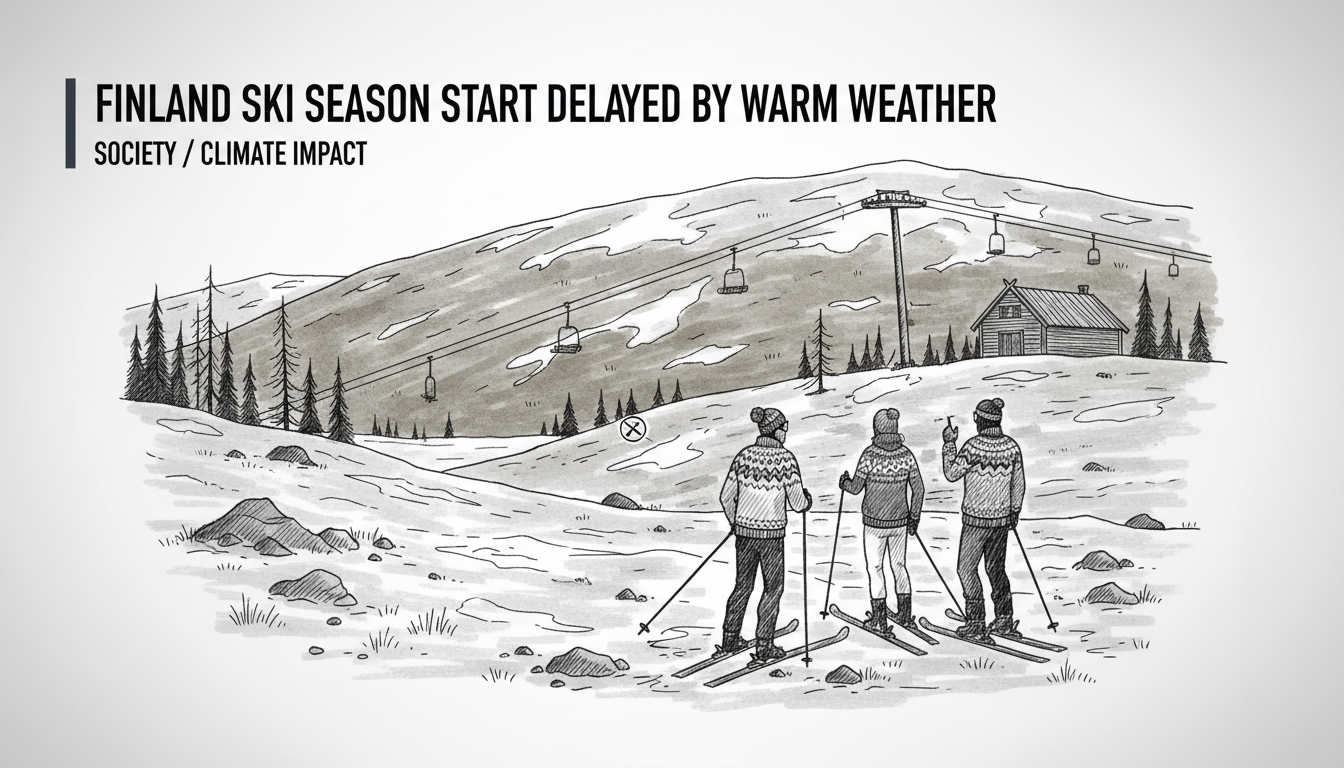
Finland's 2024-2025 ski season is facing significant delays across southern resorts, with unseasonably warm temperatures challenging the traditional winter sports calendar. In Joutseno, the Myllymäki ski resort managed to open just one of its slopes on December 19th, a limited launch directly attributed to a rain-soaked autumn that hampered critical snowmaking operations. This constrained opening, followed by a planned Christmas Eve and Day closure, underscores a growing anxiety within Finland’s winter tourism sector as climate patterns become less predictable. "We started more or less on schedule, even though the autumn was warm and rainy," said resort entrepreneur Jyri Paunonen, striking a cautiously optimistic note that belies the broader challenges.
For families hoping for a traditional white Christmas on the slopes, the reality at many southern Finnish resorts has been one of waiting and watching the weather forecasts. The opening of a single run at Myllymäki represents a hard-won victory for snow cannon operators who battled against above-freezing temperatures. This scene is repeating across the region, where natural snowfall has been sparse and artificial snow production has become a race against time and thermodynamics. The economic stakes are high; the pre-Christmas and holiday period is a crucial revenue window for ski centers, catering to local families and domestic tourists before the international season peaks.
A Regional Challenge Across Southern Slopes
The situation at Myllymäki is not an isolated incident but a symptom of a milder climatic pattern affecting southern Finland. While Lapland’s Arctic resorts in Rovaniemi, Levi, and Ylläs enjoy more reliable cold and deeper natural snowpack, centers in the country’s southern and central lake regions are on the front line of changing winters. The typical season in these areas, which historically runs from late November to April, is becoming compressed and less certain. This variability forces resort managers to make significant capital investments in high-efficiency snowmaking systems, a financial burden that smaller family-run operations may struggle to bear.
Experts point to a clear trend. "The baseline for operating a ski resort in Southern Finland has shifted," notes a recent report from the Finnish Tourism Association. "Reliability is no longer drawn from the weather but from technological capacity and energy reserves." This shift has direct policy implications, touching on energy infrastructure, business subsidies for green technology, and regional economic planning. The Ministry of Economic Affairs and Employment monitors these trends closely, as winter tourism contributes substantially to local economies in rural municipalities like Joutseno.
The Snowmaking Arms Race
To combat the warm spells, Finnish ski resorts are engaging in a technological arms race. Modern snowmaking requires precise conditions: humidity below 80% and air temperatures consistently below -2°C to -3°C. The warm, damp autumn experienced this year provided a very narrow window for effective production. The process is also energy-intensive, linking the ski industry’s viability directly to energy prices and carbon footprint considerations. Resorts are now evaluating more efficient fan and lance systems, as well as exploring renewable energy sources to power their operations, aligning with both economic and national sustainability goals.
This investment is a direct adaptation strategy. "Snowmaking is no longer a backup system; it is the primary system for initiating and maintaining the season in many locations," said a representative from the Association of Finnish Ski Resorts in an interview. The Finnish Meteorological Institute's data supports this strategic pivot, showing a measurable trend toward shorter winter periods with less stable snow cover in the south over the past two decades. This scientific reality is what resort operators now plan for, with business models increasingly built around artificial snow guarantees.
Broader Implications for Finnish Winter Culture
The delayed start to the ski season resonates beyond resort balance sheets, touching a core element of Finnish national identity and lifestyle. Access to winter sports is deeply embedded in the culture, with many children learning to ski through school programs and families prioritizing outdoor winter activities. A inconsistent season disrupts this rhythm, potentially impacting public health initiatives promoting physical activity and the passing of traditions between generations. The Eduskunta has previously discussed supporting sports infrastructure as a matter of public well-being, a debate that may gain new urgency as natural conditions change.
Furthermore, the success of the ski season is interwoven with related industries, including equipment rental, retail, hospitality, and transportation. A slow start or a poor season creates a ripple effect through these sectors. For international tourism, Finland markets itself as a winter wonderland; variability in southern resort conditions could pressure marketing efforts and redirect tourists northward, concentrating economic benefits in Lapland while challenging other regions. The government’s tourism strategy, "Sustainable Growth in Tourism 2022-2028," explicitly aims to distribute tourist benefits across the country, a goal complicated by uneven climatic impacts.
Looking Ahead: Adaptation and Policy
The current season at Myllymäki highlights a critical juncture. The resort’s ability to open even one run is a testament to adaptation, but it also poses a question about long-term sustainability. Policy discussions in Helsinki are beginning to reflect this new normal. Some analysts suggest that support for climate adaptation in the tourism sector, possibly through business investment grants or support for energy-efficient infrastructure, could become a more prominent feature of regional development policy. This aligns with broader EU cohesion funding objectives aimed at supporting economic transition in vulnerable regions.
As the season progresses, all eyes will be on the weather. A sustained cold period could allow Myllymäki and other resorts to fully open their terrain and recover a profitable season. Another warm spell, however, could result in further closures and financial strain. This uncertainty is the new business environment for Finnish winter tourism. The experience at Myllymäki this December serves as a clear case study: the future of skiing in Southern Finland will depend less on hoping for snow and more on planning, investment, and resilience in the face of a changing climate. The question for policymakers is how to ensure this vital part of Finnish culture and commerce does not melt away.