
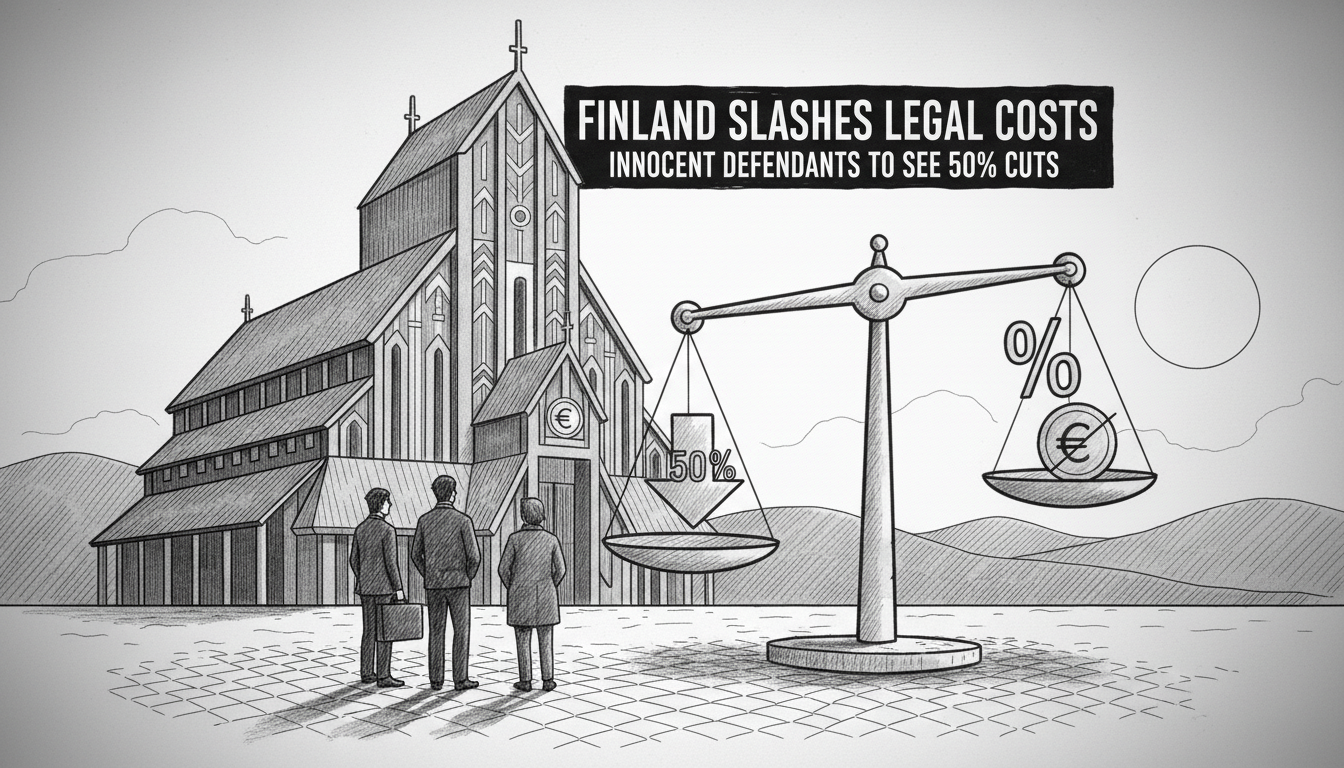
Finland's Ministry of Justice is preparing a draft law that would dramatically reduce compensation for legal costs paid to individuals acquitted of crimes. The proposal, developed without public consultation, could cut reimbursements by nearly half. This move directly challenges a long-standing principle of Finnish law: that those found innocent should not be financially ruined by their defense. The plan has emerged from the government's broader austerity drive, sparking immediate concern among legal experts about fairness and access to justice.
Justice Minister Leena Meri (Finns Party) has not publicly commented on the specific draft. The Ministry of Justice confirmed preparatory work is underway as part of the government's spending review. A ministry official, speaking on background, stated the goal is to achieve "necessary savings" while maintaining a "functioning compensation system." The proposal is expected to be presented to the Ministerial Committee on Economic Policy in the coming weeks before any public presentation.
A Quiet Push for Deep Cuts
The legislative draft was prepared in what sources describe as "complete silence" within the ministry's bureaucracy. Key stakeholder groups, including the Finnish Bar Association and human rights organizations, were not consulted during the initial drafting phase. This lack of engagement is unusual for reforms touching on fundamental legal rights. The process suggests the cuts are being treated primarily as a budgetary exercise rather than a reform of legal principles.
Current law mandates that the state cover the "necessary" legal costs of a defendant who is fully acquitted or against whom charges are dropped. This includes lawyer's fees, expert witness costs, and other court-related expenses. The system is designed to rectify the inherent imbalance where the state, with its vast resources, prosecutes an individual. If the draft becomes law, the compensation criteria would be tightened and the acceptable rates for legal services slashed, leading to the estimated 50% reduction in total payouts.
The Principle of Financial Innocence
Finnish jurisprudence holds that a person cleared of criminal charges should be returned, as much as possible, to the position they were in before the accusation. This includes financial restoration. "The state accuses you, the state should make you whole if you are proven right," explains Professor of Procedural Law, Anna Launio, from the University of Helsinki. "Eroding this principle is dangerous. It introduces a financial risk into defending one's innocence, which is a cornerstone of a fair society."
The existing model is not without critics. Some prosecutors and municipal finance officials argue the system is sometimes exploited, with defendants running up large bills for legal services knowing the state will foot the bill if they win. The proposed cuts are framed by proponents as a way to curb excessive spending and encourage more cost-conscious legal defense. However, critics counter that the fear of not being fully reimbursed may lead innocent people to accept weaker legal representation or even plead guilty to lesser charges to avoid financial catastrophe.
EU Context and Domestic Austerity
This initiative sits within the right-wing coalition government's stringent austerity program, which seeks billions in savings across public services. The justice sector has not been spared. While EU law does not directly mandate specific compensation rates for acquitted individuals, it firmly upholds the right to a fair trial and access to justice. The European Court of Human Rights (ECtHR) has repeatedly ruled that excessive financial barriers to mounting a defense can violate Article 6 of the European Convention on Human Rights.
"There is a clear tension here," says EU law scholar Dr. Markus Heikkilä. "The ECtHR interprets the right to a fair trial broadly. If a person is deterred from mounting a proper defense due to fear of unrecoverable costs, that could become a Strasbourg case. Finland would need to demonstrate that any new system still provides effective access to justice for the innocent." The government's challenge will be to justify the cuts without crossing the line into creating an unfair procedural hurdle.
The Human Impact Beyond the Budget
Beyond the legal principles, the cuts would have a direct human impact. Consider a small business owner falsely accused of fraud. Under the current system, they might hire a specialist lawyer and a financial auditor to dismantle the prosecution's case, costing tens of thousands of euros. If acquitted, they are reimbursed. Under the proposed system, they might only recover half that amount, leaving them with a crippling debt despite their innocence.
"This penalizes the acquitted," says defense attorney Sofia Virtanen. "My client's innocence is binary—they are either guilty or not. A 50% reimbursement tells them, 'You were right, but you still pay.' It transforms a legal victory into a financial defeat." This dynamic could disproportionately affect middle-income individuals. The very poor qualify for full public legal aid, and the very wealthy can absorb the costs, but those in the middle bear the greatest risk.
Political Reactions and Next Steps
The opposition has seized on the issue. Social Democratic Party MP and former Justice Minister, Katri Viinanen, has demanded the government immediately publish the draft. "This is a stealth attack on a fundamental right," Viinanen stated. "They are trying to sneak it through as a line item in a budget document. It deserves full parliamentary debate and public scrutiny." The Left Alliance and the Green League have echoed these concerns, framing the issue as one of societal fairness.
Within the ruling coalition, reactions are mixed but muted. The National Coalition Party (Kokoomus), which leads the government, has traditionally supported business-like efficiency in the public sector but also values legal certainty. The Finns Party, which holds the justice portfolio, has advocated for a tougher stance on crime and cost-cutting. The Swedish People's Party and the Christian Democrats, smaller coalition partners, have yet to take a public position but are known to be sensitive to issues of procedural justice.
The draft law's journey is just beginning. After internal government review, it will be sent for formal comments to various organizations—a stage where the Bar Association and human rights groups will voice strong opposition. It will then proceed to Parliament's Legal Affairs Committee for detailed scrutiny. Given the controversy, the process could be lengthy and contentious, with the final outcome depending on whether coalition discipline holds or if public pressure forces a compromise.
Finland's plan to halve legal cost reimbursements for the innocent raises a profound question: should the state's budgetary pressures be allowed to dilute the principle that winning your freedom in court should not come with a life-altering bill? The government sees necessary savings; the legal community sees a dangerous precedent. As the draft moves from ministerial silence into the harsh light of public debate, Finland is set for a fierce clash over what it truly means to be found innocent.