
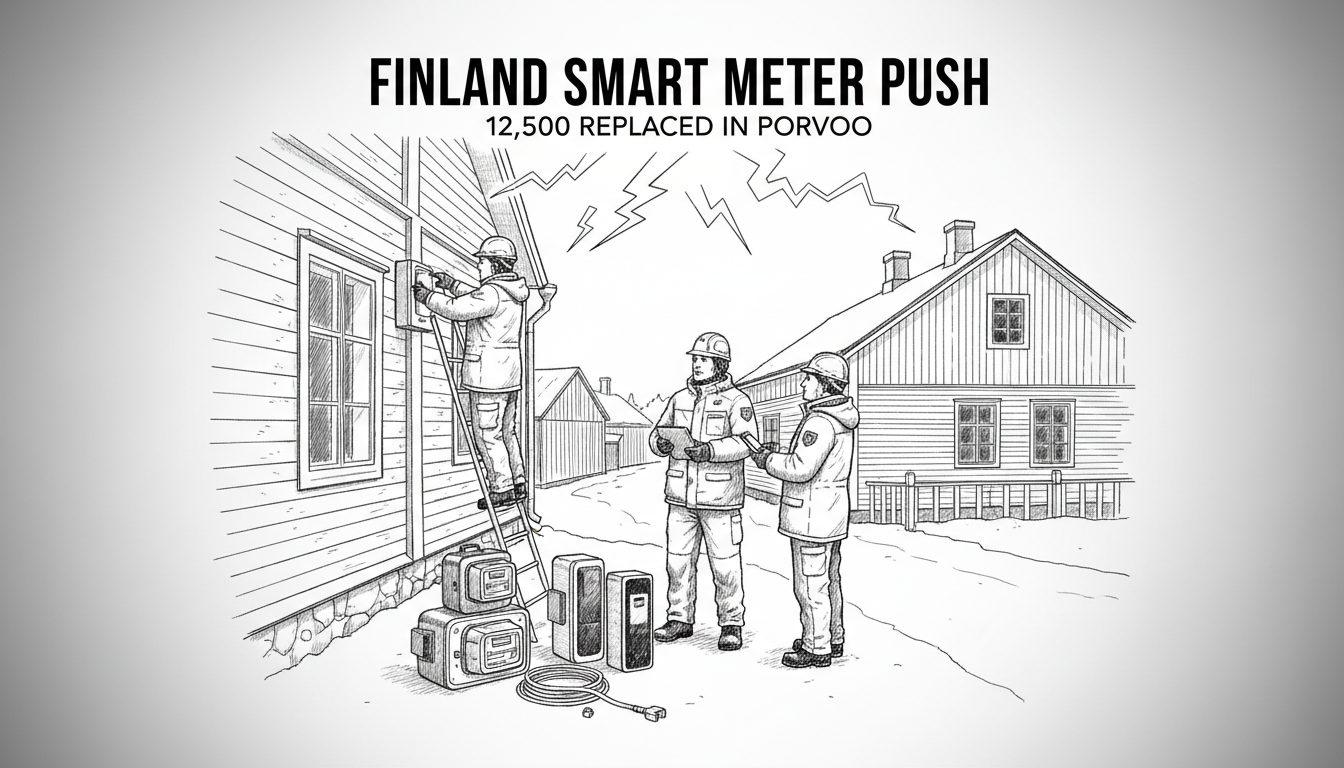
Finland's nationwide upgrade to smart electricity meters has reached a significant milestone in the historic city of Porvoo, where the local grid operator has now replaced over 12,500 traditional meters. Porvoon Sähköverkko Oy is managing the project to eventually swap approximately 40,000 devices across its network. The initiative forms a critical piece of Finland’s strategy to modernize its power grid, improve energy efficiency, and empower consumers. The transition, however, is raising questions about data privacy, costs, and the tangible benefits for the average household.
The National Push for a Smarter Grid
This local effort is not happening in isolation. It is part of a concerted, EU-driven push to create a more resilient and flexible energy infrastructure across the continent. Finland's national energy and climate strategy explicitly links smart metering to the broader goals of carbon neutrality and energy security. By providing detailed, real-time data on electricity consumption, smart meters are considered foundational technology for the future grid. They enable utilities to better manage load, reduce outages, and integrate a growing share of intermittent renewable sources like wind and solar power. "The old mechanical meters are simply relics of a one-directional grid," says Dr. Elina Saarelainen, an energy systems researcher at Aalto University. "The future is dynamic, requiring two-way communication between the producer and the consumer. Smart meters are the first, essential node in that network."
What Changes for the Consumer in Porvoo?
For residents of Porvoo, the new device on the wall means a shift from estimated monthly bills to precise, hourly-based charging. The most immediate benefit touted by operators is the potential for savings. Consumers can access detailed usage data via online portals or apps, allowing them to identify energy-hungry appliances and shift consumption to cheaper, off-peak hours. This granular visibility is particularly valuable for households with solar panels, as it allows them to precisely match their own production with consumption, maximizing self-use and optimizing feed-in to the grid. The Finnish Energy Authority states that informed consumers can reduce their overall electricity use by 2-5% simply by engaging with this data. Yet, this requires active participation. The passive consumer may see little immediate change beyond the disappearance of the familiar spinning disk.
Lingering Questions and Concerns
Despite the promised benefits, the rollout prompts scrutiny. A primary concern circulating in public discourse involves data privacy and security. A smart meter generates a continuous, detailed log of a household's activities—when people are home, when specific appliances run, and even behavioral patterns. Who owns this data, who can access it, and how is it protected from cyber threats? Finnish law and EU regulations like the GDPR provide a strong framework, mandating that consumption data is anonymized for any use beyond billing and grid management. Porvoon Sähköverkko Oy assures customers that data is handled with strict confidentiality. Nevertheless, the debate persists, reflecting a broader societal negotiation between technological utility and personal privacy in the digital age. Another question focuses on cost allocation. The installation is funded through the grid operator's investments, which are ultimately recouped via network charges on all customers' electricity bills. This leads some to question whether the benefits justify the universal cost, especially for those who may not actively use the new features.
The Road Ahead for Finland's Energy Transition
Looking beyond Porvoo, Finland's progress is substantial. The national target aimed for 80% penetration by the end of 2024, and current industry reports indicate the country is on track or has met this ambitious goal. This infrastructure lays the groundwork for more advanced innovations. The next step is leveraging this network to enable automated demand response, where smart appliances can automatically reduce power during peak strain on the grid, enhancing stability. Furthermore, it facilitates the expansion of electric vehicle charging infrastructure and large-scale battery storage solutions. As Minister of Economic Affairs Wille Rydman noted in a recent parliamentary debate on energy security, "A digitalized grid is a secure grid. It is our best tool for balancing an energy mix that increasingly relies on clean but variable domestic production."
A Quiet Revolution in the Historic City
Back in Porvoo, with its wooden old town and modern industrial harbor, the meter swap continues methodically. It represents a quiet, almost invisible revolution. There are no dramatic headlines, just technicians systematically updating the physical backbone of daily life. The success of this multi-million-euro investment will not be measured by installation numbers alone, but by how effectively it engages consumers and enables the integration of renewable energy. The critical question for policymakers and the utility now is whether the public will be passive recipients of this new technology or active participants in a more sustainable energy system. The meter on the wall is smart, but the future of Finland's energy landscape will be shaped by the choices made by the people living with it.