
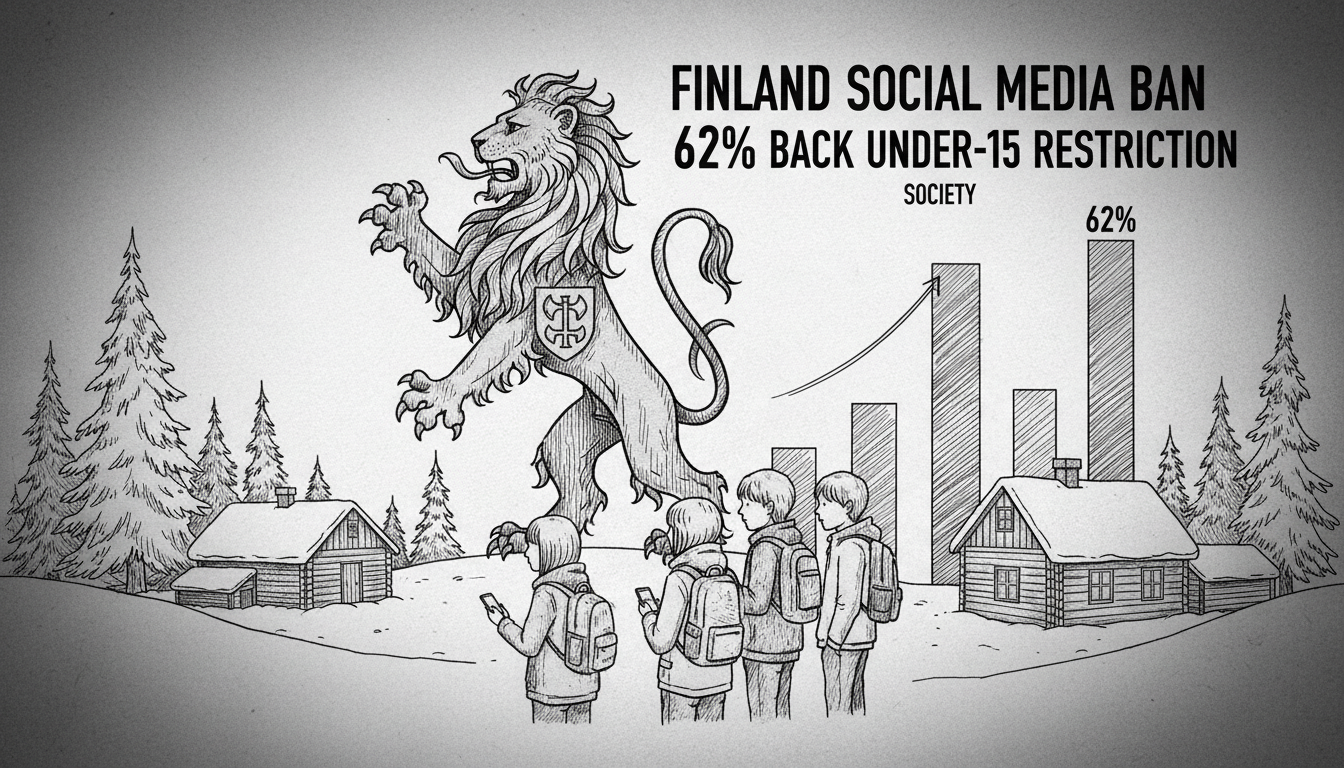
Finland social media regulation for minors has surged to the top of the national policy agenda after a new poll revealed overwhelming public support for a ban on access for children under 15. The USU-gallup shows 62% of Finns support the proposed restriction, with only 19% opposed. This strong public mandate arrives as Prime Minister Petteri Orpo’s government initiates a formal inquiry into the feasibility and scope of such a ban, a move first signaled by Orpo and Social Security Minister Sanni Grahn-Laasonen last November. The findings place Finland at the forefront of a contentious European debate, pitting the protection of young people’s mental health against fundamental rights to information and expression.
A Clear Public Mandate for Action
The poll data presents a decisive snapshot of Finnish public opinion. Beyond the 62% in favor, a significant 19% of respondents said they could not state a position, suggesting the complexity of the issue even among those not actively opposed. The low opposition figure of 19% indicates that arguments centered on children’s safety currently hold greater sway than concerns over potential overreach. Child Ombudsman Elina Pekkarinen interpreted the results as a clear signal. She stated that Finns are deeply worried about the extensive effects of social media use on children and young people. This concern transcends typical political divides, creating a unique consensus that policymakers in Helsinki are now compelled to address.
From Political Signal to Policy Process
The transition from political discussion to concrete policy began in the halls of the Government Palace last autumn. Prime Minister Petteri Orpo and Minister Sanni Grahn-Laasonen, both from the conservative National Coalition Party (Kokoomus), publicly floated the idea of restricting social media for under-15s. Orpo subsequently confirmed the launch of an official assessment to explore the legal, technical, and social implications. This process will need to navigate Finland’s constitutional protections and its obligations under European Union law, particularly the Digital Services Act (DSA) and fundamental rights charters. The government’s approach suggests a preference for a nationally coordinated solution rather than relying solely on parental controls or platform self-regulation.
The Finnish Context: Welfare State Meets Digital Age
Finland’s strong predisposition toward such protective measures is rooted in its deep-seated welfare state model, where child well-being and education are paramount societal goals. The country has a history of proactive legislation in areas affecting youth, from stringent alcohol regulations to comprehensive anti-bullying programs in schools. The debate over social media is framed through this lens of collective responsibility. Proponents argue that unregulated access represents a public health risk, akin to other regulated substances or activities, with documented links to increased anxiety, sleep disruption, and cyberbullying among adolescents. The proposed ban is seen by many as a logical extension of the state’s duty to provide a safe environment for development.
Expert Perspectives: Protection Versus Autonomy
The proposal has ignited a vigorous debate among child development specialists, psychologists, and legal scholars. Dr. Katriina Kivilahti, a clinical psychologist specializing in adolescent mental health at the University of Helsinki, supports stricter limits. “The adolescent brain, particularly the prefrontal cortex responsible for impulse control and risk assessment, is still developing,” she explains. “Social media platforms are often designed to maximize engagement, not well-being, exposing young teens to constant social comparison and curated realities at a vulnerable stage.” She advocates for the ban as a necessary “circuit breaker” to allow healthier developmental pathways to form.
Conversely, Professor Marko Junkkari, a legal scholar focusing on digital rights, raises significant constitutional concerns. “Any blanket ban must be scrutinized against the right to freedom of expression and the right to receive information, which are protected under the Finnish Constitution and the EU Charter of Fundamental Rights,” Junkkari notes. “A total prohibition for an entire age group could be deemed disproportionate. The government’s inquiry must seriously consider more nuanced approaches, such as stringent, verifiable age verification coupled with mandatory, platform-wide safety-by-design standards, rather than an outright access ban.”
The Enforcement Dilemma and Technical Hurdles
A critical question facing the government’s inquiry is practical enforcement. How would a ban on social media for under-15s be implemented and verified? Experts point to several challenges. Simple age-gating based on birthdate entry is easily circumvented. More robust methods, like linking access to a digital ID (such as Finland’s strong electronic identification system), raise serious privacy concerns and may be technically complex for global platforms to integrate. There is also the issue of jurisdiction; popular social media companies are based outside Finland, complicating national enforcement. The government may explore requiring platforms to implement high-assurance age verification for all Finnish users as a condition of operating in the country, a move that would likely face legal challenges from the tech industry.
The European Dimension: Finland as a Potential Pioneer
Finland’s policy move does not occur in a vacuum. Across the European Union, regulators are grappling with how to protect minors online. The EU’s landmark Digital Services Act already imposes special obligations on platforms to protect minors, but stops short of mandating age-based access bans. The United Kingdom’s Online Safety Act pushes platforms to use age estimation tools. If Finland proceeds with a legislative ban, it would be one of the most restrictive regimes in Europe, potentially setting a precedent. The Finnish model would be closely watched in capitals from Stockholm to Paris, where similar concerns are rising. However, any Finnish law must demonstrate compliance with the EU’s single market rules and fundamental rights framework, setting the stage for potential scrutiny by the European Commission and the Court of Justice of the EU.
The Road Ahead in the Eduskunta
The government’s inquiry will eventually yield a report, which will inform potential draft legislation. Any bill would then follow the standard legislative process in the 200-seat Eduskunta (Finnish Parliament). Given the cross-party nature of the concern, securing a parliamentary majority may be more straightforward than for typically divisive issues. However, the details will be fiercely contested. Key questions include the exact age threshold, the definition of “social media” covered, exemptions for educational or communication tools, the enforcement mechanism, and penalties for non-compliance. The Social Democratic Party (SDP) and the Left Alliance are likely to support strong protective measures, while some members of the Greens and the Swedish People’s Party may emphasize digital rights and education over prohibition.
A Defining Moment for Digital Childhood
The overwhelming public support for a social media ban for under-15s marks a pivotal moment in Finland’s relationship with technology. It reflects a growing societal pushback against the unregulated digital landscape, especially concerning children. The government’s response will test Finland’s ability to translate its robust welfare principles into the digital domain. The final policy will likely be a hybrid—perhaps not an absolute ban but a suite of the most aggressive age restrictions and safety mandates permissible under EU law. The outcome will signal whether Finland chooses to be a digital fortress for its youth or seeks a more integrated path of managed access and empowerment. As the inquiry begins its work, the nation watches, knowing the decision will shape the childhood of a generation.