
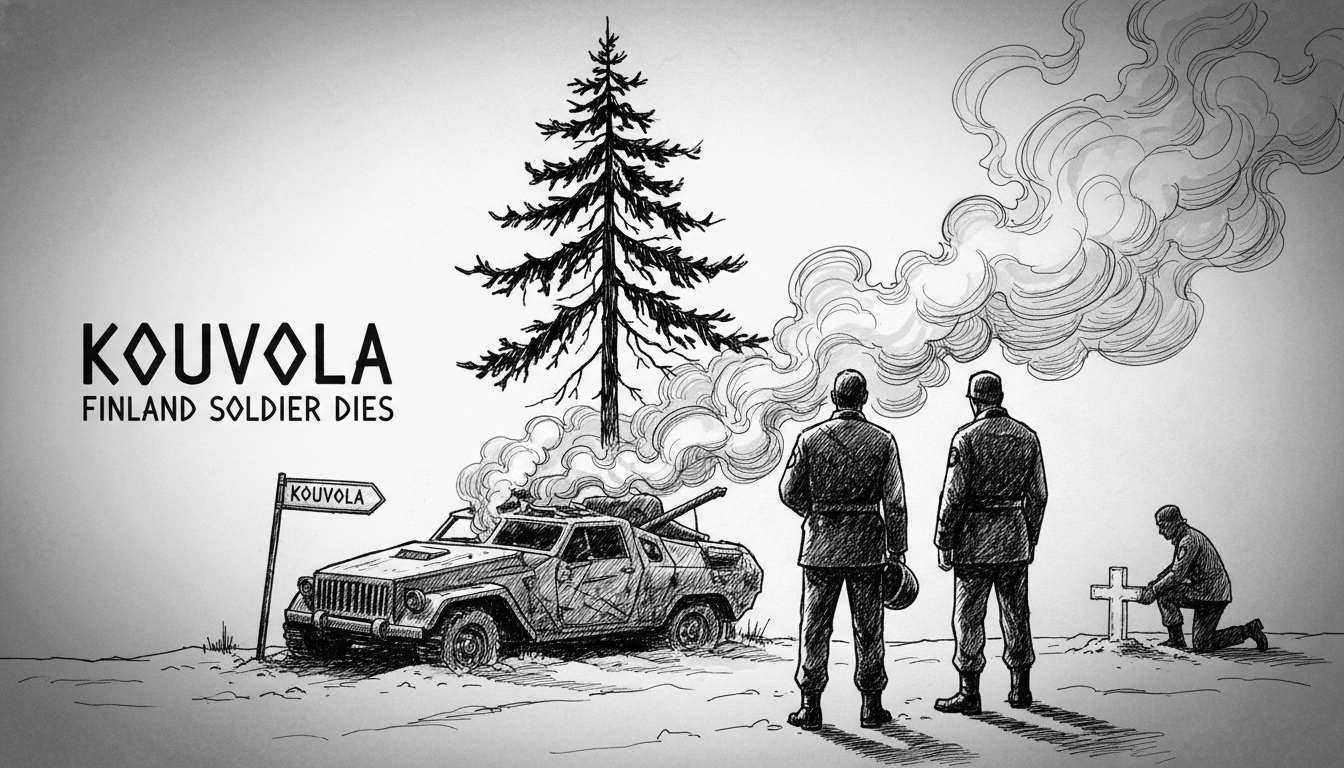
Finland car accident statistics gained another tragic data point last Thursday evening. A young conscript, whose mandatory military service had just concluded hours earlier, was killed in a collision at a major intersection in the southeastern city of Kouvola. The incident occurred at the junction of Highway 6 (Kuutostie) and Karjalankatu, a route familiar to hundreds of soldiers from the nearby Karelia Brigade.
From Barracks to Tragedy
The Finnish Army, Maavoimat, confirmed the victim's identity as a soldier from the Karjalan Prikaati (Karelia Brigade) based in Vekaranjärvi. He had formally completed his service and was traveling home when the accident happened. Military officials stated they had successfully notified the soldier's next of kin, initiating the formal support protocols for grieving military families. The transition from structured military life to civilian freedom, a day marked by celebration for most conscripts, ended in catastrophe for one family.
This intersection sits on a key artery for the region. Highway 6 runs from the south coast up to Kajaani, serving as a vital transport link. For conscripts finishing their service at the sprawling Vekaranjärvi garrison, it is often the first leg of the journey home. The specific circumstances of the collision remain under investigation by local police, who are reconstructing the event to determine cause and liability.
A Recurring National Heartbreak
While uniquely devastating for the family involved, fatal traffic accidents involving young adults, including conscripts, represent a persistent challenge in Finland. Data from Trafi, the Finnish Transport and Communications Agency, shows road deaths have plateaued after years of decline. Young male drivers continue to be a statistically higher-risk category globally, a pattern reflected in Finnish safety reports.
“Every death on the road is a profound societal failure,” notes Liisa Häyrinen, a senior researcher with the Finnish Road Safety Council. “When it involves a young person at the very start of their adult life, the loss of potential is incalculable. Intersections like these require constant engineering and behavioral review.” Häyrinen explains that while Finland has among Europe's safest roads, complex junctions where high-speed highways meet urban streets remain critical risk points.
The timing of this accident, occurring immediately after the soldier's discharge, raises separate questions about transition support. The Finnish military provides extensive training and structure during service, but the immediate shift back to civilian routine is abrupt.
The Military's Role in Transition Safety
“The end of service is an emotional and logistical milestone,” says Colonel Mikko Heiskanen, a retired army officer who once commanded a conscript battalion. “There is formal dismissal, returning equipment, collecting personal effects, and often a strong desire to simply get home. While commanders emphasize safe travel, the ultimate responsibility rests with the individual. The military's duty of care is a topic of deep reflection after such an event.”
Heiskanen points out that the military does conduct driver safety briefings as part of conscript training. However, these are general and not specifically tailored to the immediate post-service departure. There is no formal protocol where the military organizes or monitors transportation for discharged conscripts; they are free citizens upon termination of service. This tragedy may spark internal discussion on whether that transition process could include more robust safety messaging at the very moment of departure.
Grief counseling services from the Finnish Defense Forces are now available to the soldier's immediate comrades. Psychologists highlight that such losses can be particularly traumatic for peer groups who shared the intense experience of military service, only to see a member perish immediately after.
Infrastructure and Investigation
Authorities in the Kouvola region have launched a thorough technical investigation. This will examine factors like vehicle speed, road conditions, traffic light sequences if present, and visibility at the intersection. Any history of prior incidents at that specific crossing will be scrutinized. The findings could lead to recommendations for road engineering changes, such as modified traffic calming measures or improved signage.
Local municipal officials have expressed their condolences but deferred detailed comment pending the police investigation's outcome. The focus for now remains on supporting the bereaved family and the investigative process. The story has resonated nationally, touching a nerve in a country where universal male conscription makes military service a common rite of passage.
The death underscores a painful dichotomy: the successful completion of mandatory service, a requirement designed in part to protect the nation, followed by a death on the domestic road network. It highlights that danger is not confined to the training field. For the Finnish military community in Vekaranjärvi, the return to routine will be marked by sorrow. For transportation safety experts, it is another urgent data point in the continuous work to achieve zero traffic fatalities.
As the police investigation continues quietly, a central, unresolved question lingers within the defense establishment and among safety advocates. Could a more structured transition, even in its final hour, help safeguard those who have just completed their duty? The search for answers begins in the grim shadow of an avoidable loss.