
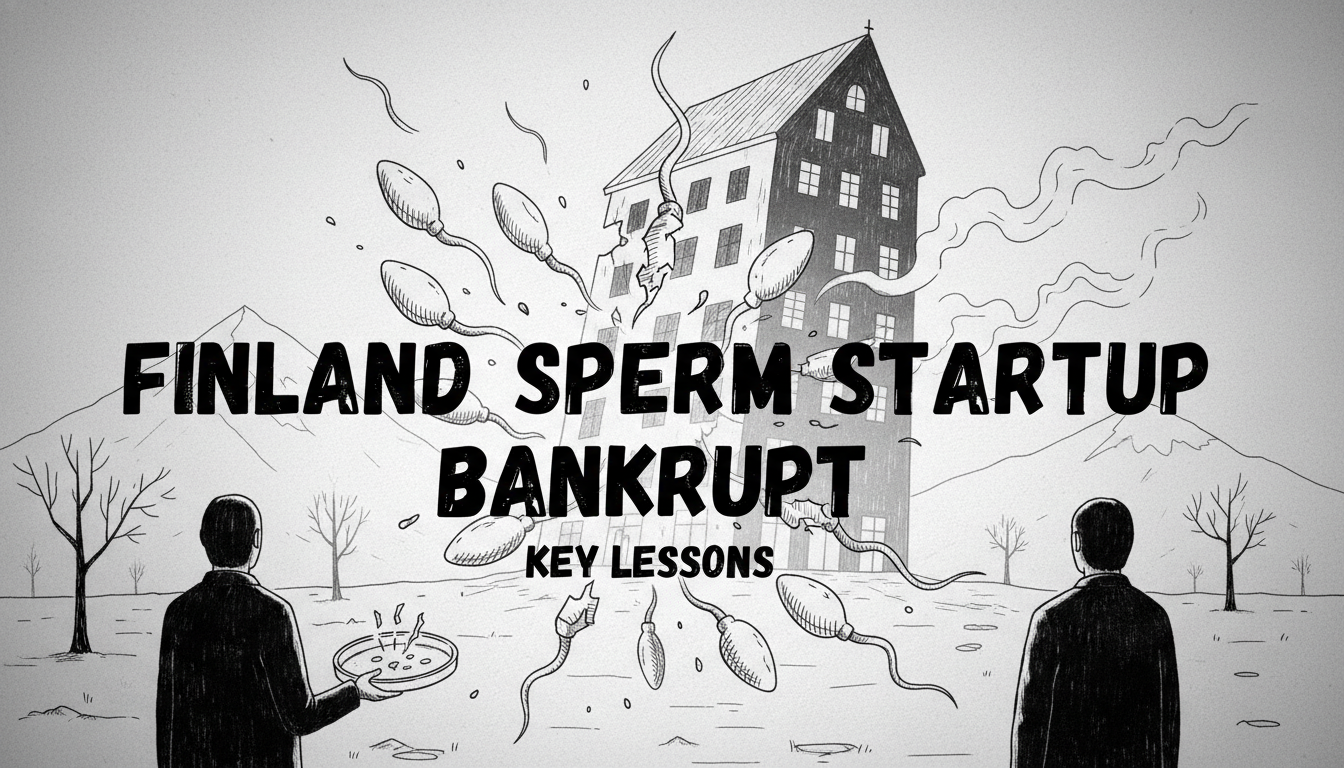
Finland's startup ecosystem, known for producing global successes like Supercell and Wolt, recorded over 5,000 active startups last year, but the failure of a niche Mikkeli-based firm highlights persistent risks. Myxline Oy, a startup specializing in the discreet transport of sperm samples for fertility treatments, has filed for bankruptcy at the Helsinki District Court. The company's collapse, attributed by its CEO to a decisive conflict with a single investor, offers a sobering case study in the vulnerabilities of early-stage ventures, particularly those operating outside the main Helsinki hub and within highly specialized markets.
CEO Mika Seppänen stated the company's downfall was directly due to a dispute with one key investor who "set themselves in opposition." This single-point failure underscores a critical weakness. While not disclosing the investor's identity or the nature of the conflict, Seppänen’s comment points to the profound power dynamics and risks when a fledgling company's financial lifeline is controlled by a solitary backer. Myxline operated primarily in the capital region despite being headquartered in Mikkeli, a city of 52,000 in the South Savonia region, illustrating the common practice of regional startups servicing the larger Helsinki market while grappling with distance from its dense network of venture capitalists and advisors.
A Niche Business Model Meets Harsh Reality
Myxline's business proposition was undeniably specific: providing secure, temperature-controlled logistics for human sperm samples. This service catered to fertility clinics, healthcare providers, and individuals, requiring impeccable reliability and compliance with strict medical transport regulations. The model filled a clear gap in a growing market, as fertility treatment demand continues to rise across the Nordic countries. Yet, its hyperspecialization also limited its total addressable market and potential revenue streams compared to broader logistics or health-tech platforms. The bankruptcy filing in Helsinki, rather than a local court in Mikkeli, confirms the company's operational and legal ties to the capital, a common but often costly necessity for regional startups seeking national reach and legitimacy.
The Peril of the Single Investor
The central role of investor conflict in this bankruptcy is a red flag for the ecosystem. "A startup's over-reliance on one investor is like building a house on a single pillar," comments Anna Korhonen, a Helsinki-based startup advisor and former venture partner. "If that relationship fractures, the entire structure collapses. Diversification of funding sources, even at an early stage, is a fundamental risk mitigation strategy that is sometimes overlooked in the rush for initial capital." This dynamic can be exacerbated for startups in niche sectors or located outside major hubs, where the pool of interested investors is inherently smaller. The investor may demand outsized influence or equity, creating an unstable foundation. The Myxline case suggests negotiations broke down irreparably, leaving the company with no viable financial path forward.
Analyzing Finland's Startup Geography
Mikkeli represents the broader challenge of Finland's startup geography. While government and EU regional development funds actively promote entrepreneurship across the country, a 2023 report from the Finnish Startup Community showed that nearly 70% of all venture capital investment was captured by companies based in Uusimaa, the region containing Helsinki. Startups in smaller cities often face the "proximity penalty," with less frequent access to investor meetings, mentorship circles, and the informal networks where deals are frequently brokered. Myxline's attempt to bridge this gap by operating in Helsinki while being based in Mikkeli incurred higher operational costs—a double burden for a capital-intensive logistics business. This geographic friction can strain resources and slow growth, making startups more vulnerable when crises emerge.
Expert Perspective on Systemic Implications
Experts see Myxline's failure as a microcosm of wider systemic issues. "This bankruptcy is not just a story of a dispute; it's a story about market depth and resilience," says Dr. Elias Virtanen, a researcher in innovation ecosystems at Aalto University. "For highly specialized B2B startups, the path to scalability is narrow. They must achieve operational excellence rapidly and secure anchor clients. If their funding structure is fragile, the margin for error evaporates. The Finnish ecosystem excels in gaming and consumer tech, but we need to build stronger support structures—specialized angel networks, industry-specific grants—for deep-tech and niche service startups to thrive beyond the capital region." He also points to the need for more standardized shareholder agreements and dispute resolution mechanisms tailored for early-stage companies to prevent catastrophic breakdowns.
Lessons for the Nordic Startup Scene
The closure of Myxline delivers several clear lessons for entrepreneurs and policymakers. First, founder-investor alignment is as crucial as the capital itself; due diligence should flow both ways. Second, business models serving ultra-niche markets require exceptionally careful financial planning and realistic scaling timelines. Third, Finland's national startup success narrative must consciously address the geographic disparity in support and funding. Strengthening regional ecosystems through decentralized investor forums and matching services could help prevent similar outcomes. Finally, the case highlights the importance of building a balanced cap table early, even if it means slower initial funding rounds.
As the Helsinki District Court processes the bankruptcy application, the story of Myxline fades from the headlines. Yet its end offers a more valuable contribution to Finland's entrepreneurial community than its brief operation ever did: a stark, real-world reminder that innovation requires not just a good idea, but a resilient foundation. In a country celebrated for its startup prowess, can the ecosystem evolve to better cushion the fall for its most specialized and geographically distant ventures, turning isolated failures into collective learning?