
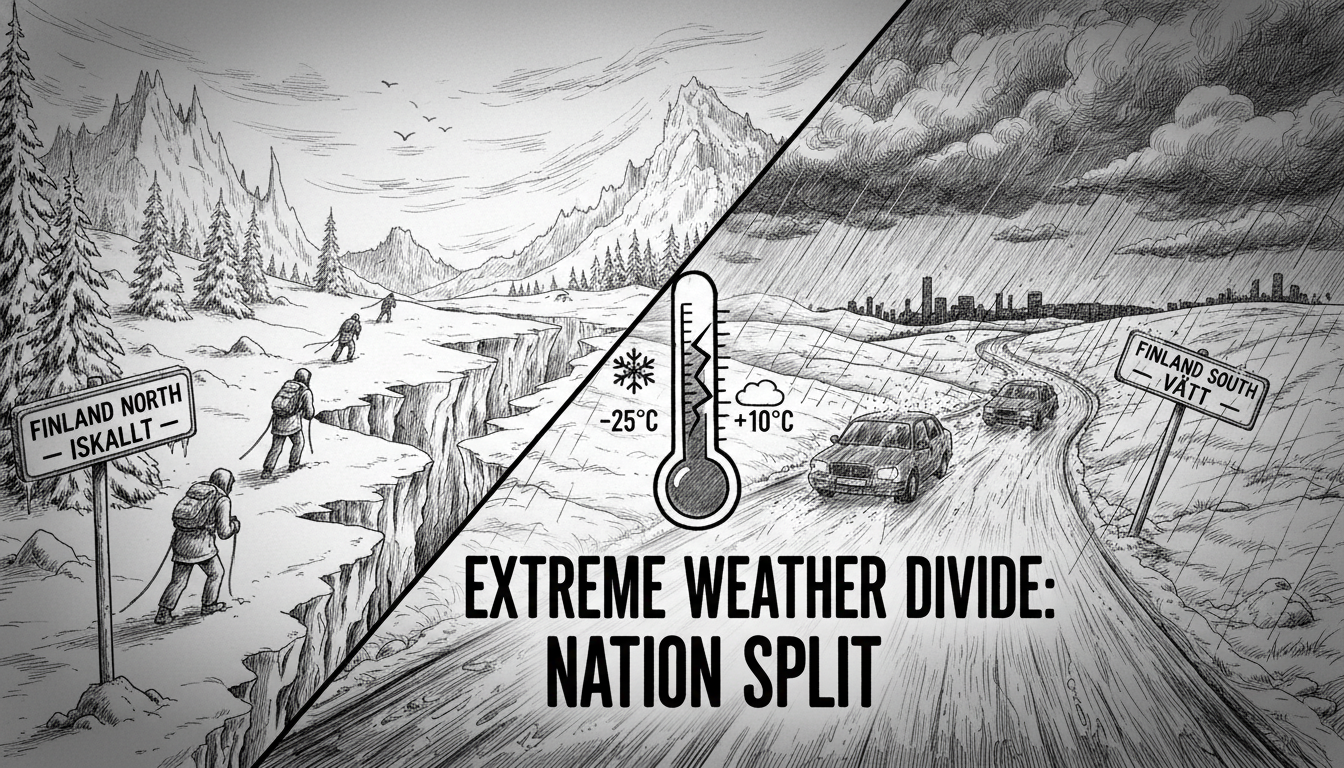
A stark meteorological division has cleaved Finland, creating two distinct weather nations within one country. The Finnish Meteorological Institute and private forecaster Foreca report a dramatic split, with persistent gray, mild, and wet conditions dominating the south while severe frost and snow squalls grip the north. This sharp contrast presents immediate logistical challenges and highlights Finland's unique climatic vulnerability.
On Monday, a precipitation area moves eastward across the country. Several centimeters of snow are expected, particularly near the eastern border, in North Ostrobothnia, and in Southern Lapland. Officials have classified road conditions as dangerous in these northern regions, warning drivers to prepare for poor or very poor driving conditions. The divide is not merely inconvenient but operationally significant for transport and emergency services.
By Tuesday, the cold intensifies sharply, especially in Lapland. Temperatures could plunge to minus 30 degrees Celsius in parts of the region, potentially breaking the current winter's cold record of minus 31.6 degrees. Widespread snowfall of 10 cm, locally 15–20 cm, is forecast for Tuesday evening and night, creating treacherously slippery roads. The temperature gap between south and north could exceed 35 degrees, a dramatic illustration of the divide.
The split is expected to persist through the coming weekend, coinciding with Finland's Independence Day celebrations. A gradual evening out of the temperature difference is forecast, but a wintry trend is predicted to begin by Sunday, with uncertainty remaining in the longer-range outlook. For the national holiday, scattered snow showers are possible across central regions, while rain or sleet is more likely on the southern and western coasts.
This weather event carries deeper implications beyond the forecast. Finland's long, narrow geography makes it inherently susceptible to such splits, where Arctic air from the northeast clashes with milder Atlantic systems. These conditions test national infrastructure, from road maintenance protocols to energy grid stability, as heating demand spikes in the north while the south contends with dampness and potential flooding from melting snow. The situation requires coordinated response from municipal authorities across a vast area.
For international observers and residents, this is a potent reminder of Finland's climatic reality. The country routinely manages extremes, but a clear north-south divide of this magnitude stresses systems and planning. It influences daily life, business logistics, and even political considerations, as regional needs diverge based on immediate environmental conditions. The forecast calls for public vigilance and underscores the importance of heeding official warnings from meteorological authorities.