
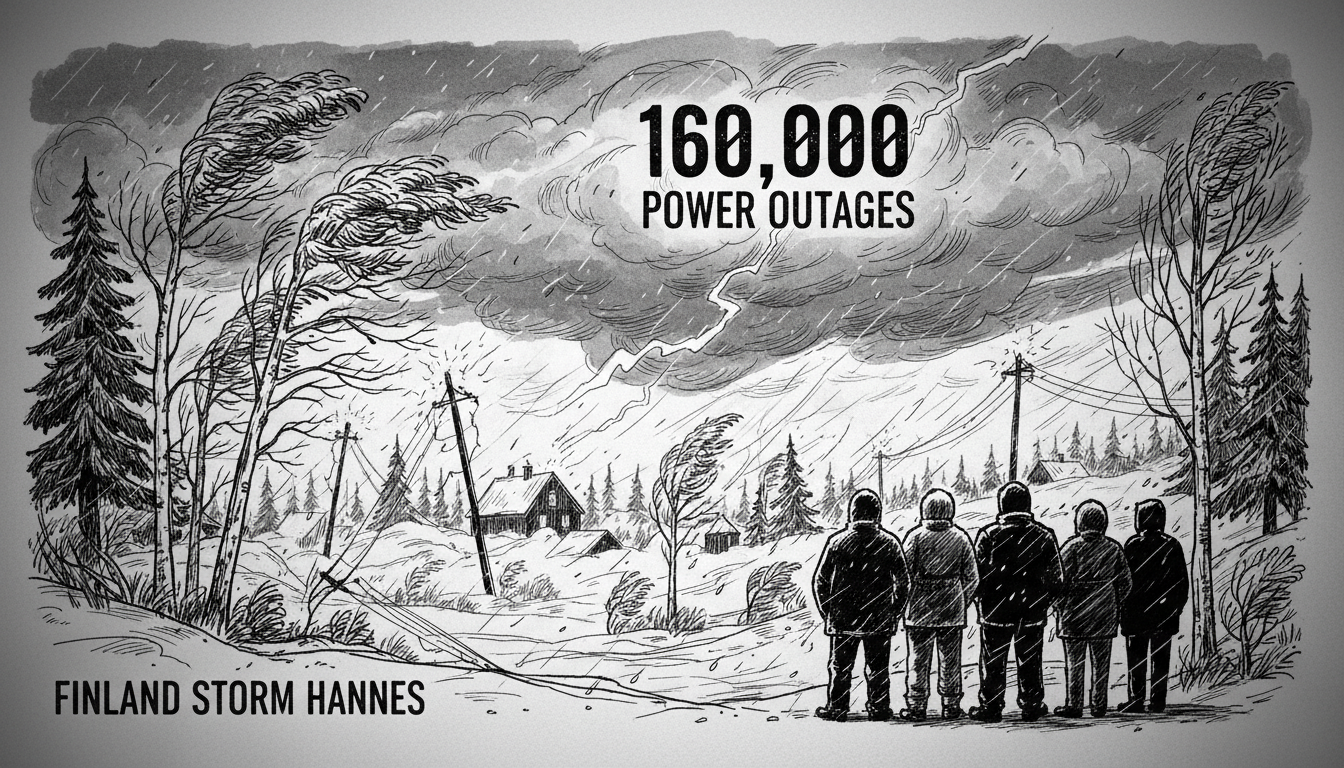
Finland's Hannes storm left nearly 160,000 households without electricity after lashing the country with hurricane-force winds. Emergency services reported hundreds of calls as the severe weather system downed power lines and trees across southern and central regions. The Finnish Meteorological Institute (Ilmatieteen laitos) confirmed the storm's peak had passed by early Sunday, with winds gradually subsiding from their most intense levels of 18-22 meters per second.
Storm Hannes Unleashes Autumn Fury
The powerful extratropical cyclone, named Hannes by Finnish meteorologists, swept across the country on Saturday and into Sunday. It represents the first major autumn storm of the season, testing the nation's infrastructure and emergency preparedness. Such storms are characteristic of Finland's geographical position, exposed to North Atlantic weather systems. This particular event caused widespread disruption to transport and essential services, highlighting the constant challenge of maintaining grid reliability in extreme conditions.
Power companies worked through the night to assess damage and begin restoration. The outages were concentrated in areas where forests lie close to overhead lines, a common feature of the Finnish landscape. Falling trees and branches represent the single greatest cause of storm-related power failures in the country. Repair crews faced hazardous conditions as they navigated dark, wind-swept roads to reach fault locations.
Emergency Services Face Hundreds of Calls
Rescue departments (pelastuslaitos) across affected regions logged several hundred storm-related tasks. These ranged from removing fallen trees from roads and railways to securing damaged structures and responding to minor weather-related accidents. No major injuries or fatalities had been reported by Sunday morning, a testament to public heeding of official warnings. The Finnish National Rescue Association (SPEK) often emphasizes that public caution during severe weather advisories is a critical factor in preventing casualties.
‘Our teams have been responding continuously through the night,’ said a duty officer for the Helsinki Rescue Department in a statement. ‘The priority has been ensuring roads are clear for emergency vehicles and addressing immediate safety hazards to the public.’ The coordinated response involves local rescue services, power grid operators, and municipal crisis management teams. This inter-agency cooperation is a standard and well-practiced procedure for severe weather events in Finland.
Meteorological Context and Winding Down
According to the Finnish Meteorological Institute's update posted on social media platform X around 1:30 AM Sunday, the strongest winds from Hannes were abating. While a Nordic storm warning remained in effect for sea areas, wind speeds on land were decreasing. The institute's network of weather stations recorded the strongest gusts in coastal regions and open landscapes. Accurate, timely forecasting from the state institute allows municipalities and infrastructure operators to preposition resources and issue public alerts.
‘The storm track and intensity developed largely as forecasted,’ a meteorologist from the institute noted. ‘These systems gain energy from the temperature contrast between the cold continent and the warmer seas.’ As climate change alters sea surface temperatures and atmospheric patterns, researchers are studying potential impacts on the frequency and intensity of North European autumn and winter storms. This forms part of a broader EU-wide effort to model climate risks to critical infrastructure.
Infrastructure Resilience in Focus
The scale of the power outages, affecting a significant portion of the population, immediately turns attention to the resilience of the national grid. Finland has been investing in grid modernization and underground cabling, but the cost of burying all lines in a vast, forested country is prohibitive. Storm-hardening overhead networks—through stronger poles, more frequent tree-trimming, and smart grid technology that isolates faults—remains a primary strategy. The Ministry of Economic Affairs and Employment regularly reviews security of supply standards for distribution network operators.
Energy experts point to a dual challenge. ‘We must maintain a reliable electricity supply during increasingly volatile weather while also building the new clean energy infrastructure needed for the transition,’ said Dr. Eero Vartiainen, an energy systems researcher. ‘Events like Storm Hannes show that physical resilience against natural forces is just as crucial as capacity.’ The recent push for greater energy independence and interconnection within the EU also hinges on resilient national grids that can withstand shocks.
Looking Ahead: Recovery and Preparedness
By Sunday afternoon, power restoration efforts were expected to shift from emergency repairs to reconnecting smaller clusters of customers. The process can take several days for the most remote or severely damaged lines. Citizens are advised to report outages to their local energy company and to treat any downed power lines as extremely dangerous. The public is also encouraged to maintain emergency supplies for at least 72 hours, a standard preparedness recommendation in Finland.
The passage of Storm Hannes serves as an annual reminder of nature's force in the Nordic region. It tests response systems and provides data for improving future preparedness. As cleanup begins, the focus will be on restoring normalcy. Yet, for policymakers, the event adds another data point to the complex equation of safeguarding society against climate and environmental risks in the decades to come. Will investments in infrastructure keep pace with the changing climate's demands?