
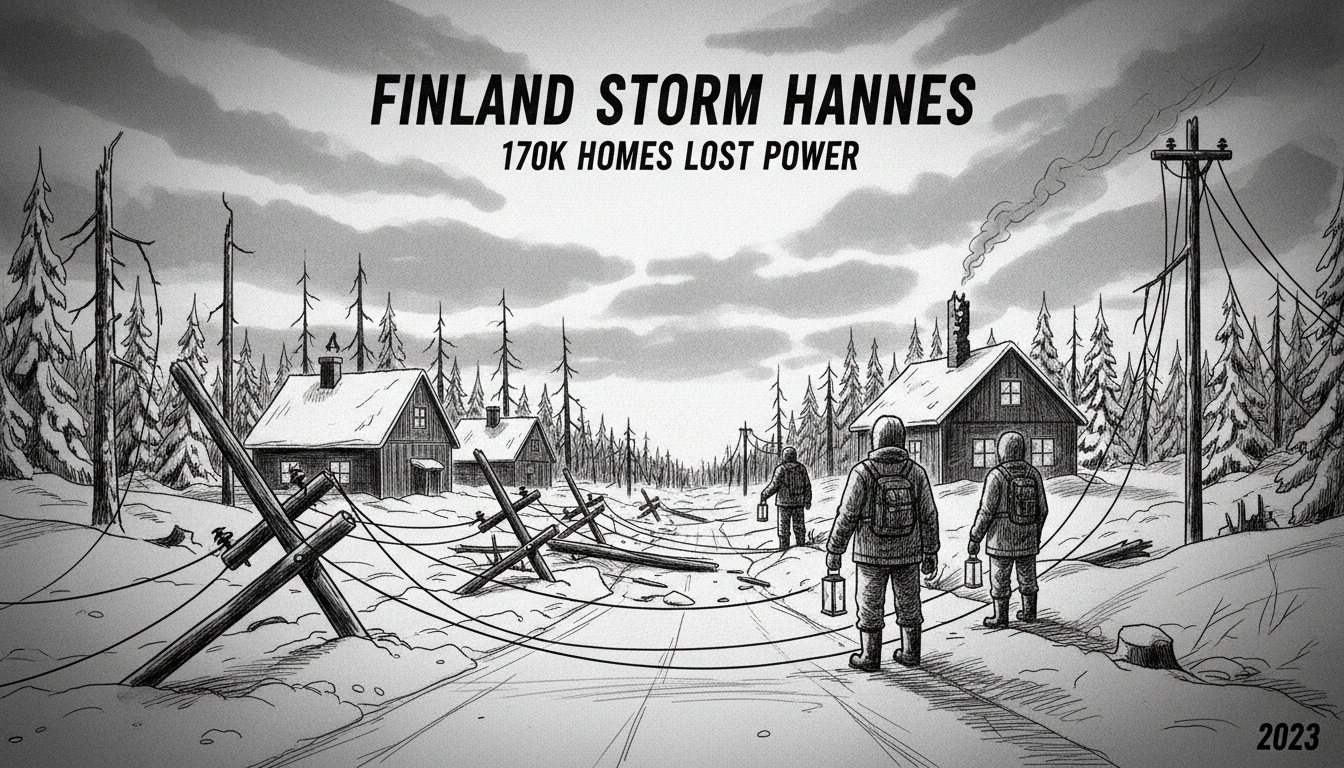
Finland storm Hannes is bearing down on the country's west coast, with energy utility Järvi-Suomen Energia preparing for potential power outages across the southern Savonia region. The storm's peak is forecast for midnight on Saturday, threatening to repeat the severe disruptions caused by last year's Storm Pyry, which left more than 170,000 households in the dark. While the strongest wind gusts are expected in Western Finland, the national grid operator Fingrid and regional companies are on high alert for cascading impacts. Finland's boreal forests and extensive overhead power lines make its electricity network uniquely vulnerable to autumn gales. 'We have pre-positioned repair crews and are monitoring the situation hour by hour,' a Järvi-Suomen Energia spokesperson said in a statement. The company's warning underscores a recurring seasonal challenge for Finnish infrastructure, where falling trees and broken power lines can isolate communities for hours or even days.
The Mechanics of a Nordic Storm
Storm Hannes follows a familiar atmospheric pattern for late autumn, drawing its power from the temperature contrast between the still-warm seas and cooling continental air. Meteorologists at the Finnish Meteorological Institute note that while the core of the storm will hit the west, its trailing fronts can generate powerful wind gusts hundreds of kilometers inland. These conditions are particularly dangerous in regions like Etelä-Savo, where a mix of dense forest and a distributed population complicates rapid response efforts. The storm's timing, peaking overnight, adds another layer of risk as darkness hampers damage assessment and repair work. Historical data shows that most prolonged outages in Finland are caused not by the initial high winds, but by secondary damage as weakened trees succumb hours later.
Grid Resilience Under Pressure
Finland's energy sector has invested heavily in grid resilience over the past decade, yet severe storms consistently test its limits. The 170,000 customer outages during 2023's Storm Pyry represented one of the most significant recent disruption events. Analysts point to a dual strategy of hardening physical infrastructure and improving logistical coordination. 'The focus is on rapid fault identification and deploying crews to critical nodes first, like substations feeding hospitals and emergency services,' explains energy sector consultant Liisa Aalto. 'Companies like Järvi-Suomen Energia use detailed weather modeling to predict which circuit segments are most likely to fail.' This proactive approach involves clearing danger trees along key power corridors during the summer, a continuous effort that is never fully complete given Finland's vast forest cover.
The Human and Economic Toll
Beyond the immediate inconvenience, power outages in Finland's often chilly autumn carry real economic and safety implications. For households relying on electric heating and well pumps, a loss of power can mean a rapid drop in indoor temperature and a loss of running water. Small businesses, particularly in the agricultural and tourism sectors, face spoilage and operational shutdowns. The Social Insurance Institution of Finland (Kela) can provide compensation for food spoilage during prolonged outages, but the process requires official confirmation from the energy company. Municipalities in rural areas often activate emergency warming shelters in public buildings when outages are expected to last more than a few hours. This community-level response is a standard part of Finland's comprehensive civil preparedness planning.
A Recurring Challenge in a Changing Climate
While storms like Hannes are an annual occurrence, climate scientists are observing trends that could influence their frequency and intensity. Warmer Baltic Sea surface temperatures in autumn can potentially fuel more powerful low-pressure systems. Although attributing any single storm to climate change is complex, the broader pattern aligns with models predicting more energetic weather systems for Northern Europe. This presents a long-term strategic challenge for Fingrid and regional distributors. The debate continues between investing further in burying power lines—an extremely costly option in rocky terrain—versus enhancing the speed and capacity of the repair network. Some experts advocate for a greater push toward local microgrids and household-level battery backup systems to reduce dependence on the long-distance transmission network during storms.
Preparedness as a National Habit
Finnish society's generally high level of preparedness softens the impact of these inevitable disruptions. It is common practice for households to have alternative lighting, battery-powered radios, and supplies to manage for 72 hours without services. Public service announcements from the Ministry of the Interior consistently reinforce these messages in the lead-up to the storm season. Energy companies, for their part, have refined their customer communication, providing more accurate outage maps and restoration estimates via mobile apps and websites. The system is not perfect, and frustration often mounts in isolated areas where repair times stretch long, but the institutional response is systematic. The true test for Storm Hannes will be whether the preparations and predictions match the storm's actual path and fury.
As midnight approaches on Saturday, the focus shifts from preparation to response. Will the investments and lessons from Storm Pyry result in a faster restoration of power for affected Finns, or does Hannes hold new surprises? The answer will play out in the dark forests and quiet towns of Etelä-Savo and beyond, measured in the number of homes that remain warm and lit through the blowing gale.