
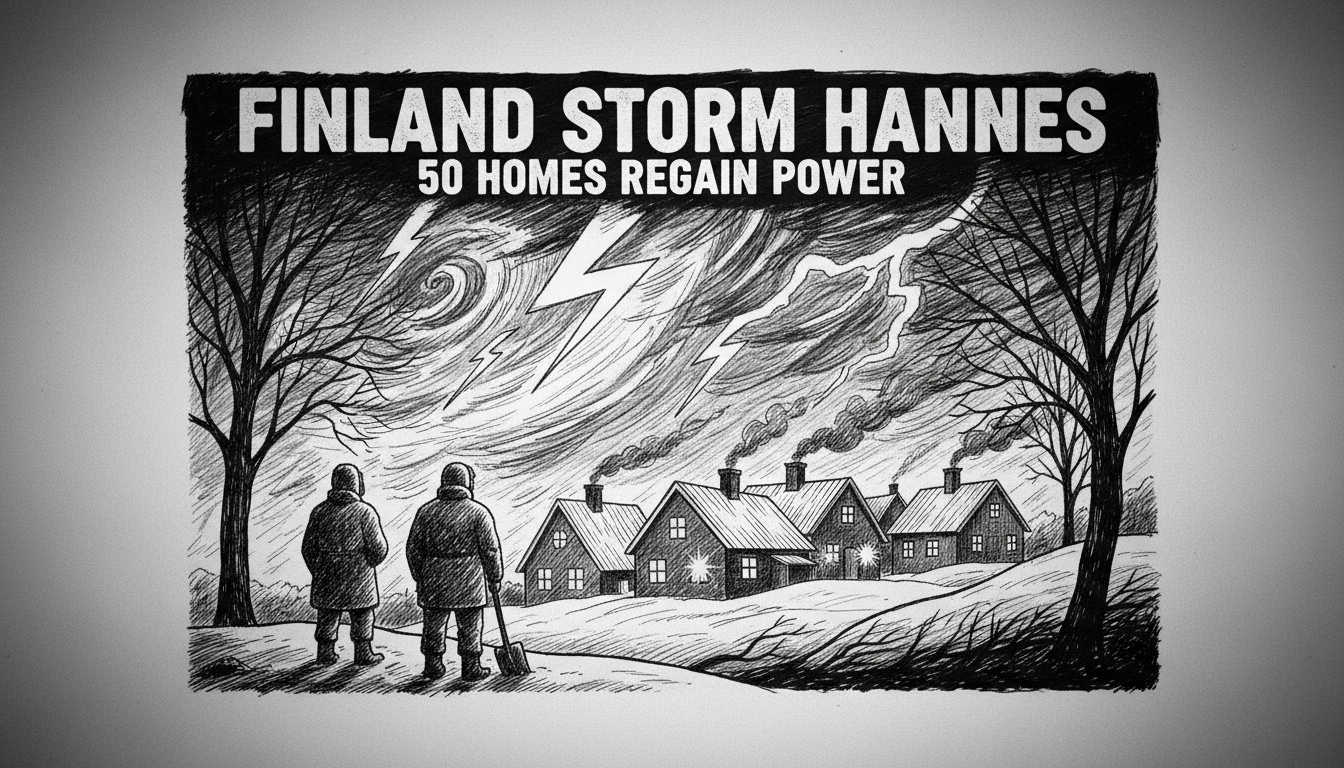
Finland’s Kanta-Häme region, where roughly 50 customers remained without electricity on Friday, is set to see its final households reconnected by the weekend. This marks the final chapter in the restoration effort following Storm Hannes, which ripped through southern Finland earlier this month, toppling trees and severing power lines. For the last affected families, the return of light and heat ends a disruptive period of uncertainty. 'Our crews have worked tirelessly in difficult field conditions to restore supply to the main network,' said a representative from the local energy company, Caruna. 'The remaining outages are in isolated, hard-to-reach locations, but we are confident they will be resolved.'
Repair work to address underlying damage and prevent future faults, however, will extend well into the following week. This highlights the ongoing challenge of maintaining a reliable electricity supply in one of Europe's most forested nations, where extreme weather poses a constant threat to infrastructure.
The Path to Restoration
The effort to rebuild Kanta-Häme's power grid after Hannes has been a large-scale logistical operation. Teams of lineworkers have been navigating boggy, snow-dusted terrain to locate breaks, clear fallen timber, and erect new pylons. The process is methodical and often dangerous, prioritizing major lines that serve the greatest number of customers before moving to individual connections. The regional emergency services center coordinated closely with the utility companies, ensuring that vulnerable residents, particularly the elderly, were checked on during the outage.
While power is returning, the visible scars of the storm remain. Roadsides are littered with piles of cut branches and splintered tree trunks, evidence of the wind's force. The Finnish Meteorological Institute classified Hannes as a strong autumnal storm, with wind gusts exceeding 25 meters per second in coastal areas. Such events test the resilience of the national grid and the preparedness of local municipalities.
A Recurring Challenge for Finnish Infrastructure
Widespread power outages are, to a degree, an accepted seasonal reality in Finland. The country's expansive forests, which cover over 75% of the land area, border countless kilometers of overhead power lines. When autumn gales or heavy wet snow arrives, trees and limbs become projectiles. 'The geometry of the Finnish landscape is a fundamental challenge,' explains Dr. Elina Seppänen, an energy infrastructure researcher at Aalto University. 'We have a dispersed population and a long network of lines running through forests. Investing in underground cabling everywhere is economically unfeasible, so utilities must focus on strategic clearing and stronger grid components.'
Compared to many other European countries, Finland's grid is generally considered highly reliable, with an average customer interruption time of less than two hours per year. This statistic, however, masks regional disparities. Rural areas like parts of Kanta-Häme experience more frequent and longer outages than urban centers. The country's energy companies allocate significant annual budgets for preventative forestry management, cutting back danger trees within a specified corridor alongside power lines. Yet, as Storm Hannes proved, a severe storm can overwhelm even these precautions.
The Human and Economic Cost of Darkness
Beyond the inconvenience, a prolonged power outage carries tangible costs. For households, it means spoiled food, a loss of heating during the crucial early heating season, and potential water supply issues if wells rely on electric pumps. For businesses, especially small enterprises and farms, the interruption can mean lost revenue and operational chaos. The Federation of Finnish Enterprises notes that while insurance may cover some losses, the disruption to productivity and supply chains is a recurring economic drag on rural communities.
Local authorities in municipalities like Hämeenlinna and Forssa activated their contingency plans, opening public buildings as warming shelters for those needing refuge. The social impact, while often temporary, underscores a community's dependence on a constant energy flow. 'You realize how much we take for granted,' said Maarit Koskinen, a resident of a small village outside of Renko, who was without power for four days. 'The quiet was the strangest part—no hum from the fridge, no lights from neighboring houses. Just dark and quiet.'
Investing in a More Resilient Future
The response to Storm Hannes follows a familiar and tested pattern. The focus now shifts from emergency repair to mitigation. The continued fieldwork next week involves not just fixing what broke, but upgrading sections of line to better withstand future storms. This includes installing more durable poles, increasing tension on wires, and further widening clearance zones in known problem areas.
At the national policy level, the Ministry of Economic Affairs and Employment is overseeing a long-term grid development program. This program aims to balance reliability with the transition to a greener energy system. There is an active debate about the level of investment needed and who should bear the cost—taxpayers, all ratepayers, or those in particularly vulnerable regions. The Finnish Energy Association advocates for a pragmatic approach, emphasizing robust maintenance over revolutionary change. 'The goal is not to create an unbreakable grid, which is impossible,' states their latest report on grid resilience. 'The goal is to minimize disruption and accelerate recovery when nature intervenes.'
As the lights come back on in the last homes in Kanta-Häme, the episode serves as an annual reminder. In a nation defined by its nature, the balance between technological society and the natural environment is constantly being negotiated, often on the winds of an autumn storm. With climate models predicting an increase in extreme weather events for the Nordic region, the lessons learned from Hannes will inform preparation for storms yet to come.