
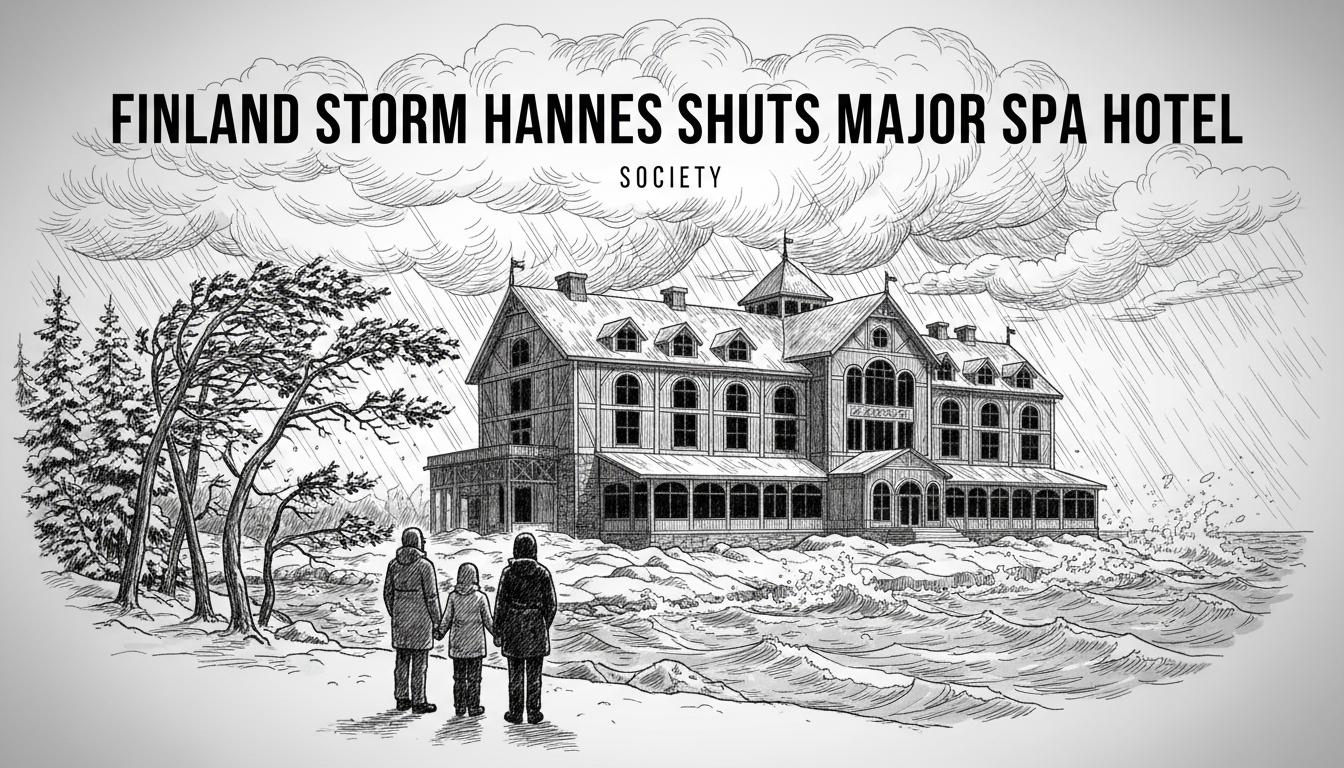
Finland's latest major storm, Hannes, forced the immediate closure of the popular Peurunka Spa Hotel in Laukaa, leaving guests displaced and highlighting the persistent vulnerability of the nation's infrastructure to severe weather. Powerful winds and falling trees caused extensive power outages across Central Finland, with the resort's management scrambling to deploy backup generators for limited hotel functions while its core spa facilities remained completely dark. 'Hannes did us a mischief,' Peurunka's CEO Kimmo Jantunen stated, expressing hope that the spa could reopen by Sunday as repair crews worked to restore downed power lines across the region. This incident is not isolated but part of a recurring pattern of autumn and winter storms that test the resilience of Finnish society, from remote households to major tourism enterprises.
A Recurring Battle Against the Elements
Storm Hannes arrived with a familiar fury for Finns. The country's geographical position exposes it to North Atlantic weather systems, making powerful autumn storms a regular, if disruptive, feature of life. Central Finland, with its vast and dense forests, is particularly susceptible. Over 75% of Finland's land area is forested, a statistic that speaks to both national identity and infrastructural challenge. During high winds, these trees become hazards, falling across roads and, critically, power lines. The result is often widespread, scattered outages that can take utility companies days to fully resolve. In January 2022, Storm Aila left approximately 70,000 households without power, a benchmark that illustrates the potential scale of such events. Hannes, while perhaps less extensive, delivered a targeted blow to a key economic and recreational hub in the region.
The immediate impact at Peurunka was a stark division between light and dark. Backup power generators, or varavoima, were activated but could not cover the entire sprawling property. This allowed sections of the hotel to maintain basic operations, but the spa complex—the heart of the resort's appeal—was plunged into inactivity. Guests could not access pools, saunas, or treatment areas, fundamentally undermining the resort's purpose. This partial functionality underscores a critical preparedness dilemma for large businesses: how much backup capacity is economically feasible, and what constitutes an essential service during a failure?
Grid Resilience and the Cost of Reliability
The repeated cycle of storms and outages places Finland's energy grid operators under constant scrutiny. Experts consistently emphasize the need for improved grid resilience, a topic that resonates in political discussions in Helsinki regarding national infrastructure funding. Solutions are technically available but come with significant price tags. Burying power lines, known as underground cabling, offers superior protection from wind and falling trees but can cost up to ten times more than overhead lines. It is primarily implemented in urban areas and for critical new installations. For the vast, forested transmission networks covering rural and central Finland, reinforcement of existing pylons and poles, along with aggressive vegetation management (clearing treelines), remains the primary defence strategy.
This economic calculus has direct consequences for businesses like Peurunka. For a spa hotel, a power outage is not merely an inconvenience; it is a complete operational shutdown of its core product. The incident raises questions about regional preparedness and whether key tourism infrastructure should be prioritized for faster power restoration or supported in building more comprehensive backup systems. The Finnish government and the EU have funding channels for projects enhancing regional resilience and the green transition, which could potentially include investments in decentralized energy solutions like larger-scale backup systems or local microgrids for critical community hubs.
The Human and Economic Ripple Effect
Beyond the darkened spa pools, the effects of Storm Hannes ripple outward. Displaced guests face cancelled holidays, requiring rebooking or refunds. Local suppliers who provide food, linens, and services to the resort see orders paused. Employees face disrupted shifts and uncertainty. For the municipality of Laukaa, Peurunka is a significant employer and tourist draw; its closure has a tangible economic impact. This human impact layer is often the immediate story, yet it is intrinsically linked to the broader policy and infrastructure narrative.
Kimmo Jantunen's hope for a Sunday reopening was a statement of optimism contingent on the hard work of line technicians. Their task is daunting: traversing difficult terrain to locate breaks, remove fallen trees, and restring cables, often in challenging weather conditions. The speed of restoration depends on the extent of the damage, accessibility, and available manpower. Each major storm provides data and lessons for these utility companies, informing where to focus future reinforcement efforts. However, with climate models suggesting the potential for increased extreme weather events, the race between hardening infrastructure and the power of storms like Hannes continues.
A National Challenge with Local Faces
The story at Peurunka Spa Hotel is a localized case study of a national Finnish experience. It sits at the intersection of natural geography, climate policy, economic planning, and daily life. While Finland is often hailed for its technological advancement and societal resilience, nature periodically issues a powerful reminder of its fundamental force. The response to Hannes will be measured not just in hours until the power returns, but in the ongoing discussions it fuels about investment, preparedness, and the true cost of reliability in a country where darkness and cold are not mere metaphors but seasonal realities.
As repair crews work through the weekend, the quiet halls of the spa serve as a temporary monument to this struggle. The eventual restoration of power will be celebrated, but the incident will be logged alongside Aila and others, contributing to an ever-growing dossier that argues for a future where Finland's celebrated connection to nature does not come at the cost of repeated dislocation. The question for policymakers in the Eduskunta and for utility boardrooms is whether the increasing frequency of these 'mischefs' justifies a monumental shift in how Finland underpins its modern society against the ancient force of the storm.