
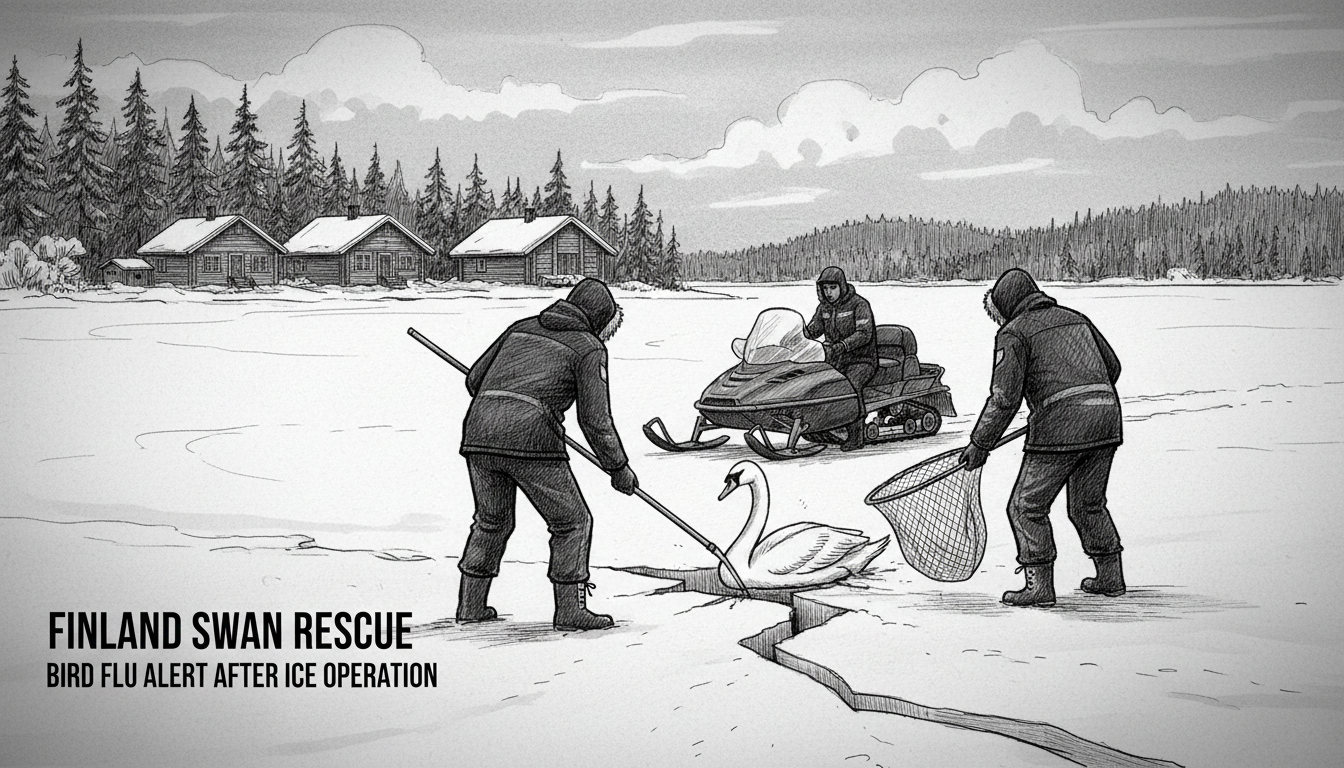
Finland's Kymenlaakso Rescue Department performed a delicate ice rescue of a distressed swan on Ummeljoki river last Friday, an operation that has triggered renewed warnings about avian influenza risks. A passerby spotted the weakened bird on dangerously thin ice and alerted authorities, setting in motion a coordinated response involving police and specialist surface rescue teams.
Two 'pintapelastajat', or surface rescuers, from the Kymenlaakso Rescue Department navigated the precarious ice using a surface rescue raft to reach the swan. The bird, while not physically frozen to the ice, was in poor condition and unable to free itself. The rescuers carefully placed the swan into a cardboard container for transport. "The police went to check on it first. However, the police could not go onto the ice because the ice is very thin," stated on-duty fire chief Reijo Houni, outlining the initial assessment that required specialized equipment and training.
The rescued swan was transported to a bird rehabilitation center in the municipality of Pyhtää for professional care and observation. This standard procedure for distressed wildlife in Finland took on additional significance due to concurrent public health warnings. Houni issued a clear caution to the public in the rescue's aftermath, noting recent avian influenza activity. "It is not advisable to approach sick animals without protective equipment, and you should not touch dead animals," he said.
A Rescue Highlighting Systemic Coordination
This incident on the Ummeljoki river exemplifies Finland's integrated approach to public safety and animal welfare. The chain of response—from civilian report to police assessment to specialized rescue and finally to wildlife rehabilitation—functions as a well-practiced protocol. The Kymenlaakso Rescue Department's surface rescue unit possesses the specific equipment, like the rescue raft, and cold-water ice training that general police units do not, allowing for a risk-appropriate escalation of response.
Such operations are not uncommon in a nation with extensive waterways and long winters, where animals and sometimes people fall through ice. The rescue services' mandate broadly covers saving lives and preventing endangerment, which Finnish case law and practice have extended to situations where an animal is in severe distress and its plight causes public concern. This reflects a societal value deeply embedded in Finnish environmental law, which emphasizes the responsibility of care for nature.
The Looming Background of Avian Influenza
The fire chief's warning underscores a serious national and European concern. Highly Pathogenic Avian Influenza (HPAI) has caused significant outbreaks across European bird populations in recent years, leading to mass culls in poultry farms and devastating wild bird colonies. Finland has recorded cases in both wild birds and poultry, prompting the Finnish Food Authority (Ruokavirasto) to maintain strict biosecurity measures and surveillance programs.
Wild waterfowl, particularly swans, geese, and ducks, are known natural reservoirs for avian influenza viruses. A sick or dead swan on a public waterway is considered a potential biohazard. Authorities consistently advise the public not to handle such birds and to immediately contact municipal environmental services or the emergency number 112, as the passerby correctly did in this case. The bird rehabilitation center in Pyhtää is equipped to handle such cases with necessary quarantine and safety protocols, determining the swan's illness and whether it poses a contagion risk.
Finland's Framework for Animal Welfare and Public Health
This single rescue operation sits at the intersection of several Finnish policy areas: rescue services, environmental protection, animal welfare, and public health. Finland's Animal Welfare Act mandates that animals must not be caused unnecessary suffering, and while focused on animals in human care, its ethos influences official responses to wild animals in acute distress. Furthermore, Finland's constitution includes a commitment to environmental responsibility, a principle that guides administrative actions.
The operational collaboration between police, rescue services, and wildlife experts is facilitated by Finland's strong digital governance infrastructure and clear lines of communication between municipalities and state agencies. In the broader EU context, Finland follows both its national statutes and European directives on animal health, particularly EU regulations on transmissible animal diseases that mandate monitoring and reporting of outbreaks like avian influenza. The Helsinki-based ministries regularly coordinate with the European Commission's Directorate-General for Health and Food Safety on these fronts.
The Human Element in Environmental Stewardship
The initial report by a vigilant citizen remains the critical first link in this chain. Public awareness campaigns by organizations like the Finnish Association for Nature Conservation and official guidelines from the Finnish Food Authority have educated citizens on what to do when encountering sick wildlife. This public engagement is a cornerstone of Finland's environmental monitoring, turning everyday citizens into observers who support the work of official agencies.
The rescue also highlights the professional specialization within Finland's rescue services. Surface rescuers undergo rigorous training for water and ice emergencies, a necessary investment for a country with 187,888 lakes. Their intervention in this case prevented a likely tragedy for the swan and a potential public health issue if the bird had died on the ice from a contagious disease, creating a hazard for other animals or curious humans.
Looking Beyond the Ummeljoki River
As the swan receives care in Pyhtää, the incident serves as a microcosm of broader challenges. Climate change is leading to unpredictable ice conditions, potentially increasing risks for wildlife and humans alike. Simultaneously, the global spread of animal diseases like avian influenza requires constant vigilance. Finland's response system, tested in this small-scale event, is built for such complexities.
The successful rescue demonstrates how societal values—compassion for animals, respect for nature, and collective responsibility—are operationalized through trained professionals and alert citizens. It reinforces a model where protecting wildlife is seen not as separate from public safety, but as an integrated component of it. As spring thaw continues across the Finnish landscape, this collaboration between a passerby, police, rescuers, and wildlife rehabilitators stands as a quiet testament to a functioning society, one where even a single swan on thin ice merits a full and careful response.
Will this integrated model become even more crucial as environmental and zoonotic disease pressures increase? The smooth operation on Ummeljoki suggests Finland is preparing to answer yes.